

 en
en Español
 русский
 中文简体
中文简体
Industry News
How Does a Moving Walkway Transform Passenger Transportation in Large Airports?
Content
- 1 Introduction
- 2 What Is an Airport Moving Walkway and How Does It Work?
- 3 Why Are Airport Moving Walkways Becoming Essential for Modern Airports?
- 4 Key Features Integrated Into Modern Airport Moving Walkway Systems
- 5 Energy-Efficient Operation Technology
- 6 How Airport Moving Walkway Systems Improve Terminal Design and Space Utilization
- 7 Indoor and Outdoor Airport Moving Walkway Applications
- 8 Outdoor Airport Moving Walkway Systems
- 9 How Smart Technologies Are Changing Airport Moving Walkway Systems
- 10 Energy Efficiency and Sustainable Development of Airport Moving Walkway Technology
- 11 Conclusion
Introduction
Modern airports have evolved into large-scale transit hubs that integrate services, retail, and terminal connections, making internal mobility a major challenge. Moving walkways have become essential for improving efficiency, allowing passengers to move quickly between key areas such as check-in, security, gates, and baggage claim.
Their growing use is driven by trends like smart airport design, better passenger experience, accessibility, and energy efficiency. Working alongside elevators and shuttles, moving walkways reduce walking fatigue and transfer times, supporting smoother passenger flow and operations during peak hours.
What Is an Airport Moving Walkway and How Does It Work?
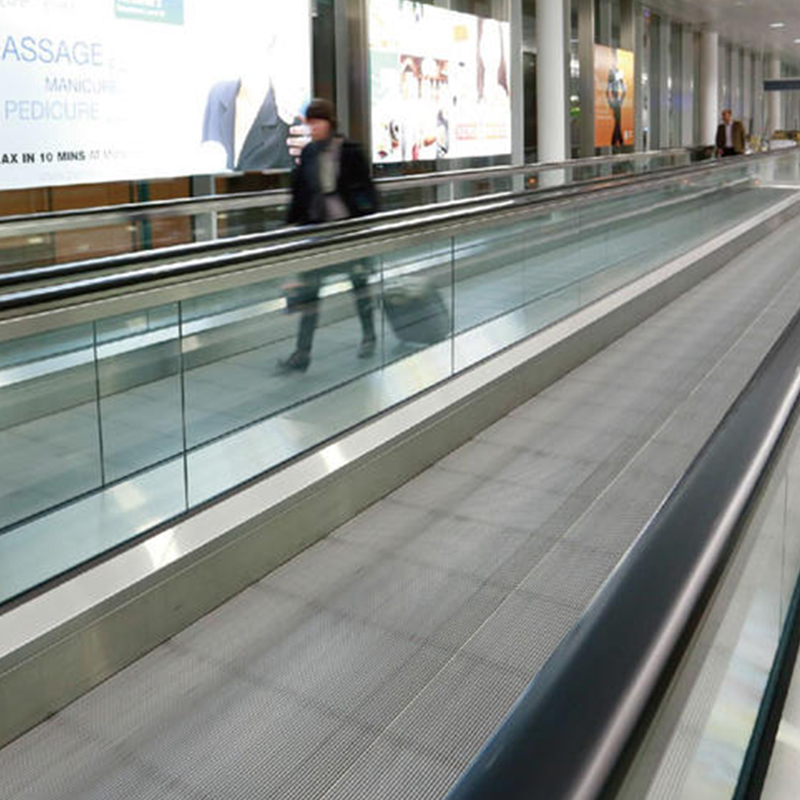
An airport moving walkway is an automated horizontal passenger transportation system designed to move people efficiently through large indoor or outdoor public facilities. It consists of a continuously moving platform powered by an electric drive system, allowing passengers to stand or walk while being transported along a fixed route.
Compared with conventional pedestrian pathways, airport moving walkway systems provide several advantages. They reduce physical effort, improve passenger distribution, and allow airports to manage long-distance movement more effectively.
Modern airports often include large terminal buildings where passengers may need to walk considerable distances between different service areas. Without efficient mobility equipment, long walking routes can create inconvenience, especially for passengers carrying luggage, elderly travelers, and people with limited mobility.
A moving walkway addresses these challenges by creating a continuous transportation channel that connects important areas within airport facilities.
Main Operating Principle of Moving Walkway Systems
The operation process of an airport moving walkway involves several coordinated components:
- The electric motor generates driving power.
- The drive system transfers mechanical energy to the moving platform.
- Pallets or belt surfaces move continuously along the track.
- Passengers step onto the system and are transported smoothly.
- Sensors and control systems monitor operating conditions.
The system is designed to maintain stable movement speed and passenger comfort while ensuring operational safety.
Main Components of Airport Moving Walkway Systems
| Component | Main Function | Importance in Airport Applications |
|---|---|---|
| Moving Pallets or Belt Surface | Provides the passenger transportation platform | Ensures stable and continuous movement |
| Drive System | Supplies mechanical power for operation | Maintains reliable performance |
| Handrail System | Provides passenger support during movement | Improves safety and riding comfort |
| Control System | Manages operation modes and equipment status | Enables intelligent operation |
| Safety Sensors | Detect abnormal conditions and risks | Protects passengers and equipment |
| Structural Frame | Supports the complete system | Provides durability and stability |
Each component plays an important role in ensuring that the airport moving walkway can operate continuously in high-traffic environments.
Why Are Airport Moving Walkways Becoming Essential for Modern Airports?
Improving Passenger Flow Efficiency
Passenger flow management has become one of the most important considerations in modern airport design. Large international airports often include multiple terminal buildings, extended boarding corridors, transfer areas, and remote gates. The distance between these locations can create significant challenges for passengers.
An airport moving walkway improves passenger flow by providing an additional transportation channel that reduces walking pressure and prevents congestion in busy areas.
The system helps airports achieve:
- Faster passenger movement
- Better distribution of travelers
- Reduced congestion in long corridors
- Improved transfer efficiency
- Enhanced passenger satisfaction
For airports handling high passenger volumes, efficient internal transportation is essential for maintaining smooth daily operations.
A well-designed moving walkway system can support continuous passenger circulation without requiring additional staff intervention. This makes it particularly suitable for areas where passenger movement remains constant throughout the day.
Enhancing Passenger Comfort and Accessibility
Passenger experience has become a major factor in airport competitiveness. Travelers increasingly expect convenient, comfortable, and accessible transportation solutions throughout their journey.
The airport moving walkway provides significant benefits for:
- Passengers carrying heavy luggage
- Elderly passengers
- Families traveling with children
- Passengers with mobility limitations
- Travelers transferring between distant gates
By reducing walking distance and physical effort, moving walkway systems improve accessibility across airport environments.
Modern designs also focus on passenger comfort through:
- Smooth acceleration and deceleration
- Low operating noise
- Stable platform movement
- Easy entry and exit areas
- Improved safety features
These improvements allow airports to create a more passenger-friendly environment while optimizing transportation efficiency.
Key Features Integrated Into Modern Airport Moving Walkway Systems
The development of airport moving walkway technology has moved beyond basic transportation functions. Modern systems now integrate advanced features designed to improve safety, efficiency, durability, and operational management.
Advanced Safety Features
Safety remains the highest priority in airport transportation equipment. Because airport moving walkway systems operate continuously in crowded environments, they require reliable protection mechanisms.
Modern safety technologies include:
Emergency Stop Systems
Emergency stop devices allow operators or passengers to quickly stop the equipment when abnormal conditions occur.
Speed Monitoring Systems
Speed control technology ensures that the moving walkway operates within a safe range, preventing uncomfortable acceleration or unexpected changes.
Sensor-Based Protection
Sensors continuously monitor:
- Passenger movement
- Mechanical operation
- Platform conditions
- System performance
If abnormal conditions are detected, the system can automatically trigger protective actions.
Safety Function Table
| Safety Feature | Function | Operational Benefit |
|---|---|---|
| Emergency Stop Button | Stops equipment immediately during emergencies | Provides rapid response protection |
| Speed Monitoring | Maintains stable operating speed | Improves passenger comfort |
| Safety Sensors | Detect unusual conditions | Reduces operational risks |
| Automatic Fault Detection | Identifies system problems | Supports preventive maintenance |
| Protective Components | Prevent mechanical hazards | Improves long-term reliability |
Safety technologies allow airport moving walkway systems to operate effectively even in high-density passenger environments.
Energy-Efficient Operation Technology
Energy efficiency has become another important development direction for airport transportation equipment. Airports operate continuously, and reducing unnecessary energy consumption can significantly improve operational sustainability.
Modern energy-efficient airport moving walkway designs incorporate technologies such as:
- Variable speed operation
- Intelligent standby modes
- High-efficiency motors
- Automated operating adjustments
- Smart energy monitoring
For example, when passenger demand decreases, intelligent control systems can adjust operation modes to reduce unnecessary power consumption while maintaining service availability.
The integration of energy-saving technologies helps airports achieve a balance between transportation efficiency and environmental responsibility.
Comparison Between Moving Walkway and Escalator-Based Systems
| Comparison Factor | Airport Moving Walkway | Escalator System | Moving Walk Way Escalator Concept |
|---|---|---|---|
| Primary Purpose | Horizontal passenger transportation | Vertical passenger transportation | Automated passenger movement solution |
| Typical Location | Airport corridors, terminals, transfer areas | Floors, platforms, entrances | Large transportation facilities |
| Passenger Movement | Long-distance horizontal travel | Vertical level changes | Continuous passenger movement |
| Main Advantage | Reduces walking distance | Connects different levels | Improves overall mobility efficiency |
| Common Application | Airports and transportation hubs | Commercial buildings and stations | Airports and public facilities |
Although their structures are different, all these systems share a common goal: improving passenger movement efficiency and creating smoother transportation experiences.
How Airport Moving Walkway Systems Improve Terminal Design and Space Utilization
Modern airport terminal design is increasingly focused on passenger circulation efficiency. Unlike traditional airport layouts with short walking distances, contemporary terminals often include extended concourses, multiple boarding zones, remote gates, and interconnected buildings.
This expansion creates a demand for efficient internal transportation systems.
The airport moving walkway provides a practical solution by transforming long pedestrian routes into efficient transportation corridors.
Connecting Different Terminal Zones
One of the most important applications of moving walkway systems is connecting different functional areas within airports.
Typical application locations include:
- Passenger terminals
- Boarding corridors
- Transfer areas
- Parking connections
- Transportation hubs
- Airport shopping zones
By integrating moving walkways into terminal planning, airports can improve passenger circulation and reduce unnecessary walking pressure.
For example, passengers transferring between distant boarding gates can use a moving walkway to maintain efficient movement without causing congestion in pedestrian areas.
Supporting High Passenger Volume Management
Airports experience significant fluctuations in passenger traffic. During peak travel periods, large numbers of passengers move simultaneously through terminals.
A properly designed airport moving walkway system helps manage these situations by:
- Increasing transportation capacity
- Reducing pedestrian congestion
- Improving passenger distribution
- Supporting faster terminal circulation
Unlike fixed pedestrian pathways, moving walkways provide continuous movement, making them especially valuable in high-density transportation environments.
Indoor and Outdoor Airport Moving Walkway Applications
Airport environments are diverse, and moving walkway systems must adapt to different installation conditions. Depending on location requirements, airport moving walkway solutions can generally be divided into indoor and outdoor applications.
Indoor Airport Moving Walkway Solutions
Indoor airport moving walkway systems are commonly installed inside terminal buildings where environmental conditions are relatively stable.
Typical indoor applications include:
- Main terminal corridors
- Boarding areas
- Transfer passages
- Passenger service zones
Indoor systems focus strongly on passenger comfort, quiet operation, and aesthetic integration with architectural design.
Indoor Application Areas and Functions
| Application Area | Main Function | Passenger Benefit |
|---|---|---|
| Terminal Corridors | Transport passengers across long distances | Reduces walking fatigue |
| Boarding Connections | Improve gate accessibility | Shortens transfer time |
| Transfer Passages | Support connecting passengers | Improves airport efficiency |
| Commercial Areas | Guide passenger movement | Enhances shopping accessibility |
Indoor moving walkway designs usually emphasize:
- Smooth operation
- Low noise performance
- Modern appearance
- Easy maintenance access
Because indoor airport environments require continuous passenger service, reliability and comfort are key design priorities.
Outdoor Airport Moving Walkway Systems
Outdoor airport moving walkway systems are designed for more demanding environments. Compared with indoor equipment, outdoor systems require stronger protection against environmental influences.
Common outdoor applications include:
- Connections between terminal buildings
- Parking areas
- Transportation stations
- Outdoor passenger pathways
Outdoor airport moving walkway solutions must consider:
- Rain protection
- Temperature changes
- Wind exposure
- Dust resistance
- Corrosion prevention
Indoor vs Outdoor Airport Moving Walkway Comparison
| Feature | Indoor Moving Walkway | Outdoor Moving Walkway |
|---|---|---|
| Installation Environment | Controlled indoor spaces | Open-air environments |
| Main Design Focus | Comfort and appearance | Durability and protection |
| Environmental Requirements | Moderate protection | Higher weather resistance |
| Common Materials | Passenger-friendly finishes | Weather-resistant materials |
| Maintenance Consideration | Easy access maintenance | Protection against external conditions |
Outdoor applications require careful engineering to ensure stable performance under changing weather conditions.
How Smart Technologies Are Changing Airport Moving Walkway Systems
The development of smart airports is accelerating the transformation of traditional transportation equipment. Modern airport moving walkway systems are increasingly connected with digital management platforms, allowing airports to achieve better monitoring, operation control, and maintenance planning.
The concept of an automatic airport moving walkway system for large terminals represents this technological direction.
Smart technologies are helping airport operators move from reactive maintenance toward predictive management.
Intelligent Monitoring Systems
Traditional equipment inspections often rely heavily on manual checks. However, modern moving walkway systems increasingly use digital monitoring technologies to provide real-time operational information.
Intelligent monitoring can analyze:
- Equipment operating status
- Motor performance
- Mechanical conditions
- Safety sensor feedback
- Energy consumption
These systems help maintenance teams identify potential issues before they affect passenger services.
Benefits include:
- Reduced unexpected downtime
- Improved equipment availability
- Better maintenance scheduling
- Enhanced operational reliability
Automated Operation Management
Large airports require transportation systems that can adapt to changing passenger demand.
Smart control systems allow moving walkways to optimize operation based on actual usage conditions.
Possible intelligent functions include:
- Automatic standby modes
- Variable operating speeds
- Remote control management
- Real-time system adjustment
This approach improves both energy efficiency and passenger service quality.
Smart Technology Features Table
| Smart Feature | Function | Operational Advantage |
|---|---|---|
| Remote Monitoring | Tracks system conditions | Enables efficient management |
| Intelligent Sensors | Collects operational data | Supports predictive maintenance |
| Automatic Control | Adjusts operation modes | Improves energy efficiency |
| Digital Management Platform | Integrates equipment information | Enhances decision-making |
Energy Efficiency and Sustainable Development of Airport Moving Walkway Technology
Sustainability has become an important consideration in airport infrastructure development. Airports are large-scale facilities that consume significant amounts of energy, making energy-efficient equipment an essential part of future planning.
The energy efficient airport moving walkway design approach focuses on reducing power consumption while maintaining reliable passenger transportation.
Variable Speed Technology
One important energy-saving method is variable speed control.
Traditional systems may operate continuously at a fixed speed. However, intelligent moving walkway systems can adjust operation according to passenger demand.
During periods of lower passenger activity, the system may operate in energy-saving modes while remaining available for immediate passenger use.
Advantages include:
- Reduced unnecessary energy consumption
- Improved equipment efficiency
- Lower operating costs
- Longer component service life
High-Efficiency Drive Systems
The drive system is one of the most important components affecting energy performance.
Modern designs focus on:
- Efficient motors
- Optimized mechanical structures
- Reduced friction
- Improved control accuracy
These improvements help airport moving walkway systems achieve better performance with lower energy requirements.
Conclusion
As global aviation infrastructure expands, airport moving walkways have become essential for managing complex passenger flows. They reduce physical effort, improve accessibility, and support efficient movement across terminals, transfer areas, and outdoor connections.
Modern systems go beyond basic transport, integrating safety sensors, speed monitoring, fault detection, and energy-saving controls. These advances enhance reliability, passenger safety, and sustainability, with heavy-duty and intelligent designs now serving both indoor and outdoor airport environments.
Related Products
Related News
Built on safety, forging trust in vertical mobility.
lf you have any questions or need help, feel free to contact with our team.
 export@tenau.com.cn
 +86-18601458867
 +86-512-65059883
Elevator & Escalator
Factory Add
East of Xicheng Road, North of Lianyi Road, Nanxun Economic Development Zone, Nanxun District, Huzhou City, Zhejiang Province, P.R.China
Copyright © Tenau Elevator (China) Co., Ltd. All Rightd Reserved.
Custom High Quality Elevator Suppliers and World Brand Elevator Company