

 en
en Español
 русский
 中文简体
中文简体
Industry News
How Elevator Car Accessories Define Safety, Comfort, and Long-Term Performance
Content
- 1 The Elevator Car Cab as an Engineered System
- 2 Elevator Hand Rails: Support, Circulation, and Accessibility
- 3 Elevator Toe Guard and Platform Apron Lift Safety
- 4 Elevator Car Top Railings and the Maintenance Station
- 5 Elevator Buffer and Counterweight Buffer Systems
- 6 Elevator Safety Device and Elevator Gibs: The Hidden Guidance System
- 7 Cab Interior Design for Clinical and Residential Settings
- 8 Where Each Accessory Sits Inside the Car and Shaft
- 9 Building an Inspection Routine Around These Accessories
- 10 Frequently Asked Questions
- 10.0.1 Q1: How high should hand rails be mounted inside an elevator car
- 10.0.2 Q2: What is the difference between a toe guard and an apron
- 10.0.3 Q3: Why does the car top need a railing if technicians are trained to be careful
- 10.0.4 Q4: How often should gibs be replaced
- 10.0.5 Q5: Are oil buffers better than spring buffers
- 10.0.6 Q6: Do residential elevators need the same safety devices as commercial ones
The Elevator Car Cab as an Engineered System
An elevator car is often judged by its finish panels and lighting, yet the accessories bolted to that cab carry most of the functional weight. Hand rails, toe guards, top railings, buffers, safety devices, and gibs each solve a distinct mechanical or human-factors problem. Together they turn a moving steel box into a space that passengers trust and technicians can service without improvising. This article walks through each accessory category, explains the engineering reasoning behind it, and shows how the same cab can be configured differently depending on whether it serves a busy clinical corridor or a private residential shaft.
The scope here is intentionally practical. Rather than repeating marketing language, the sections below describe load paths, clearance dimensions, inspection routines, and the trade-offs that specifiers weigh when selecting each component. Numbers are given as general industry ranges rather than fixed specifications, since actual values depend on code jurisdiction, car size, and rated speed.
Elevator Hand Rails: Support, Circulation, and Accessibility
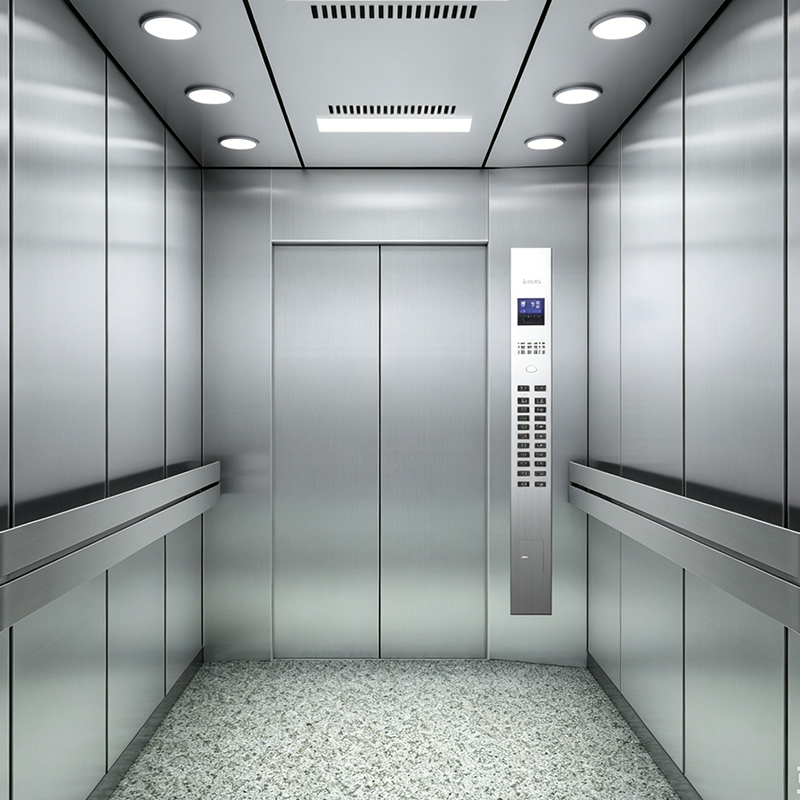
Hand rails inside a car cab serve three overlapping purposes: physical support during acceleration and deceleration, a wayfinding reference for visually impaired riders, and a secondary handhold during loading of wheeled equipment such as stretchers or carts. In a passenger cab, rails are typically mounted between 800 and 900 millimeters above the finished floor, a height chosen to suit both standing adults and wheelchair users reaching across their body.
Mounting and Structural Considerations
Rails are fixed to the cab wall panel through stand-off brackets rather than direct surface mounting, which does two things. It keeps a hand grip clearance of roughly 38 to 45 millimeters between the rail and the wall so fingers do not pinch, and it distributes lateral load into the cab wall stiffener rather than the decorative panel skin. A rail that is only screwed into thin decorative laminate will eventually work loose under repeated sideways loading from leaning passengers.
- Round profile rails distribute grip pressure evenly and are common in general passenger service
- Flat or oval profiles offer a larger contact surface, often specified in care settings where a firmer forearm rest is useful
- Continuous three-wall rail runs are frequently required in cabs used for medical transport, since a stretcher attendant needs an unbroken handhold while walking alongside the car
Material and Finish Choices
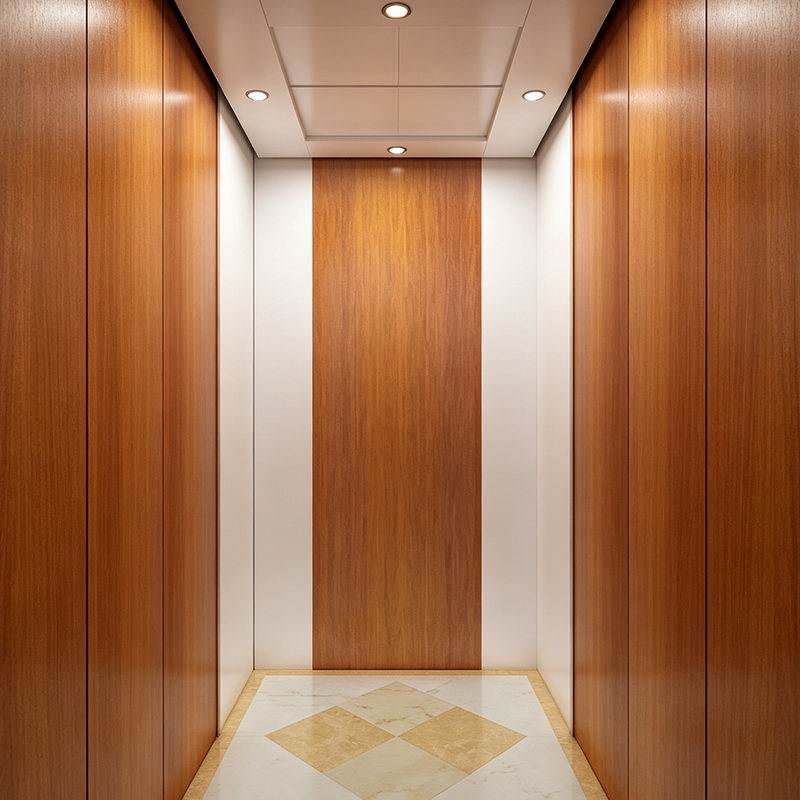
Stainless steel remains the dominant choice because it resists the frequent contact and cleaning chemicals typical of both commercial and clinical settings. Satin finishes are preferred over mirror polish in high-traffic cabs because they hide fingerprints and light surface scratching, which matters over a multi-year service life. In a residential cab, a warmer tone such as brushed bronze or a wood-look composite is sometimes selected purely for interior design continuity with the rest of the home.
Load Testing and Long-Term Fatigue
Specifiers sometimes assume a hand rail only needs to resist a static push, but the more realistic loading scenario is repeated, uneven leaning combined with sudden car deceleration. Over thousands of cycles this produces a fatigue loading pattern rather than a single peak load, which is why bracket welds and fasteners are inspected for micro cracking rather than just checked for looseness. A rail that passes a simple hand push test on day one can still develop bracket fatigue several years into service if the underlying wall stiffener was undersized for the expected traffic volume.
Elevator Toe Guard and Platform Apron Lift Safety
The toe guard, sometimes called the apron or kickplate, is the sloped or vertical steel plate that extends downward from the leading edge of the car sill. Its job is straightforward but critical: it prevents a foot, cart wheel, or dropped object from sliding into the gap between the car floor and the hoistway wall when the car stops slightly above or below a landing.
Why Depth and Angle Matter
Code-driven minimum toe guard depths generally fall in the 750 millimeter range, extending from the sill downward, with the lower portion often angled inward at roughly 60 degrees from horizontal. That angle is not cosmetic. A vertical plate alone can still trap a foot if the car re-levels; the angled section is what actually deflects an object away from the gap rather than just covering it.
| Toe Guard Feature | Typical Function | Common Failure Mode if Missing |
|---|---|---|
| Vertical apron section | Blocks direct sightline and access into the pit gap | Foot or debris enters gap during re-leveling |
| Angled lower section | Deflects objects away from the hoistway wall | Trapped object jams car movement |
| Continuous width coverage | Matches full sill width including door zone | Gap exposed at door track edges |
| Corrosion-resistant coating | Maintains rigidity in pit moisture conditions | Plate deforms or rusts through over years |
Platform apron lift safety becomes especially relevant on freight and platform lifts where the car floor itself can tilt or where loading ramps are used. In these applications, the apron is frequently designed to fold or hinge automatically when the platform leaves a landing, closing the gap dynamically rather than relying on a fixed plate alone. Maintenance technicians should check apron hinge pins and return springs during routine inspection, since a sluggish return mechanism defeats the purpose of a folding apron just as surely as a missing fixed guard would.
Coordinating Toe Guard Depth With Pit Design
Toe guard depth is not chosen in isolation. It has to be coordinated with the pit depth, the travel allowed for the buffer, and the space reserved for pit ladders or sump pumps. A pit that is shallower than typical can force a compromise between full toe guard depth and buffer stroke clearance, which is why pit layout drawings should be reviewed early in a project rather than after the car frame and sill height have already been finalized.
Elevator Car Top Railings and the Maintenance Station
Car top railings exist for one audience only: the technician who must ride on top of the car during inspection, adjustment, or emergency recovery. A folding or fixed railing system typically wraps three sides of the car top, leaving the fourth side clear where the technician steps on and off from the landing.
Working Clearance and Refuge Space
Modern code requirements define a minimum refuge space above the car top, meaning enough vertical and horizontal clearance for a person to stand safely even if the car were to travel to its uppermost position. Railings are positioned so that a technician working within that refuge space cannot be pushed toward the shaft wall or counterweight travel path. Rail height is generally in the 900 to 1100 millimeter range, tall enough to act as a real barrier rather than a trip hazard.
The Car Top Maintenance Station
Beyond the railing itself, a proper car top maintenance station includes a stop switch reachable from the access point, an inspection control station with up and down buttons, a light switch for the car top work light, and often a power outlet for a portable lamp or tool. Positioning all of these within arm's reach of the entry point matters because a technician should never need to lean past the railing to operate a control.
- Fixed stop switch, lockable in the stop position
- Inspection speed control, independent from normal operating speed
- Illuminated work light with a dedicated switch
- Non-slip walking surface across the full car top area, not just near the access hatch
Folding Rails on Height-Restricted Shafts
Some low-overhead installations cannot accommodate a permanently upright railing because the fully extended car would leave insufficient clearance at the top of the shaft. In these cases a folding railing is used, held upright by a spring latch during normal maintenance work and manually folded down before the car is driven to its uppermost inspection position. Technicians should treat the latch mechanism itself as an inspection item, since a worn latch that fails to hold the rail upright removes the barrier exactly when it is needed most.
Elevator Buffer and Counterweight Buffer Systems
Buffers sit at the bottom of the pit and absorb energy if a car or counterweight ever travels past its normal lowest stopping point. They are a last-resort safety device, not a normal-operation component, which is exactly why their condition is so often overlooked until an inspection flags it.
Spring Buffers Versus Oil Buffers
Spring buffers are mechanically simple: a heavy coil compresses to absorb impact and then returns the car upward. They are common on lower-speed installations because their stopping distance is short and predictable. Oil buffers, used on faster cars, dissipate energy hydraulically as a plunger is pushed into an oil-filled cylinder, producing a more gradual deceleration appropriate for higher kinetic energy. An oil buffer that has lost fluid or developed a seal leak will not provide its rated stroke, which is why oil level checks are a standard line item in periodic maintenance logs.
Counterweight Buffer Placement
The counterweight buffer is a mirror-image safety device positioned where the counterweight would land if it overtravelled downward, which corresponds to the car overtravelling upward. Because the counterweight moves opposite to the car, its buffer sits on the opposite side of the pit from the car buffers, and pit layout drawings should always show both clearly to avoid confusion during installation or inspection.
Elevator Safety Device and Elevator Gibs: The Hidden Guidance System
Two components rarely seen by passengers do most of the quiet work of keeping a car aligned and stoppable: the safety device (often called the safety gear) and the gibs that guide the car along its rails.
How the Safety Device Engages
The safety device is mechanically linked to the governor rope. If car speed exceeds a preset threshold, typically during an uncontrolled descent, the governor trips a linkage that forces wedge blocks against the guide rails, clamping the car in place through friction and mechanical wedging rather than relying on the hoist rope or brake alone. This is why the safety device is tested as an independent system, separate from the normal brake, during commissioning and periodic requalification.
Gibs and Guide Rail Contact
Gibs are the replaceable inserts, often a low-friction composite or lined metal, that sit inside the guide shoe and make actual sliding contact with the guide rail. Their job is to keep lateral and front-to-back movement within a tight tolerance, usually just a few millimeters, so the car does not sway or rattle against the rail as it travels. Because gibs wear gradually with every trip the car makes, they are treated as a scheduled wear item rather than a one-time installation, similar in concept to a brake pad.
| Component | Primary Role | Typical Inspection Focus |
|---|---|---|
| Governor and safety linkage | Trips mechanical clamp at overspeed | Trip speed calibration, linkage freedom of movement |
| Guide shoe gibs | Maintain rail contact and lateral tolerance | Wear thickness, unusual noise or vibration |
| Car and counterweight buffers | Absorb energy on overtravel | Oil level or spring condition, stroke clearance |
Cab Interior Design for Clinical and Residential Settings
The same structural accessories described above get finished very differently depending on where the cab is installed. A cab intended as a hospital elevator is specified around stretcher and bed transport, infection control, and continuous heavy use, while a home elevator is specified around quiet operation, a smaller footprint, and interior finishes that match a residence rather than a clinical corridor.
Clinical Cab Priorities
- Wider door clear opening and deeper cab depth to accommodate a full-length bed or stretcher plus an attendant
- Continuous wraparound hand rails at both standard and lower heights for varied patient reach
- Wall protection panels or bumper rails positioned at cart height, separate from the hand rail, to absorb impact from wheeled equipment
- Washable, low-porosity wall and floor finishes that tolerate frequent disinfection
- Independent service control allowing staff to bypass normal call queuing during emergencies
Residential Cab Priorities
- Compact car dimensions matched to typical residential shaft footprints
- Softer noise and vibration targets, since the shaft often runs adjacent to living spaces
- Interior finishes selected to match household materials such as wood veneer or painted panel work
- Simplified single or two-button call stations rather than multi-floor commercial panels
- Lower duty cycle expectations, allowing lighter-duty accessory hardware where local code permits
A third, less visible difference is accessory sizing. A home villa elevator cab is usually narrower, so hand rail brackets and toe guard width are trimmed to match, whereas clinical cabs standardize on wider hardware runs that can later be reused across similar hospital floors without custom refabrication.
Where Each Accessory Sits Inside the Car and Shaft
The diagram below places the main accessories discussed in this article relative to the car body, from the cab interior down to the pit floor, to make their relative positions easier to visualize.
Building an Inspection Routine Around These Accessories
Because these components rarely fail during normal operation, they are easy to deprioritize during routine service visits. A more resilient approach is to fold them into a fixed inspection cadence rather than treating them as optional extras.
Suggested Inspection Grouping
- Monthly visual check of hand rail bracket tightness and toe guard fasteners
- Quarterly check of car top railing hinges, stop switch function, and work light operation
- Semi-annual measurement of gib wear thickness against manufacturer tolerance
- Annual buffer inspection, including oil level for hydraulic buffers and spring condition for mechanical buffers
- Full safety device trip test performed at the interval required by local code, coordinated with governor calibration
Recording these checks in a shared maintenance log, rather than relying on a single technician's memory, also helps building owners spot patterns, such as a gib wearing faster on one guide rail than the other, which usually points to a rail alignment issue worth correcting before it accelerates further wear.
Frequently Asked Questions
Q1: How high should hand rails be mounted inside an elevator car
Most passenger cabs place the rail between 800 and 900 millimeters above the finished floor, though clinical cabs sometimes add a second lower rail to suit a wider range of users.
Q2: What is the difference between a toe guard and an apron
The two terms are generally used interchangeably to describe the same sloped plate beneath the car sill, though platform lifts sometimes use a hinged folding apron rather than a fixed plate.
Q3: Why does the car top need a railing if technicians are trained to be careful
Training reduces risk but does not remove the physical hazard of an unguarded edge above a shaft. Railings provide a passive barrier that continues protecting a technician even during a momentary lapse in attention.
Q4: How often should gibs be replaced
There is no single fixed interval, since wear depends on ride frequency and rail alignment. Most maintenance programs measure gib thickness at scheduled intervals and replace them once wear approaches the manufacturer defined tolerance.
Q5: Are oil buffers better than spring buffers
Neither type is universally better. Spring buffers suit lower speed applications with simple maintenance needs, while oil buffers suit higher speed cars where a more gradual, controlled deceleration is required.
Q6: Do residential elevators need the same safety devices as commercial ones
Yes, the core safety categories such as the safety device, buffers, and guide rail guidance remain required. What typically changes between a residential and a commercial installation is duty cycle expectations and interior finish, not the presence of these core safety systems.
Related Products
Related News
Built on safety, forging trust in vertical mobility.
lf you have any questions or need help, feel free to contact with our team.
 export@tenau.com.cn
 +86-18601458867
 +86-512-65059883
Elevator & Escalator
Factory Add
East of Xicheng Road, North of Lianyi Road, Nanxun Economic Development Zone, Nanxun District, Huzhou City, Zhejiang Province, P.R.China
Copyright © Tenau Elevator (China) Co., Ltd. All Rightd Reserved.
Custom High Quality Elevator Suppliers and World Brand Elevator Company