

 en
en Español
 русский
 中文简体
中文简体
Industry News
MRL vs. MR: Which Passenger Elevator is Best for Your Project?
Content
- 1 MRL vs. MR: Choosing the Right Passenger Elevator for Your Project
- 2 Understanding Traditional Machine Room (MR) Elevators
- 3 The Innovation of Machine Room-Less (MRL) Elevators
- 4 Detailed Comparison: MRL vs. MR Elevators
- 5 Financial Analysis: Total Cost of Ownership
- 6 Optimal Applications: MRL vs. MR in Different Building Types
- 7 Technical Advantages and Performance Characteristics
- 8 Installation Timeline, Logistics, and Implementation Considerations
- 9 Maintenance, Service, and Long-Term Operations
- 10 Regulatory Compliance, Safety Standards, and Code Requirements
- 11 Environmental Impact and Sustainability Considerations
- 12 Decision Framework: Selecting the Optimal System for Your Project
- 13 Practical Implementation Scenarios
- 14 Emerging Technologies and Future Developments
- 15 Implementation Checklist and Next Steps
- 16 Frequently Asked Questions
MRL vs. MR: Choosing the Right Passenger Elevator for Your Project
When planning a modern building project, one of the most critical decisions involves selecting the appropriate elevator system. The choice between Machine Room-Less (MRL) and traditional Machine Room (MR) elevators significantly impacts construction costs, building layout efficiency, maintenance requirements, and long-term operational expenses. This comprehensive guide explores the fundamental differences, advantages, and disadvantages of both systems to help you make an informed decision tailored to your specific project needs.
Passenger elevators have evolved dramatically over the past two decades. The emergence of MRL technology represents a paradigm shift in elevator design philosophy, challenging the conventional approach that had dominated the industry for nearly a century. Understanding these distinctions is essential for architects, engineers, developers, and facility managers who seek to optimize their building investments.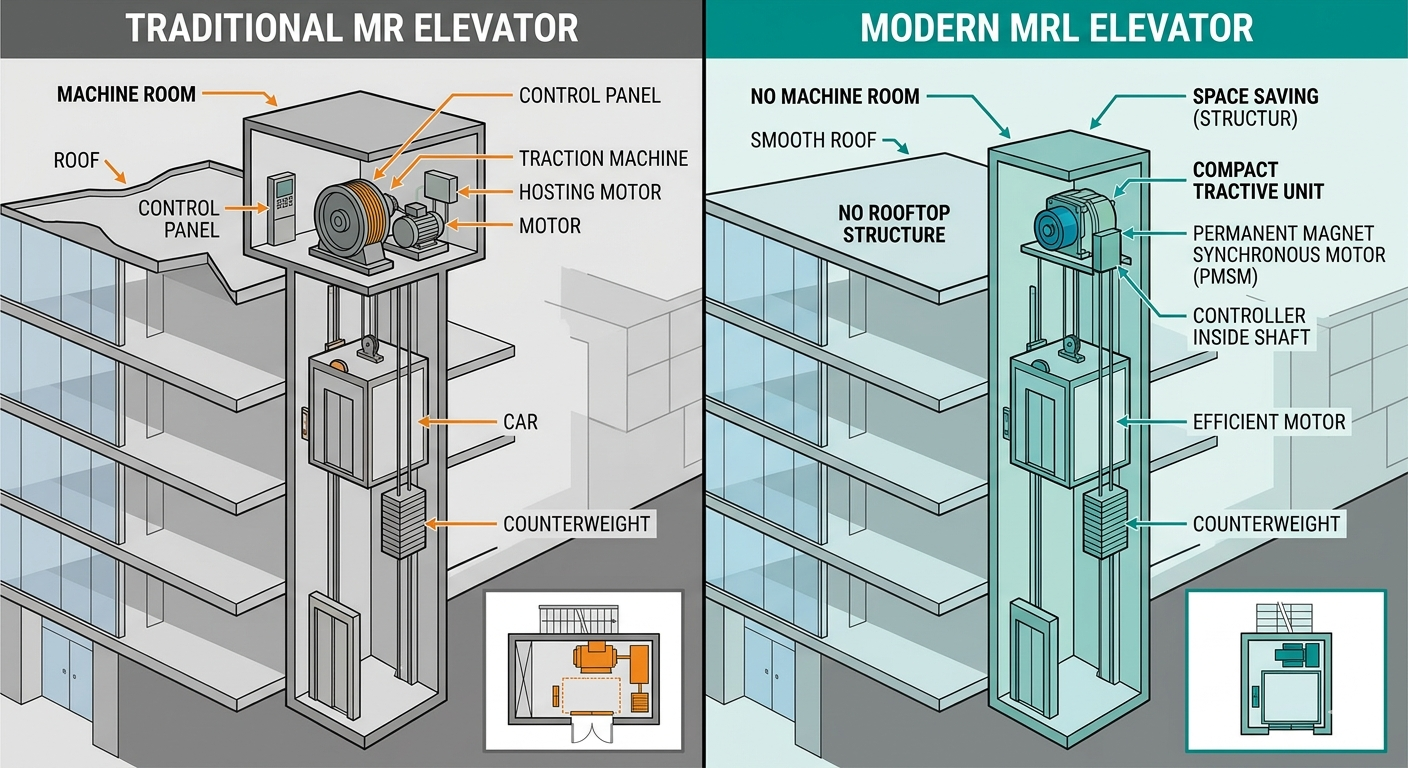
Understanding Traditional Machine Room (MR) Elevators
The Conventional Elevator Architecture
Traditional Machine Room elevators represent the established standard in vertical transportation. In this configuration, the elevator's motor, controller, and mechanical components are housed in a dedicated machine room, typically located directly above the elevator shaft or in an adjacent space on the top floor of the building.
Key Components of MR Systems
The traditional MR elevator system comprises several essential elements:
- Traction machine (motor and gearbox assembly)
- Brake system for safety and holding power
- Rope sheaves and guide rails
- Control cabinet and electrical distribution system
- Dedicated machine room space (typically 80-120 square meters)
- Hydraulic or mechanical door operators
- Safety switches and monitoring systems
Operational Principles
In an MR system, the traction machine uses steel ropes to lift and lower the car. The motor operates at a relatively low speed (typically 30-50 RPM), providing smooth and reliable operation. The gearbox multiplies the torque, allowing efficient lifting of heavy loads. The brake engages automatically when the car stops, providing safe holding capacity even during power failures. This time-tested design has earned widespread trust across residential and commercial applications worldwide.
Space and Location Considerations
A dedicated machine room requires substantial floor space—typically equivalent to the footprint of one complete apartment or office unit. This space must be maintained at specific environmental conditions, including proper ventilation, temperature control, and humidity management. The machine room must accommodate not only the elevator machinery but also service personnel who perform regular maintenance, inspections, and repairs.
The Innovation of Machine Room-Less (MRL) Elevators
Revolutionary Design Philosophy
MRL elevator technology fundamentally reimagines the relationship between machinery and building space. By integrating the motor and control systems directly into the elevator car or within the shaft structure, MRL systems eliminate the need for a separate machine room. This innovation, developed through advanced engineering and materials science, has transformed elevator design since its introduction in the 1980s.
How MRL Systems Function
Instead of traditional rope-and-pulley mechanisms operating from above, MRL systems employ one of two primary technologies:
- Gearless Direct Drive: The motor connects directly to the sheave without an intermediate gearbox, reducing mechanical complexity and maintenance requirements. This design enables smooth acceleration and precise leveling.
- Compact Geared Systems: Smaller, more efficient gearing arrangements fit within the shaft structure or car itself, maintaining torque multiplication while reducing overall size requirements.
Spatial Integration and Benefits
By relocating mechanical components to the top of the shaft structure or into the car frame itself, MRL systems recover valuable building space. A typical MRL installation recovers 80-120 square meters that would otherwise be reserved for the machine room. This recovered space can be converted to rentable floor area, increasing the building's revenue-generating potential or providing additional functionality without increasing the building's overall footprint.
Environmental Adaptability
MRL systems prove particularly advantageous in challenging environmental conditions. They require no dedicated climate control, operate reliably in extreme temperatures (both hot and cold climates), and function effectively at high altitudes where air density affects cooling efficiency. This adaptability makes MRL technology especially valuable for projects in geographically diverse locations.
Detailed Comparison: MRL vs. MR Elevators
The following table presents a comprehensive comparison of key characteristics across multiple dimensions:
| Feature | MRL Elevators | MR Elevators |
|---|---|---|
| Machine Room Required | No | Yes (80-120 m2) |
| Installation Speed | Faster (3-4 weeks) | Standard (4-6 weeks) |
| Initial Capital Cost | 15-20% higher | Standard baseline |
| Space Recovery Value | High (additional rentable area) | None (space is mandatory) |
| Maintenance Complexity | Lower (fewer components) | Standard (established procedures) |
| Annual Maintenance Cost | 5-10% lower | Standard baseline |
| Environmental Control Needs | None required | Ventilation and cooling needed |
| Typical Speed Range | 1.0-4.0 m/s | 1.0-4.0 m/s |
| Load Capacity | 1,000-2,500 kg | 1,000-3,500 kg |
| Service Access | Pit and top of car access | Machine room access |
Financial Analysis: Total Cost of Ownership
Initial Capital Investment
MRL elevators typically command a premium of 15-20% over traditional MR systems during initial purchase and installation. This higher upfront cost reflects the advanced engineering, specialized components, and sophisticated control systems required. For a typical commercial building project, this premium ranges from $15,000 to $35,000 per unit, depending on specifications and installation complexity.
Space-Related Economic Value
The most significant economic advantage of MRL systems emerges from recovered building space. In commercial real estate markets with values ranging from $300 to $1,000 per square meter annually, the elimination of an 80-120 square meter machine room generates substantial financial benefits:
- Additional annual rental revenue: $24,000 to $120,000 per elevator unit
- Capital value increase: $300,000 to $1.2 million per elevator (depending on market conditions)
- Payback period for premium cost: typically 1-3 years in commercial markets
- Long-term asset appreciation: recovered space appreciates with building value
Maintenance and Operational Expenses
MRL systems demonstrate superior long-term operational economics through reduced maintenance requirements. The absence of a gearbox, reduced mechanical complexity, and fewer lubrication points contribute to:
- Annual maintenance savings: 5-10% compared to MR systems
- Reduced downtime frequency due to simplified mechanics
- Lower replacement parts costs over the equipment lifecycle
- Decreased emergency repair incidents
- Environmental control cost elimination
Lifecycle Cost Analysis
Over a 20-year elevator lifecycle, the total cost analysis typically favors MRL systems in urban commercial environments:
- Year 1-3: MR systems appear more economical due to lower initial costs
- Year 4-10: MRL systems recover the initial premium through space rental value
- Year 11-20: MRL systems demonstrate superior cumulative financial performance through maintenance savings and property appreciation
- Overall 20-year benefit: $100,000 to $500,000 per unit in typical commercial markets
Optimal Applications: MRL vs. MR in Different Building Types
Commercial Passenger Elevator Requirements
Commercial buildings—including office towers, shopping centers, and hospitality facilities—present compelling cases for MRL technology evaluation. In these environments, every square meter of space translates directly to revenue generation. The space recovery advantage of MRL systems becomes decisive, especially in metropolitan areas where real estate values are highest.
Commercial MRL Advantages:
- Maximizes rentable floor area and building value
- Reduces architectural constraints and design limitations
- Enables flexible floor layouts without machine room accommodation
- Supports modern, open-plan office configurations
- Enhances building sustainability credentials
Commercial MR Advantages:
- Established maintenance networks and technician familiarity
- Lower initial capital investment
- Available high-capacity options (up to 3,500 kg)
- Proven performance in extreme-use environments
Residential Passenger Elevator Applications
In residential passenger elevator projects, the decision between MRL and MR systems depends on building height, density, and market positioning.
MRL Suitability in Residential Projects:
- Mid-rise residential buildings (8-25 stories)
- Urban luxury apartment developments
- Mixed-use residential-commercial projects
- Space-constrained urban infill projects
- Sustainable and green-certified residential buildings
MR Suitability in Residential Projects:
- High-rise residential towers (25+ stories)
- Buildings with existing machine room infrastructure
- Projects with lower cost sensitivity
- Developments requiring ultra-high-capacity elevators
- Buildings in regions with established MR maintenance traditions
High-Speed Passenger Elevator Considerations
High-speed passenger elevators operating at 3.5-4.0 m/s or higher present unique considerations. While both MRL and MR systems can accommodate these speeds, traditional MR configurations dominate in ultra-high-speed applications due to established engineering practices and proven performance at extreme speeds. However, advanced MRL technology continues expanding into higher-speed markets.
Small Machine Room Solutions
An intermediate category exists between traditional MR and full MRL systems: small machine room passenger elevators. These systems compress machine components into a smaller footprint (20-40 square meters) located within or adjacent to the shaft structure. This approach offers:
- Moderate space recovery compared to full MRL systems
- Lower initial cost than full MRL systems
- Established maintenance protocols and wider technician availability
- Flexibility for retrofit applications
- Effective compromise for transitional projects
Technical Advantages and Performance Characteristics
Speed and Acceleration Profiles
Both MRL and MR systems achieve comparable speed ranges (1.0-4.0 m/s for standard passenger elevators), with acceleration characteristics determined by passenger comfort considerations rather than mechanical constraints. Modern MRL systems employ sophisticated variable frequency drives (VFDs) that provide smoother acceleration curves and reduced mechanical stress compared to traditional systems.
Energy Efficiency Performance
MRL systems demonstrate superior energy efficiency through multiple mechanisms:
- Direct Drive Advantage: Gearless systems eliminate gearbox friction losses, improving overall efficiency by 10-15%
- Regenerative Braking: Modern MRL units capture kinetic energy during descent, returning power to building systems
- Reduced Standby Consumption: Simplified control systems consume less power during idle periods
- Thermal Management: More efficient cooling requirements reduce auxiliary energy demands
Safety and Redundancy Systems
Both systems incorporate comprehensive safety features, though implementation approaches differ:
MRL Safety Features:
- Multiple mechanical lock systems along the shaft
- Integrated emergency descent capability (backup power systems)
- Sophisticated load-weighing and imbalance detection
- Advanced door safety sensors and interlock mechanisms
MR Safety Features:
- Proven, well-established safety protocols (century-old technology)
- Redundant brake systems and mechanical stops
- Accessible emergency manual operation from machine room
- Wide familiarity among service technicians with safety procedures
Noise and Vibration Characteristics
MRL systems generally produce lower operational noise levels due to:
- Absence of gearbox mechanical noise
- Direct motor-to-sheave coupling reducing vibration transmission
- Advanced damping systems integrated into car suspension
- No machine room ventilation fans generating ambient noise
MR systems may generate higher noise levels, particularly with geared machines, though modern designs continue improving acoustic performance through isolation mounts and improved bearing designs.
Installation Timeline, Logistics, and Implementation Considerations
Installation Duration Comparison
MRL systems typically accelerate project timelines through simplified installation procedures:
- MRL Installation: 3-4 weeks from delivery to operational testing
- MR Installation: 4-6 weeks including machine room preparation
- Time Savings: 15-25% faster deployment with MRL systems
- Impact: Reduced construction financing costs and faster revenue generation
Logistical Advantages of MRL Systems
The elimination of machine room requirements simplifies site logistics significantly:
- Reduced equipment delivery requirements
- Simplified shaft preparation procedures
- Minimal structural reinforcement modifications
- Reduced site space requirements for installation equipment and staging
- Faster coordination between elevator installation and other trades
Retrofit and Modernization Scenarios
When upgrading existing buildings, MRL technology offers distinct advantages for constrained environments. Building renovations and modernization projects often encounter space limitations that MRL systems accommodate naturally. Small machine room elevators provide an intermediate solution for retrofits where full MRL integration proves impractical.
Maintenance, Service, and Long-Term Operations
Preventive Maintenance Protocols
MRL and MR systems both benefit from regular preventive maintenance, though implementation approaches differ substantially:
MRL Maintenance Requirements:
- Semi-annual inspections (vs. quarterly for MR systems)
- Simplified component checks due to fewer mechanical parts
- No gearbox oil analysis or replacement cycles
- Direct access to most components without machine room entry
- Approximately 20-30% fewer maintenance hours annually
MR Maintenance Requirements:
- Quarterly inspections and routine maintenance cycles
- Gearbox oil sampling, analysis, and periodic replacement
- Regular machine room climate system checks
- Extensive mechanical component lubrication and adjustment
- Established procedures familiar to most maintenance teams
Component Wear and Replacement Cycles
MRL systems demonstrate extended component lifecycles through reduced mechanical complexity:
- Guide Rails: 20+ years (both systems)
- Traction Sheaves: 15-20 years (MRL), 10-15 years (MR geared systems)
- Brake Components: 8-12 years (both systems)
- Control Electronics: 12-18 years (both systems)
- Door Mechanisms: 10-15 years (both systems)
- Gearbox (MR only): Typically 15-20 years
Emergency Service and Response
Service response and emergency handling capabilities differ between system types:
MRL Emergency Response:
- Onboard emergency power enables passenger egress without machine room access
- Simplified troubleshooting through integrated monitoring systems
- Reduced on-site diagnostic requirements
MR Emergency Response:
- Established emergency protocols and procedures widely understood
- Direct manual access to mechanical systems for emergency intervention
- Extensive technician training and experience base available
Technician Training and Certification
While MR systems benefit from broader technician familiarity due to longer market presence, MRL technician training has matured significantly. Modern service networks now provide comprehensive MRL certification programs. When evaluating system selection, verify local technician availability and training accessibility for your specific geographic location.
Regulatory Compliance, Safety Standards, and Code Requirements
International Safety Standards
Both MRL and MR elevators must comply with stringent international safety standards, including ISO 4190 series (Safety of lifts and escalators), EN 81 series (European standards), and national variations in major markets. These standards establish comprehensive requirements for:
- Load capacity limits and testing procedures
- Emergency descent and rescue systems
- Pit safety and emergency egress provisions
- Electrical safety and backup power requirements
- Regular inspection and testing protocols
Regional Regulatory Variations
Regulations governing MRL systems vary significantly by jurisdiction:
Europe: Extensive MRL adoption with comprehensive regulatory framework supporting machine room-less installations in buildings up to 25+ stories
North America: MRL adoption growing but with varying provincial and state-level regulations; some jurisdictions impose height restrictions on MRL systems
Asia-Pacific: Rapidly expanding MRL market with developing regulatory frameworks accommodating emerging technologies
Compliance Due Diligence
Before finalizing system selection, conduct thorough regulatory verification:
- Consult local building codes and elevator regulations
- Engage with relevant building authorities during design phase
- Verify MRL system certification in your specific jurisdiction
- Confirm technician licensing and certification requirements
- Understand periodic inspection and testing mandates
Environmental Impact and Sustainability Considerations
Energy Consumption Analysis
MRL systems demonstrate measurable environmental advantages through reduced energy consumption:
- Operational Energy: 10-15% reduction through improved mechanical efficiency
- Auxiliary Energy: Elimination of machine room climate control systems
- Regenerative Systems: Capture and reuse of kinetic energy during descent (advanced MRL units)
- Annual CO2 Reduction: Approximately 5-10 metric tons per elevator annually (depending on usage patterns)
Material Efficiency and Waste Reduction
The streamlined design of MRL systems reduces material consumption:
- Fewer mechanical components reduce manufacturing waste
- Eliminated machine room reduces structural steel requirements
- Simplified design facilitates end-of-life component recycling
- Direct-drive technology eliminates gearbox oil, reducing hazardous waste
Building-Level Environmental Benefits
Selection of MRL systems contributes to broader building sustainability achievements:
- Improved LEED and other green building certification scores
- Reduced HVAC system sizing requirements (no machine room cooling)
- Enhanced building energy efficiency ratings
- Demonstration of commitment to environmental responsibility
- Potential qualification for green building incentives and tax benefits
Decision Framework: Selecting the Optimal System for Your Project
Key Decision Criteria
Evaluate your project against the following primary criteria:
| Decision Factor | Favors MRL | Favors MR | Neutral/Context-Dependent |
|---|---|---|---|
| Space Cost Premium | High commercial value | Low-value space or unlimited area | Moderate space value |
| Building Height | 8-25 stories | 25+ stories | Low-rise (under 8 stories) |
| Capital Budget Priority | Long-term value emphasis | Immediate cost minimization | Balanced approach |
| Project Timeline | Accelerated schedules | Standard timelines | Flexible schedules |
| Regulatory Environment | MRL-friendly jurisdictions | MR-centric regions | Flexible regulations |
| Local Service Infrastructure | Established MRL technician networks | Traditional MR service base | Developing service options |
| Operational Philosophy | Modern, efficiency-focused | Proven, conservative approach | Mixed priorities |
Project-Specific Evaluation Process
Follow this structured approach to evaluate system suitability for your specific project:
Step 1: Quantify Space Economics
Calculate the financial value of recovered machine room space in your specific market and building type. Multiply 100 square meters by local annual rental rates or property values. If this value exceeds $25,000 annually or $250,000 in capital value, MRL economics likely favor your project.
Step 2: Assess Regulatory Feasibility
Contact your local building authority and confirm MRL compliance for your proposed building height and jurisdiction. Regulatory restrictions may eliminate MRL as an option regardless of economic benefits.
Step 3: Evaluate Technician Availability
Research local elevator service companies and verify MRL certification and experience in your region. Inadequate service infrastructure may create operational risks despite other system advantages.
Step 4: Calculate Total Cost of Ownership
Project costs over the elevator's 20-year lifecycle including initial purchase, installation, maintenance, energy, and space recovery value. Extend analysis to account for property appreciation and rental revenue changes over time.
Step 5: Consider Flexibility and Adaptability
Evaluate potential future building modifications, changes in use, and technology evolution. MRL systems may offer better adaptability to changing requirements due to compact design.
Practical Implementation Scenarios
Scenario 1: Urban Commercial Office Tower
A 20-story office tower in a metropolitan business district with premium space values ($500+ per square meter annually) planned four elevator units. Each machine room elimination recovers approximately 100 square meters, generating $200,000+ in annual rental value. The MRL premium cost of $60,000 per unit ($240,000 total) pays back within 12-14 months through recovered space alone. Additionally, faster installation accelerates lease commencement and rental revenue generation.
Recommendation: MRL systems provide compelling economic advantage
Scenario 2: Suburban Residential Complex
A 12-story mid-rise residential development in a suburban location with moderate property values ($150-250 per square meter annually). Two elevator units with machine room elimination recovering 90 square meters each provide moderate economic value ($27,000-45,000 annually). MRL premium cost of $30,000 per unit requires 8-16 months for space value recovery. Residential buyers typically prioritize additional unit space over operational efficiency.
Recommendation: MRL offers moderate advantage; MR remains competitive option
Scenario 3: Heritage Building Retrofit
A historic structure with strict height and facade constraints requires modern elevators within tight spatial limitations. Traditional machine room installation proves impossible due to heritage restrictions. Small machine room or full MRL systems become mandatory rather than optional, eliminating traditional MR as viable alternative.
Recommendation: MRL or small machine room systems required by project constraints
Scenario 4: High-Rise Luxury Residential Tower
A 35-story luxury residential tower requiring ultra-high-performance elevators with capacity of 2,500+ kg. MRL technology limitations at extreme heights and specific capacity requirements favor traditional MR systems. Space recovery benefits diminish when premium residential units command higher per-square-meter values than available alternative uses for elevator space.
Recommendation: Traditional MR systems better suited to project requirements
Emerging Technologies and Future Developments
Advanced MRL Capabilities
Continuous technological advancement expands MRL applications into previously traditional MR domains:
- Higher-Speed MRL Systems: Emerging technologies enable MRL systems at speeds up to 4.5 m/s, expanding applications to taller buildings
- Increased Load Capacities: Modern designs approach 3,000 kg capacity, previously exclusive to MR systems
- Enhanced Energy Recovery: Regenerative systems capture kinetic energy with greater efficiency and storage capacity
- IoT Integration: Predictive maintenance algorithms optimize service intervals and reduce unexpected failures
- Smart Building Integration: Seamless connectivity with building management systems for optimized traffic flow
Hybrid and Transitional Solutions
Market evolution produces intermediate solutions blending MRL and MR advantages:
- Compact Machine Rooms: 20-40 square meter rooms reduce space penalty while maintaining MR advantages
- Distributed Component Systems: Motor and controls separated strategically within building structure
- Modular Design Approaches: Easily upgraded systems accommodating future technology integration
Sustainability and Green Technology Integration
Future elevator development increasingly emphasizes environmental performance:
- Advanced regenerative systems returning 20-30% of consumed energy to buildings
- Integration with renewable energy systems (solar, wind) for elevator power
- Lightweight materials reducing structural demands and energy consumption
- AI-optimized traffic management reducing energy consumption 15-25%
- Circular economy design facilitating component reuse and recycling
Implementation Checklist and Next Steps
Pre-Decision Planning Activities
- Engage elevator consultants early in architectural design phase
- Analyze local real estate market and space valuation
- Contact building authorities for preliminary code guidance
- Research local elevator service provider capabilities and availability
- Conduct preliminary structural engineering assessment for system compatibility
- Develop preliminary cost estimates and financial models for both systems
- Identify future building modification or adaptive use scenarios
- Establish decision timeline aligned with design phase milestones
Design Phase Verification
- Prepare detailed elevator system specifications based on selected technology
- Obtain formal building authority approval for selected system
- Develop machine room design (if MR selected) or shaft verification (if MRL selected)
- Integrate elevator requirements with architectural and structural design
- Confirm utility connections and electrical requirements
- Establish maintenance access requirements and procedures
- Create operational and maintenance manuals for selected system
- Finalize elevator equipment procurement and scheduling
Post-Selection Activities
- Establish maintenance service contracts with qualified providers
- Arrange technician training on selected system specifications
- Develop preventive maintenance schedules and procedures
- Plan emergency response protocols and procedures
- Establish resident or occupant communication regarding elevator systems
- Create documentation for facility management and future operations
Frequently Asked Questions
Q1: What does MRL stand for and how is it different from traditional elevators?
MRL stands for Machine Room-Less. Traditional elevators require a dedicated machine room (typically 80-120 square meters) to house the motor, gearbox, brake, and control systems. MRL elevators integrate these components directly into the elevator car or within the shaft structure, eliminating the need for
Related Products
Related News
Built on safety, forging trust in vertical mobility.
lf you have any questions or need help, feel free to contact with our team.
 export@tenau.com.cn
 +86-18601458867
 +86-512-65059883
Elevator & Escalator
Factory Add
East of Xicheng Road, North of Lianyi Road, Nanxun Economic Development Zone, Nanxun District, Huzhou City, Zhejiang Province, P.R.China
Copyright © Tenau Elevator (China) Co., Ltd. All Rightd Reserved.
Custom High Quality Elevator Suppliers and World Brand Elevator Company