

 en
en Español
 русский
 中文简体
中文简体
Circular Glass Observation Elevator for Premium Panoramic Mobility
Content
- 1 Architectural Value of a Circular Observation Elevator
- 2 Core Product Configuration
- 3 Advanced Travel Performance
- 4 Safety Protection Built Around Passenger Confidence
- 5 IoT Monitoring and Intelligent Management
- 6 Advantages Over Conventional Competitor Products
- 7 Manufacturing Strength and Industrial Capability
- 8 Design and Research Capability
- 9 Quality Control from Materials to Finished Product
- 10 Passenger Experience and Emotional Impact
- 11 Application Scenarios
- 12 Service Standards and Lifecycle Support
- 13 Environmental and Efficiency Considerations
- 14 Why This Elevator Is a Strong Choice for Premium Projects
- 15 Frequently Asked Questions
- 15.1 What type of building is this circular glass observation elevator suitable for?
- 15.2 What makes the 180° semicircular design valuable?
- 15.3 Why is laminated glass used for the observation wall?
- 15.4 How does the VVVF drive system improve ride quality?
- 15.5 What safety systems are included?
- 15.6 How does IoT monitoring benefit building owners?
- 15.7 What interior materials are used?
- 15.8 How does this product compare with ordinary observation elevators?
- 15.9 Is the elevator suitable for high-traffic environments?
- 15.10 What manufacturing strengths support product quality?
- 16 Conclusion
- 17 References
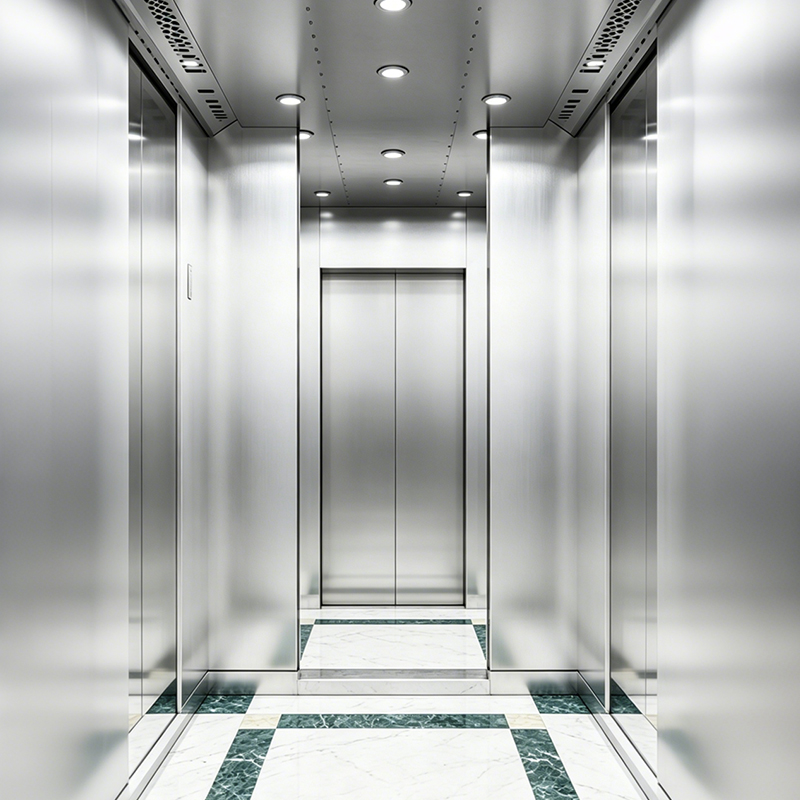
- 18 Product: Circular Glass Observation Elevator with Painted Steel Canopy and Mirror Finish
A circular glass observation elevator is more than a vertical transportation device; it is an architectural experience, a visual statement, and a high-performance mobility solution designed to connect people with space. The Circular Glass Observation Elevator with Painted Steel Canopy and Mirror Finish, model TO-G001, represents a refined approach to panoramic elevator design, combining semicircular viewing geometry, laminated glass observation walls, stainless steel interior finishes, intelligent control systems, and advanced safety protection. Built for commercial buildings, hotels, shopping centers, cultural venues, villas, hospitals, and public facilities, this elevator is engineered to provide smooth travel, premium aesthetics, and dependable long-term performance.
The product belongs to the 180° semicircular panoramic elevator category, making it especially suitable for spaces where visibility, openness, and architectural harmony are essential. Unlike conventional enclosed elevators, this observation elevator transforms movement into a memorable visual journey. Passengers can enjoy a broad viewing angle through three pieces of laminated glass, while the mirror stainless steel ceiling, hairline stainless steel car wall, painted steel canopy, and stainless steel handrail create a modern interior atmosphere. Every design element supports both elegance and durability.
In a competitive elevator market, the most successful products are not defined only by appearance. True quality requires safety engineering, intelligent control, precise manufacturing, reliable components, and full lifecycle support. This product integrates VVVF drive technology, intelligent door control, full-height infrared light curtain protection, unintended car movement protection, over-speed protection, fault self-diagnosis, remote monitoring, and anti-nuisance command management. These features allow the elevator to deliver comfortable travel while also meeting rigorous industrial safety expectations.
Manufactured by Tenau Elevator (China) Co., Ltd., the product benefits from a comprehensive elevator manufacturing system that integrates design, research and development, production, marketing, installation support, and after-sales service. The company originates from German technical concepts and applies modern intelligent manufacturing, automated production, big data management, IoT technology, and closed-loop quality control. Its factory is located in Nanxun District, Huzhou City, Zhejiang Province, at the core of the Shanghai-Nanjing-Suzhou-Hangzhou economic circle, providing a strong industrial foundation and convenient supply chain support.
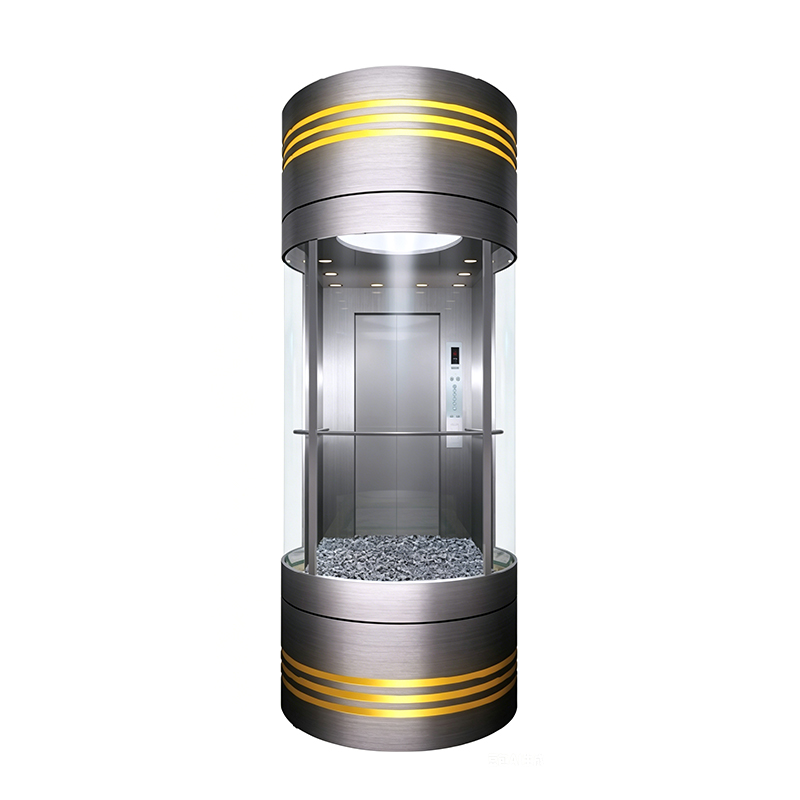
Circular Glass Observation Elevator with Painted Steel Canopy and Mirror Finish
Architectural Value of a Circular Observation Elevator
In modern architecture, elevators are no longer hidden mechanical systems. They often function as visible design elements that influence a building’s identity. A circular glass observation elevator adds openness and elegance to a space because it allows passengers to see their surroundings while traveling vertically. In shopping malls, it can increase visual interaction between different floors. In hotels, it can enhance a luxury atmosphere. In office buildings, it can reinforce a sense of openness and prestige. In cultural centers and public halls, it can become part of the visitor experience.
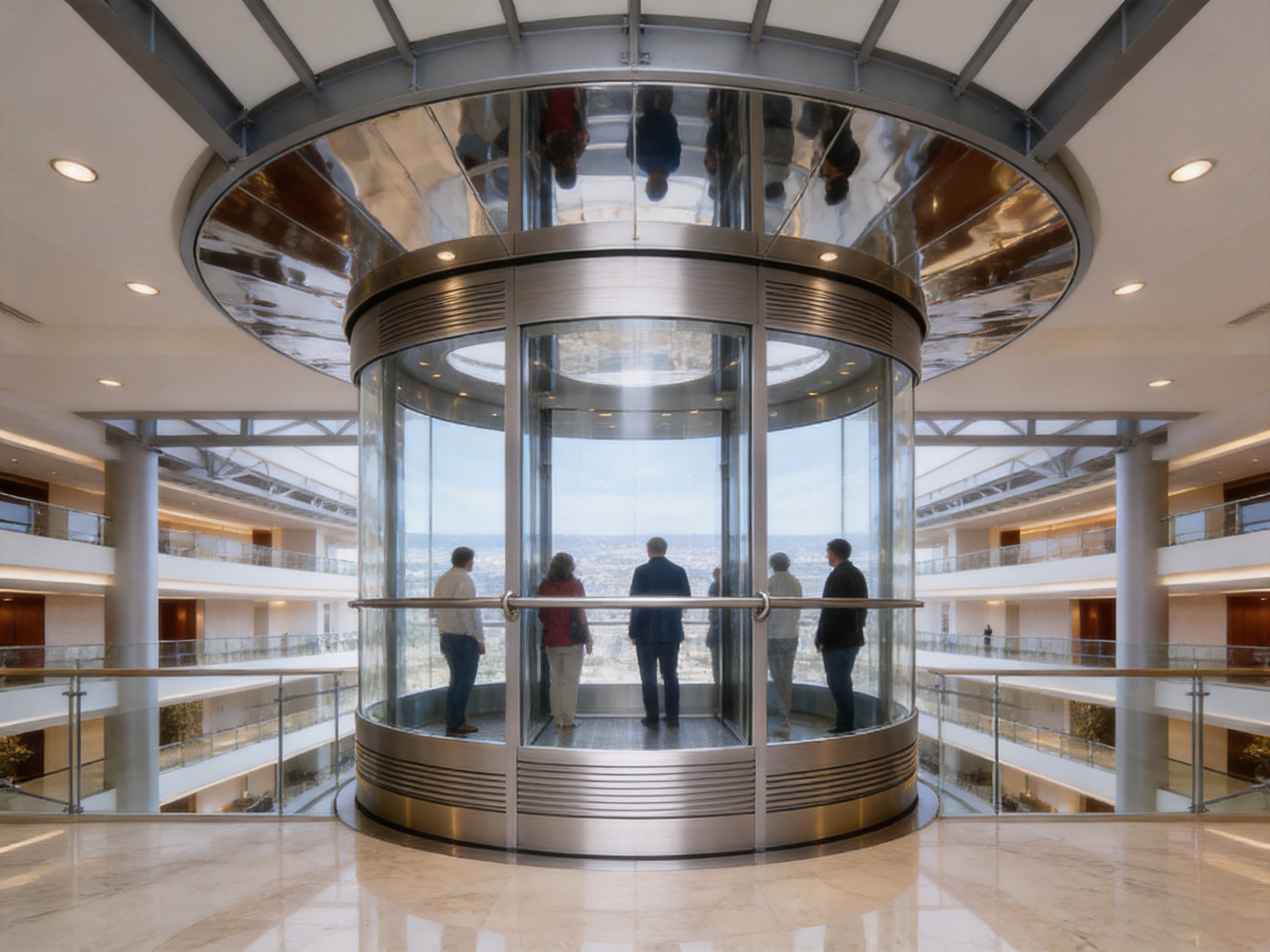
The semicircular 180° panoramic structure offers a balance between visibility and installation adaptability. A fully circular glass elevator may require more complex shaft conditions and architectural space, while a semicircular design can provide generous viewing performance with more practical building integration. The TO-G001 model uses three pieces of laminated glass for the observation wall, creating a broad transparent surface that supports passenger comfort and visual continuity. This design is especially valuable in atriums, scenic buildings, commercial façades, and interior spaces where the elevator is meant to be seen.
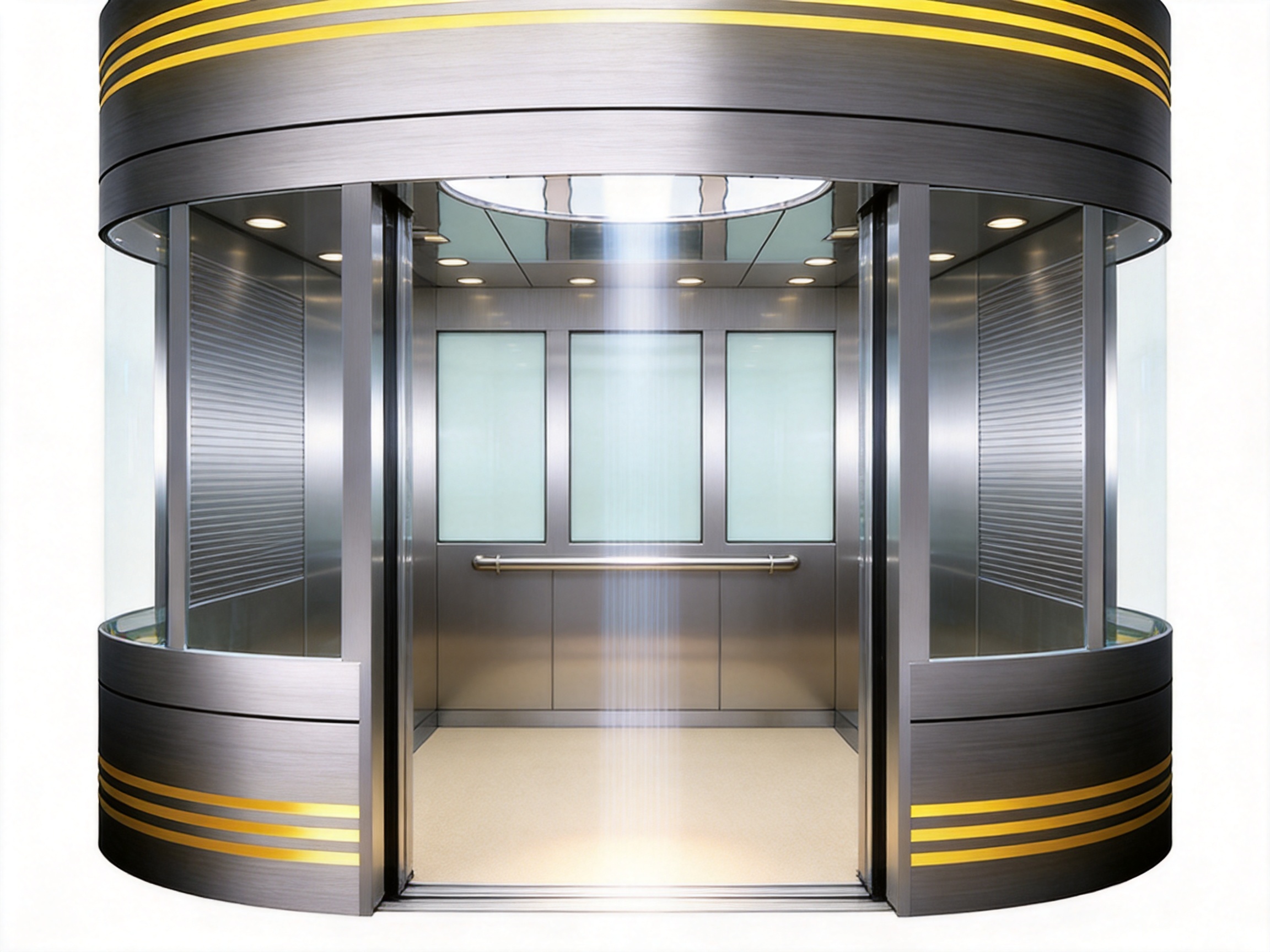
The painted steel canopy with decoration contributes to structural appearance and long-term durability. Painted steel is widely recognized for its ability to combine strength with flexible styling. When paired with mirror stainless steel in the ceiling and hairline stainless steel on the car wall, the result is a refined interior that reflects light, expands spatial perception, and resists daily wear. The stainless steel handrail provides a secure touchpoint and complements the overall design language.
Compared with many standard observation elevators, this model emphasizes a more integrated aesthetic. Some panoramic elevators may offer glass walls but use basic interior panels, inconsistent finishes, or limited ceiling design. The TO-G001 configuration is designed to create a complete passenger environment, where canopy, glass, ceiling, wall, handrail, and floor work together. The PVC floor adds practical comfort and easy maintenance, making the elevator suitable for high-traffic environments where cleanliness and durability matter.
Core Product Configuration
The elevator’s configuration reflects a combination of visual appeal and practical engineering. The observation wall is composed of laminated glass, which is commonly chosen for safety and strength in architectural applications. Laminated glass is designed to maintain integrity better than ordinary glass under impact conditions because interlayer bonding helps reduce the risk of dangerous fragmentation. This is particularly important in passenger environments, where safety and confidence are essential.
The mirror stainless steel car ceiling enhances brightness and creates a premium feeling. Mirror surfaces reflect light and can make the cabin feel more spacious. In panoramic elevators, this effect is especially beneficial because the transparent glass wall already contributes to openness. The ceiling’s reflective finish works with natural and artificial light to create a clean, high-end impression.
The hairline stainless steel car wall provides a sophisticated brushed texture. Hairline stainless steel is valued for its resistance to fingerprints, scratches, and visual aging compared with highly polished surfaces. It is a practical choice for elevator cabins that must remain attractive after repeated daily use. The single-tube stainless steel handrail adds both safety and interior unity, while the PVC floor offers an economical, comfortable, and maintainable surface.
Component |
Specification |
Practical Advantage |
Canopy |
Painted steel with decoration |
Durable structure with refined architectural appearance |
Observation wall |
Three pieces of laminated glass |
Wide 180° viewing effect with enhanced passenger confidence |
Car ceiling |
Mirror stainless steel |
Bright visual effect and premium interior atmosphere |
Car wall |
Hairline stainless steel |
Wear-resistant, modern, and easy to maintain |
Handrail |
Single tube with stainless steel |
Stable passenger support and coordinated cabin styling |
Car floor |
PVC floor |
Comfortable, practical, and suitable for frequent use |
Advanced Travel Performance
Travel comfort is one of the most important indicators of elevator quality. Passengers may not always notice complex control systems, but they immediately feel acceleration, deceleration, vibration, leveling accuracy, door movement, and noise. The TO-G001 panoramic elevator uses a VVVF drive system to adjust motor speed precisely. VVVF, or variable voltage variable frequency control, allows the elevator to accelerate and decelerate smoothly instead of starting and stopping abruptly. This improves passenger comfort, reduces mechanical stress, and contributes to energy efficiency.
For an observation elevator, smooth travel is even more important than in a fully enclosed elevator. Because passengers can see the surrounding building while moving, sudden vibration or uneven movement can reduce the sense of safety and comfort. The VVVF drive system helps deliver stable motion, making the visual experience more enjoyable. A smooth ride also reflects positively on the building itself, especially in hotels, premium commercial complexes, and high-end residential projects.
The intelligent door operator is another key travel function. Door quality strongly affects passenger perception because every ride begins and ends with door movement. A VVVF-controlled door system allows gentle, sensitive, and accurate opening and closing. This reduces impact, lowers noise, and improves reliability. In crowded environments, stable door operation can also reduce delays and improve traffic flow.
The elevator includes efficiency management through automatic pass-without-stopping when fully loaded. This means that when the elevator reaches full load condition, it can bypass additional hall calls until passenger capacity becomes available. This feature improves transport efficiency because it prevents unnecessary stops that would frustrate waiting passengers and slow down cabin movement. For commercial buildings with peak traffic periods, this function can improve operational rhythm.
Smart command functions, including registered command cancellation and anti-nuisance features, help prevent unnecessary stops caused by accidental or improper button operation. In public buildings, children or careless passengers may press multiple floor buttons without need. Anti-nuisance logic reduces wasted travel and improves service efficiency. The arrival gong provides audible notification when the elevator reaches the destination floor, supporting accessibility and passenger awareness.
Safety Protection Built Around Passenger Confidence
Safety is the foundation of elevator design. A panoramic elevator must not only look safe but also provide multiple layers of technical protection. The TO-G001 model includes a combination of mechanical, electrical, and intelligent safety functions designed to protect passengers in everyday operation and abnormal conditions.
Full-height infrared light curtain protection is installed at the entrance to detect passengers and objects during door operation. Traditional mechanical safety edges respond after contact, while infrared light curtains can detect obstruction before impact. This helps prevent the door from closing on passengers, luggage, wheelchairs, baby strollers, or other objects. High-precision light curtains support rapid obstacle detection, making door operation safer and more comfortable.
The elevator also includes accidental movement prevention, often described as unintended car movement protection. This system is designed to arrest unplanned movement while the doors are open, especially during boarding and exiting. Such protection is important because the entrance zone is one of the most sensitive points in elevator operation. By incorporating UCMP-related protection, the elevator provides enhanced safety during passenger transfer.
Over-speed control is another crucial safety function. The system provides automatic braking and safety gear protection for both upward and downward over-speed conditions. Elevator safety cannot focus only on downward movement; modern systems must also address upward over-speed risks caused by traction or control anomalies. Bidirectional over-speed protection gives building owners and passengers greater confidence.
The designated stop function allows the elevator to travel automatically to the next available floor if the door opening fails at the intended destination. This prevents passengers from being left in an inconvenient or uncertain situation. Fault self-diagnosis records recent errors to support rapid troubleshooting and restoration. Maintenance teams can identify fault patterns more efficiently, reducing downtime and improving long-term service reliability.
Door protection also includes anti-collision hardware designed to prevent car door derailment and ensure track stability. Door derailment can cause service interruption and passenger inconvenience, so reinforcing door stability is a meaningful advantage. This detail reflects a broader engineering philosophy: safety must be addressed not only by emergency systems but also by durable everyday mechanical design.
IoT Monitoring and Intelligent Management
Elevator technology is increasingly connected, and remote monitoring has become an important feature for modern building management. The TO-G001 panoramic elevator supports IoT monitoring for real-time data collection and remote management. Through connected monitoring, operating conditions, fault signals, usage patterns, and safety information can be observed more efficiently. This allows maintenance teams and building managers to make better decisions based on actual performance data rather than relying only on scheduled inspections.
IoT monitoring is especially valuable in high-traffic buildings where elevator downtime can affect customer satisfaction, business flow, and operational reputation. Early detection of abnormal conditions can help prevent minor issues from developing into major failures. Remote data also supports preventive maintenance, allowing service teams to plan inspections and parts replacement with greater accuracy.
Compared with competitors that rely mainly on traditional maintenance response, an intelligent monitoring system creates a more proactive service model. Instead of waiting for users to report a problem, the system can help identify irregularities in advance. This improves safety management, reduces service interruption, and supports full lifecycle asset value.
For panoramic elevators, remote monitoring also helps protect the building’s image. Observation elevators are often installed in visible, prestigious locations. Any malfunction may be noticed quickly by visitors. Therefore, intelligent management is not only a technical advantage but also a brand image advantage for the property owner. Smooth, reliable operation helps maintain the quality impression of the entire building.
Advantages Over Conventional Competitor Products
Many elevator suppliers can provide basic vertical transportation, but the difference between ordinary and high-quality panoramic elevators lies in the integration of design, safety, control, manufacturing precision, and service support. The TO-G001 product offers several competitive advantages.
First, its 180° semicircular panoramic design provides strong visual impact while remaining practical for architectural integration. Some competing elevators may use flat glass panels that offer limited viewing angles, while fully circular designs may be more difficult to install in many buildings. The semicircular structure offers a balanced solution, delivering openness without excessive complexity.
Second, the material combination is premium and practical. Painted steel with decoration provides a durable canopy structure; laminated glass supports visibility and safety; mirror stainless steel increases interior brightness; hairline stainless steel provides wear resistance; stainless steel handrail adds security; and PVC flooring supports easy maintenance. Competitor products may focus on a single attractive element, but this configuration provides a complete cabin system.
Third, the travel system emphasizes smoothness through VVVF drive technology and intelligent door operation. Low-quality elevators may suffer from abrupt starts, noisy doors, poor leveling, or inconsistent ride comfort. By using precise speed control and VVVF door movement, this product improves the passenger experience from entry to exit.
Fourth, safety functions are layered and comprehensive. Light curtain protection, unintended movement prevention, over-speed control, designated stop logic, fault self-diagnosis, and door anti-derailment protection create a safety ecosystem. Competitor products with fewer protective layers may meet basic requirements but may not offer the same level of operational confidence.
Fifth, IoT-based monitoring and full lifecycle service support create a smarter ownership experience. Building owners are not only purchasing equipment; they are investing in long-term reliability. Advanced remote monitoring, global unified maintenance processes, comprehensive inspection protocols, personalized client data files, and rapid service response provide value beyond the initial installation.
Manufacturing Strength and Industrial Capability
The performance of an elevator depends heavily on manufacturing quality. Even the best design can fail to deliver if production accuracy, component consistency, and quality management are weak. Tenau Elevator (China) Co., Ltd. operates as a professional comprehensive elevator manufacturer with capabilities covering design, research and development, manufacturing, marketing, installation, and after-sales service. This integrated structure allows the company to manage quality through the full process rather than relying only on external assembly.
The company is located in Nanxun, Zhejiang Province, a region with strong elevator industry resources and access to the Shanghai-Nanjing-Suzhou-Hangzhou economic circle. This location supports efficient logistics, supply chain coordination, technical talent access, and export operations. A strong manufacturing base helps the company provide passenger elevators, freight elevators, escalators, moving walks, home villa elevators, hospital elevators, cargo elevators, car elevators, elevator parts, cabin interiors, and high-speed elevator solutions.
The company introduces international technologies and rigorous management systems, complying with ISO9001 quality management, ISO14001 environmental management, and OHSMS18001 occupational health and safety management standards. These systems matter because elevator manufacturing requires repeatable precision and disciplined process control. Certification-oriented management supports traceability, documentation, inspection, and continuous improvement.
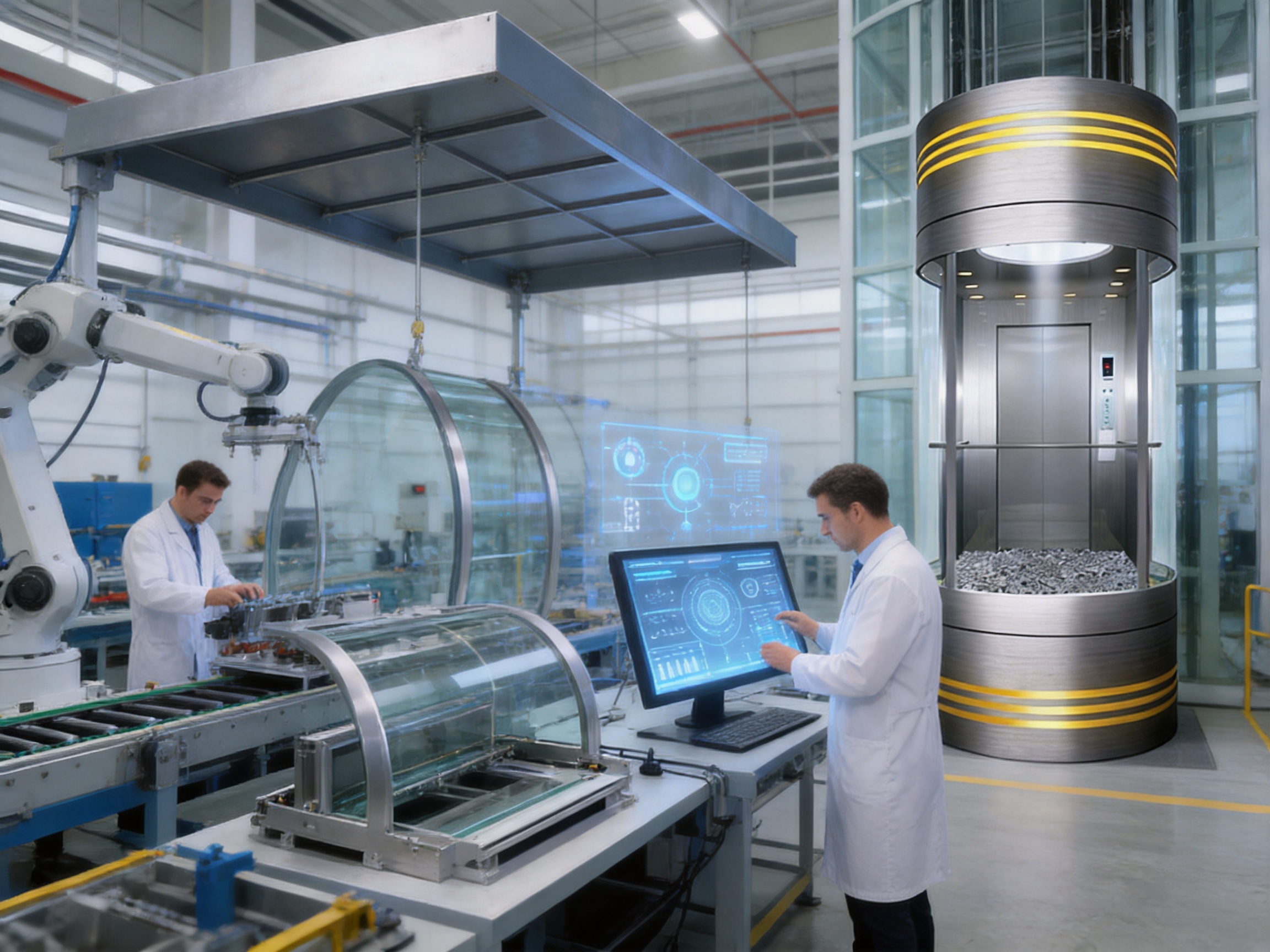
German Industry 4.0 intelligent manufacturing concepts are applied through automated production lines, big data, IoT technology, and full closed-loop quality control. Intelligent manufacturing helps reduce human error, improve production consistency, and support data-based quality management. Automated processes can improve precision in metal fabrication, component assembly, and inspection. Big data analysis can support process optimization and defect prevention.
Closed-loop quality control means that feedback from design, production, testing, installation, maintenance, and customer use can be integrated into continuous improvement. This approach is particularly important in elevator manufacturing because long-term reliability depends on thousands of details: guide rail alignment, door system accuracy, controller stability, traction system performance, cabin assembly quality, safety circuit reliability, and finishing durability.
Design and Research Capability
Advanced elevator products require strong design and R&D support. A panoramic elevator must satisfy both engineering and architectural requirements. The cabin shape, glass arrangement, lighting reflection, structural support, passenger ergonomics, control logic, and safety interfaces must work together. The manufacturer’s ability to design low-speed, medium-speed, high-speed, and ultra-high-speed elevators reflects a broad technical foundation that can support customized applications.
For the TO-G001 observation elevator, design capability appears in both visible and invisible areas. The visible areas include the semicircular cabin profile, laminated glass observation wall, mirror ceiling, hairline stainless steel wall, painted canopy, handrail, and floor finish. The invisible areas include drive coordination, door control, safety monitoring, command logic, fault diagnosis, and remote data management.
Customization is often necessary in panoramic elevator projects because buildings vary widely. Atrium dimensions, shaft structure, traffic demand, decorative style, floor height, speed requirements, and installation environment can differ from project to project. A manufacturer with integrated design and production capability can better adjust product solutions to project needs while maintaining safety and quality.
Compared with suppliers that provide only standardized products, a company with R&D strength can offer more flexible engineering support. This is important for architects, contractors, developers, and property owners who want the elevator to match the building rather than force the building to adapt to a limited elevator design.
Quality Control from Materials to Finished Product
Quality begins with material selection. Stainless steel, laminated glass, painted steel, electrical components, door systems, controllers, drive units, and safety devices all influence final performance. In a premium observation elevator, material quality is especially visible because passengers directly interact with the cabin surfaces and observe the glass structure. Poor finishing, weak panels, unstable doors, or inconsistent lighting can quickly reduce confidence.
The painted steel canopy must be processed for durability and appearance. Surface preparation, painting consistency, decorative detail, corrosion resistance, and assembly accuracy determine whether the canopy remains attractive over time. Mirror stainless steel requires careful handling to avoid scratches and deformation. Hairline stainless steel must maintain consistent texture and alignment. Glass panels must be manufactured, handled, and installed with precision to ensure both appearance and safety.
Production quality also depends on component compatibility. The drive system, controller, door operator, safety circuit, sensors, and communication modules must work together reliably. A strong manufacturing process includes inspection checkpoints, electrical testing, mechanical testing, cabin assembly verification, and final quality review. For elevators exported to multiple markets, documentation and compliance awareness are also important.
Closed-loop quality control helps ensure that problems found in production or service are fed back into design and manufacturing improvement. This creates a learning system. Over time, such a system can reduce repetitive defects, improve component selection, and refine installation guidance. For building owners, this means lower risk and better lifetime value.
Passenger Experience and Emotional Impact
Elevators are used repeatedly every day, but many are forgettable. A circular glass observation elevator creates a different emotional response. Passengers may watch the lobby, atrium, landscape, or city view unfold as they move. This visual experience can make short trips feel more pleasant and memorable. For public buildings and commercial properties, this emotional value can influence visitor satisfaction.
The TO-G001 model combines openness with comfort. The laminated glass wall provides broad visibility, while the stainless steel interior gives a sense of strength and cleanliness. The mirror ceiling adds brightness and visual height. The handrail supports stability for elderly passengers, children, and people who prefer additional support. The PVC floor provides a practical walking surface.
Ride comfort is equally important. Smooth acceleration reduces discomfort for sensitive passengers. Gentle door movement reduces anxiety at entry and exit. Arrival gong notification provides clear information. Anti-nuisance command logic reduces unnecessary delays. When these functions work together, passengers experience the elevator as efficient, calm, and trustworthy.
In hospitality and retail environments, passenger experience can become part of business value. A hotel guest who enters a well-designed glass elevator may perceive the building as more luxurious. A shopping center visitor may enjoy the view and feel more connected to the space. A residential property may use the elevator as a premium feature that improves perceived value.
Application Scenarios
The circular glass observation elevator can serve many building types. In hotels, it can be placed in an atrium or lobby to create a strong first impression. Guests traveling between floors experience the hotel’s interior design from changing perspectives, reinforcing the property’s luxury image.
In shopping malls, the elevator can improve traffic distribution while functioning as a visual attraction. Shoppers can see store displays, floor layouts, promotional areas, and activity zones while moving. The observation function can encourage exploration and help visitors understand the building layout.
In office buildings, a panoramic elevator can serve executive floors, public lobbies, or shared atrium areas. It communicates modernity and transparency while supporting efficient vertical transportation. In mixed-use complexes, it can connect commercial, leisure, and office zones with a unified design language.
In hospitals and healthcare facilities, panoramic elevators may be used in public areas where a less confined cabin can reduce passenger stress. Although hospital elevators often require special dimensions and medical functions, the design principles of smooth operation, safety protection, and reliable service remain highly relevant.
In private villas and high-end residences, an observation elevator can become both a mobility solution and a decorative feature. The glass structure can preserve interior openness and allow natural light to pass through. For homeowners, it provides convenience, accessibility, and visual sophistication.
In cultural buildings, museums, exhibition centers, and scenic facilities, the elevator can become part of the visitor route. The journey itself supports storytelling, spatial appreciation, and accessibility. The semicircular design is particularly suitable for installations where the elevator faces an open hall or landscape view.
Service Standards and Lifecycle Support
Elevator ownership does not end after installation. Long-term service determines safety, reliability, and user satisfaction. The product is supported by service standards that include global unified maintenance processes and comprehensive inspection protocols. Standardized maintenance helps ensure that critical components are checked consistently and that service quality does not depend entirely on individual habits.
Full lifecycle support is provided from the beginning of the product life to the end. This is important because elevator systems may operate for many years, and their needs change over time. Early-stage service may focus on installation adjustment and commissioning. Mid-life service may focus on preventive maintenance and component replacement. Later-stage service may include modernization planning and performance upgrades.
Personalized one-to-one client data files allow maintenance strategies to be tailored to specific elevator conditions. Elevators in high-traffic shopping centers have different maintenance needs from elevators in low-traffic private villas. Data-based planning helps optimize service frequency, parts preparation, and risk prevention.
The remote eye monitoring system keeps elevator operation and safety data under control. Combined with 24-hour service teams on standby, this creates a rapid response structure. For property owners, rapid service response reduces downtime, protects building reputation, and improves passenger confidence. For facility managers, it simplifies elevator management and supports operational planning.
Environmental and Efficiency Considerations
Modern elevators must also consider energy use and environmental responsibility. The VVVF drive system supports efficient motor control by adjusting power according to operating needs. Smooth acceleration and deceleration can reduce unnecessary energy waste and mechanical stress. Intelligent command management and full-load bypass logic reduce unnecessary stops, which can also improve traffic efficiency and reduce repeated energy consumption.
The company’s environmental management system, aligned with ISO14001 principles, supports more responsible manufacturing practices. Environmental management in elevator production may involve material utilization, waste control, energy management, painting process control, and supply chain discipline. For building projects seeking sustainable design, selecting equipment from a manufacturer with environmental management awareness is an important consideration.
Durability is also part of sustainability. A product that lasts longer, requires fewer repairs, and maintains performance over time reduces resource waste. Stainless steel finishes, laminated glass, reliable control systems, and closed-loop quality management all contribute to long-term value. Sustainable building operation depends not only on low initial energy use but also on lifecycle reliability.
Why This Elevator Is a Strong Choice for Premium Projects
The TO-G001 circular glass observation elevator is a strong choice for premium projects because it addresses multiple dimensions of value. Visually, it provides a 180° panoramic experience with elegant materials. Technically, it includes smooth VVVF drive performance, intelligent door operation, and advanced safety functions. Operationally, it supports efficiency management, anti-nuisance command logic, arrival notification, and fault self-diagnosis. Strategically, it is backed by intelligent manufacturing, quality control, and lifecycle service.
For architects, the elevator offers a design element that can enhance spatial identity. For developers, it adds marketable value and visual appeal. For facility managers, it provides intelligent monitoring and service support. For passengers, it delivers comfort, safety, and an enjoyable view. For long-term owners, it offers durability, maintainability, and technical confidence.
Compared with basic panoramic elevators, this product stands out because it is not merely a glass cabin. It is a complete system integrating structure, aesthetics, drive technology, safety engineering, digital monitoring, and service planning. This integrated value is what separates a premium elevator solution from a standard product.
Frequently Asked Questions
What type of building is this circular glass observation elevator suitable for?
It is suitable for hotels, shopping malls, office buildings, public halls, cultural venues, scenic facilities, high-end residences, villas, and other spaces where vertical transportation and visual presentation are both important. Its 180° semicircular panoramic design works especially well in atriums and open interior spaces.
What makes the 180° semicircular design valuable?
The semicircular design provides a wide observation angle while remaining more practical for many building layouts than a fully circular structure. It creates strong visual openness and allows passengers to enjoy the surrounding architecture during travel.
Why is laminated glass used for the observation wall?
Laminated glass is commonly used for safety-focused architectural applications. It offers transparency while improving passenger confidence because its layered structure helps maintain integrity better than ordinary glass under impact conditions.
How does the VVVF drive system improve ride quality?
The VVVF drive system precisely controls motor speed, allowing smooth acceleration and deceleration. This reduces vibration, improves comfort, lowers mechanical stress, and contributes to efficient operation.
What safety systems are included?
The elevator includes infrared light curtain protection, unintended car movement protection, upward and downward over-speed protection, designated stop logic, door anti-collision and anti-derailment protection, and fault self-diagnosis. These systems work together to improve passenger safety and operational reliability.
How does IoT monitoring benefit building owners?
IoT monitoring enables real-time data collection and remote management. It helps maintenance teams detect abnormal conditions earlier, plan preventive service, reduce downtime, and improve long-term equipment management.
What interior materials are used?
The elevator uses a painted steel canopy with decoration, three laminated glass observation wall sections, a mirror stainless steel ceiling, hairline stainless steel car wall, stainless steel single-tube handrail, and PVC floor.
How does this product compare with ordinary observation elevators?
It offers a more complete combination of panoramic design, premium materials, smooth VVVF travel, intelligent door operation, layered safety protection, remote monitoring, and lifecycle service support. Many ordinary observation elevators focus mainly on glass appearance but provide fewer integrated performance and service advantages.
Is the elevator suitable for high-traffic environments?
Yes. Functions such as full-load bypass, intelligent command cancellation, anti-nuisance logic, durable stainless steel finishes, and remote monitoring make it suitable for commercial and public environments with frequent passenger use.
What manufacturing strengths support product quality?
The product is supported by integrated design, R&D, manufacturing, installation support, and after-sales service. The manufacturing system applies intelligent production concepts, automated lines, big data, IoT technology, ISO-based management systems, and closed-loop quality control.
Conclusion
The Circular Glass Observation Elevator with Painted Steel Canopy and Mirror Finish is designed for buildings that demand more than simple vertical movement. It offers a panoramic passenger experience, refined material selection, smooth and intelligent travel control, comprehensive safety systems, digital monitoring, and reliable lifecycle support. Its semicircular 180° observation wall creates openness and architectural value, while its stainless steel finishes and painted canopy provide durability and visual sophistication.
Behind the product is a manufacturing system built on integrated elevator expertise, advanced production processes, international management standards, intelligent manufacturing, and full closed-loop quality control. This foundation allows the elevator to compete strongly against conventional products by offering not only attractive design but also dependable performance and long-term service value.
For premium commercial buildings, hospitality projects, public spaces, cultural facilities, and luxury residences, this elevator provides a combination of beauty, safety, comfort, and intelligent operation. It is a mobility solution that enhances architecture, supports passenger confidence, and contributes to the lasting quality of the building environment.
References
Elevator Safety Standards and Modern Vertical Transportation Engineering, International Lift Engineering Review.
Variable Voltage Variable Frequency Drive Applications in Passenger Elevators, Electrical Motion Control Journal.
Architectural Glass in Modern Building Mobility Systems, Building Materials and Safety Studies.
Intelligent Monitoring and Preventive Maintenance for Elevator Systems, Smart Building Technology Annual.
Quality Management Systems in Elevator Manufacturing, Industrial Production and Certification Handbook.
Product: Circular Glass Observation Elevator with Painted Steel Canopy and Mirror Finish

Related Products
Related News
Built on safety, forging trust in vertical mobility.
lf you have any questions or need help, feel free to contact with our team.
 export@tenau.com.cn
 +86-18601458867
 +86-512-65059883
Elevator & Escalator
Factory Add
East of Xicheng Road, North of Lianyi Road, Nanxun Economic Development Zone, Nanxun District, Huzhou City, Zhejiang Province, P.R.China
Copyright © Tenau Elevator (China) Co., Ltd. All Rightd Reserved.
Custom High Quality Elevator Suppliers and World Brand Elevator Company