

 en
en Español
 русский
 中文简体
中文简体
Machine Room Less Freight Elevators for Modern Vertical Cargo Transportation
Content
- 1 1. Product Overview: A Compact Solution for Heavy-Duty Cargo Movement
- 2 2. Core Advantages Over Conventional Freight Elevator Solutions
- 2.1 2.1 Reduced Building Space Requirement
- 2.2 2.2 Lower Construction Cost and Easier Integration
- 2.3 2.3 Gearless Synchronous Hoister for Efficiency and Durability
- 2.4 2.4 VVVF Control for Smooth and Comfortable Movement
- 2.5 2.5 Precise Leveling for Efficient Loading and Unloading
- 2.6 2.6 Wide Door Opening for Cargo Convenience
- 3 3. Structural Strength and Cargo-Focused Design
- 4 4. Safety: A Systematic Approach to Reliable Operation
- 5 5. Intelligent Control and Functional Flexibility
- 6 6. Performance Comparison Table
- 7 7. Energy Efficiency and Environmental Value
- 8 8. Manufacturing Strength: Advanced Production for Reliable Quality
- 9 9. Intelligent Production and Process Control
- 10 10. Quality Philosophy and International Service Capability
- 11 11. Application Scenarios
- 12 12. User Experience: Ease, Stability, and Practical Operation
- 13 13. Lifecycle Value for Building Owners
- 14 14. Why This Product Stands Out in a Competitive Market
- 15 15. Practical Selection Considerations
- 16 16. Q&A Section
- 16.1 Q1: What is a machine room less freight elevator?
- 16.2 Q2: Why is the machine room less design beneficial?
- 16.3 Q3: What cargo load can this elevator support?
- 16.4 Q4: How does the gearless synchronous hoister improve performance?
- 16.5 Q5: Why is VVVF control important for freight elevators?
- 16.6 Q6: How does the elevator improve loading and unloading efficiency?
- 16.7 Q7: What safety features are included?
- 16.8 Q8: Is the elevator suitable for high-frequency industrial use?
- 16.9 Q9: How does the manufacturer support product quality?
- 16.10 Q10: What after-sales service advantages are available?
- 17 17. Conclusion
- 18 References
In modern buildings, factories, warehouses, logistics centers, commercial complexes, and industrial facilities, the movement of goods is as important as the movement of people. A freight elevator is not only a lifting device; it is a central part of a building’s internal logistics system. When cargo must be moved safely, efficiently, and repeatedly between floors, the elevator must deliver dependable load capacity, precise leveling, stable operation, and long-term durability. A machine room less freight elevator answers these needs by combining strong cargo-handling performance with a compact structure that can reduce building space requirements and simplify project planning.
The machine room less freight elevator discussed in this article is designed for vertical cargo transportation. It adopts a compact structural layout, a gearless synchronous hoister, and a slim control cabinet. Because the elevator does not require a traditional independent machine room, it can help developers, contractors, and building owners reduce construction complexity and make better use of available space. This is especially valuable in modern projects where floor area, ceiling height, structural efficiency, and lifecycle operating costs all influence purchasing decisions.
Compared with many conventional freight elevator solutions, this product places greater emphasis on intelligent control, safety protection, energy efficiency, ease of maintenance, and optimized building integration. Its design is suitable for cargo applications where performance must be stable under heavy loads and where stopping accuracy is essential for easy loading and unloading. With features such as VVVF drive control, wide door openings, reinforced car structure, precise mechanical processing, and various safety functions, the elevator is positioned as a practical and advanced solution for demanding cargo transport environments.
Behind the product is an elevator manufacturing company with professional elevator and escalator production lines, automatic panel processing equipment, an intelligent production base, and experience serving customers in many international markets. The company’s manufacturing strengths include modern production planning, strict quality control, intelligent processing, intelligent detection, and a service philosophy focused on fast response, practical solutions, and long-term cooperation. These strengths are important because a freight elevator is not a simple commodity; it must be designed, manufactured, installed, and maintained according to high standards to remain safe and efficient throughout its service life.
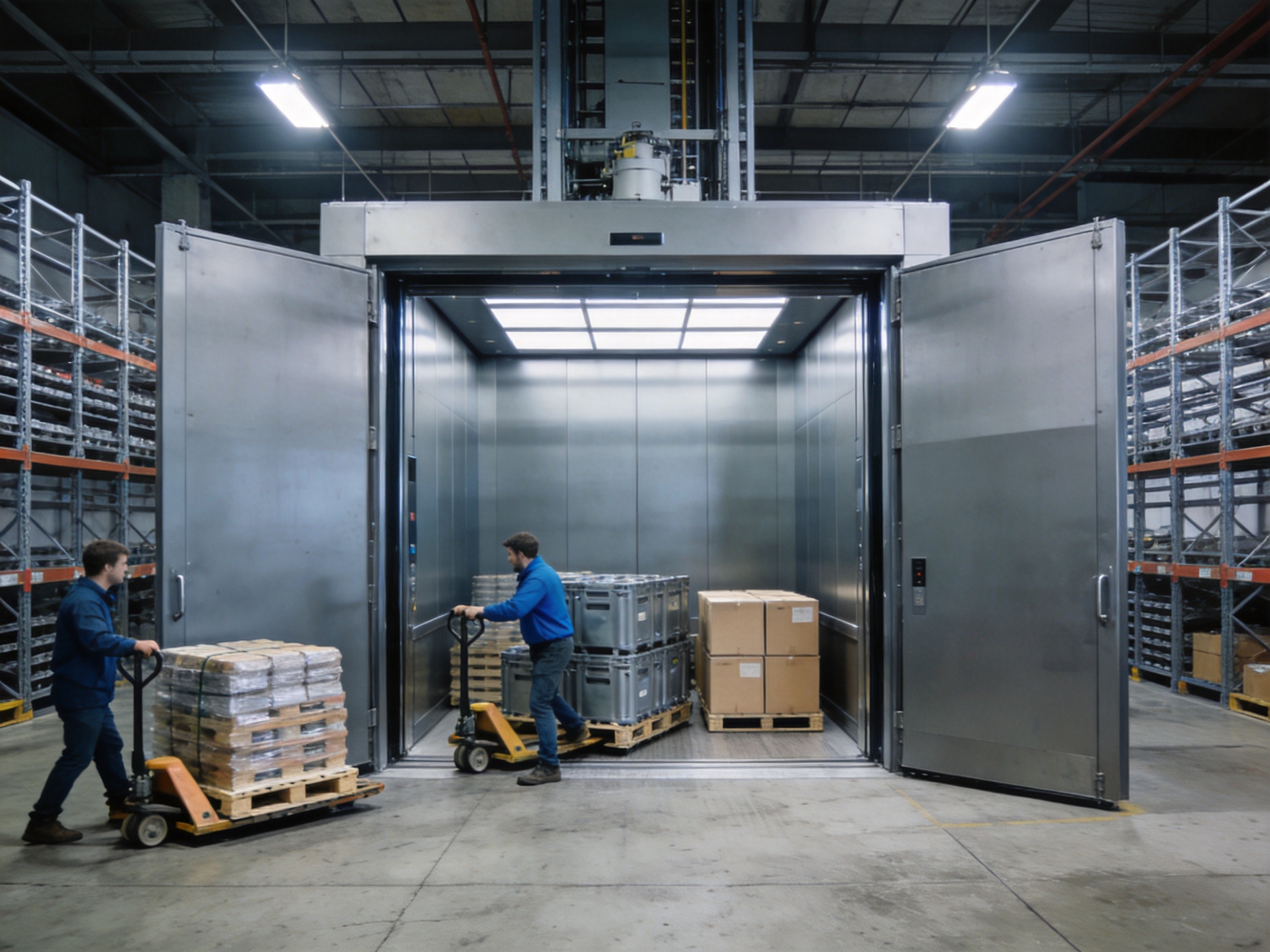
1. Product Overview: A Compact Solution for Heavy-Duty Cargo Movement
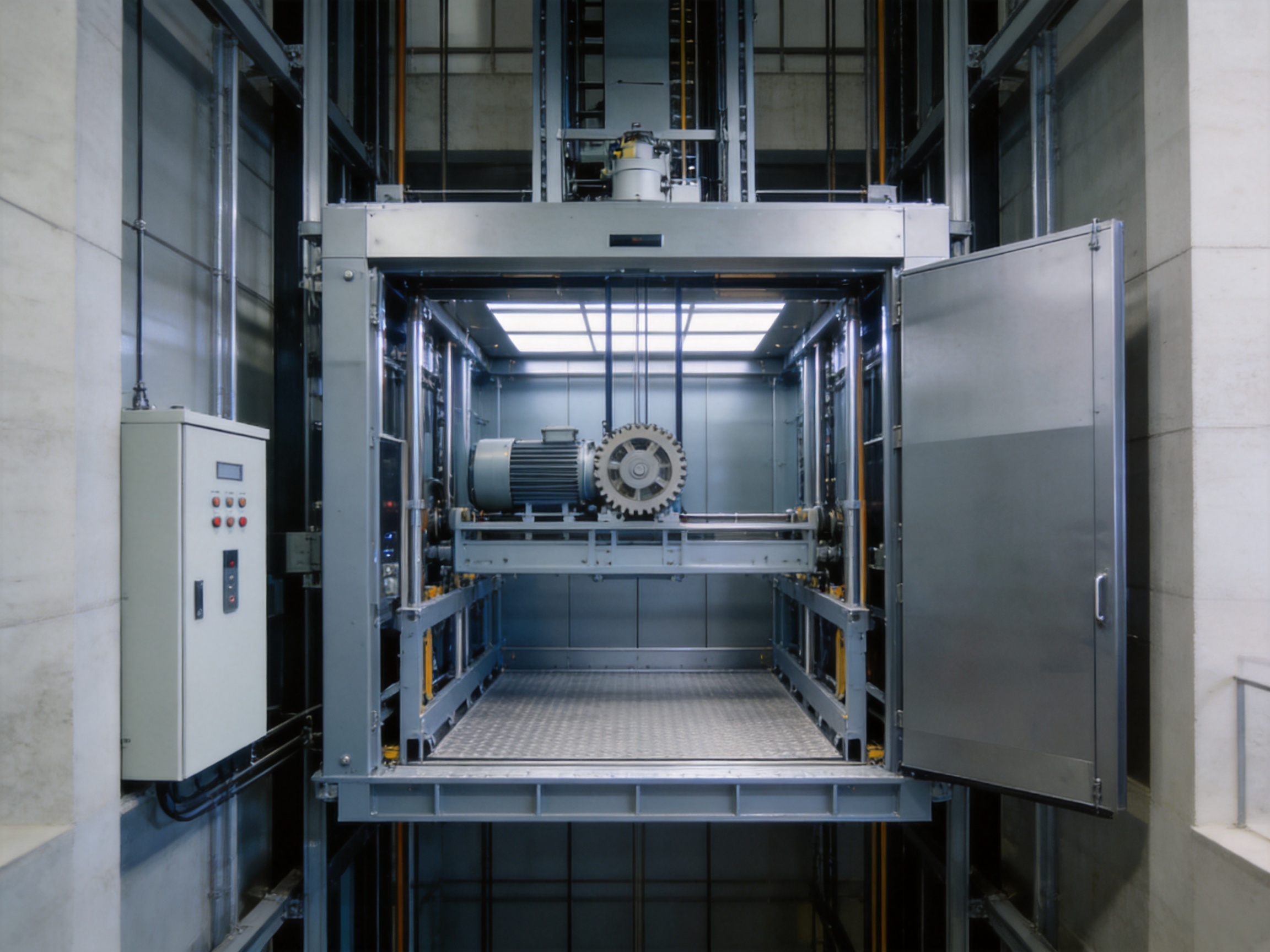
A machine room less freight elevator is built to move goods vertically without the need for a separate machine room above or beside the hoistway. Traditional freight elevators often require additional building space for the traction machine and related equipment. In contrast, a machine room less design integrates key equipment into a more compact arrangement, allowing the elevator system to occupy less structural space while still maintaining the strength and reliability required for cargo transportation.
The product uses a gearless synchronous hoister. This type of drive system is known for smooth operation, reduced mechanical loss, lower vibration, and improved energy performance compared with older geared systems. Gearless technology removes certain mechanical transmission components that can produce noise, heat, friction, and maintenance demand. For freight applications, this is particularly useful because the elevator may handle repeated cycles and heavy loads in daily operation.
The slim control cabinet is another important feature. In many building projects, technical rooms, shafts, and equipment areas are carefully calculated. A compact control cabinet helps reduce the spatial burden of the elevator system and supports more flexible architectural design. For retrofitting projects, warehouse conversions, and buildings where space is limited, this can be a decisive advantage.
The elevator is designed to provide a steady movement experience while meeting the practical demands of cargo loading. Cargo transport is different from passenger transport. Freight elevators must tolerate impacts from trolleys, pallets, forklifts, cartons, machinery, tools, and industrial materials. They must also maintain accurate floor leveling even when the car is heavily loaded. If leveling is inaccurate, goods may be difficult to move in or out, and the risk of collision or damage increases. For this reason, the product emphasizes specific leveling technology, reinforced car construction, and high-intensity materials.
The rate load capacity can be increased from 1600 kg to 3000 kg, allowing the elevator to support a wider range of cargo-handling needs. This increased load capability gives building owners more flexibility. A logistics company may need to move large parcels or palletized products, a factory may need to move components and tools, and a commercial facility may need to transport supplies, equipment, and maintenance materials. Strong load sustainability improves the building’s operational capacity and reduces bottlenecks in vertical logistics.
2. Core Advantages Over Conventional Freight Elevator Solutions
The market for freight elevators includes many types of equipment, from traditional machine-room traction elevators to hydraulic goods lifts and older geared traction systems. The machine room less freight elevator offers several competitive advantages by integrating compact design, gearless drive technology, intelligent control, reinforced construction, and modern manufacturing quality.
2.1 Reduced Building Space Requirement
One of the most visible advantages is the elimination of a traditional machine room. In conventional elevator layouts, the machine room may require additional construction area, extra structural support, ventilation, access planning, and maintenance space. These requirements can increase project cost and complicate building design. A machine room less structure allows the building designer to use space more effectively.
For developers, every square meter of usable space matters. In commercial or industrial buildings, saving technical space can create more storage area, production area, rental area, or operational space. According to the product information, the system can save construction area by approximately 10%. While actual savings depend on the project layout, even modest space savings can have significant value in urban projects or high-density industrial facilities.
2.2 Lower Construction Cost and Easier Integration
Because the elevator does not require a separate machine room, the overall civil construction process may become simpler. Builders may reduce the need for additional machine-room walls, roof structures, access doors, machine beams, and dedicated ventilation arrangements. This can help lower construction cost and improve schedule efficiency.
In renovation projects, a machine room less freight elevator can also offer practical benefits. Existing buildings may not have available space for a machine room, or structural modification may be expensive. A compact machine room less system can make vertical cargo transportation possible in buildings where traditional elevator installation would be difficult.
2.3 Gearless Synchronous Hoister for Efficiency and Durability
The gearless synchronous hoister is a major technical advantage. Traditional geared traction systems rely on gearboxes, which may introduce friction, vibration, mechanical wear, and energy loss. A gearless hoister can provide direct and efficient power transmission, helping reduce vibration and improve riding stability.
In freight applications, durability is essential. Cargo elevators are often used intensively and may experience more demanding working conditions than passenger elevators. By reducing mechanical losses and avoiding certain sources of vibration, gearless technology can help prolong the service life of components. This benefits building owners by reducing downtime, maintenance frequency, and long-term operating pressure.
2.4 VVVF Control for Smooth and Comfortable Movement
The elevator applies VVVF technology, which stands for variable voltage variable frequency control. This technology adjusts motor speed in a controlled manner, allowing smoother acceleration, deceleration, and stopping. For freight transportation, smooth movement is not only a matter of comfort; it protects goods from shaking, sliding, or impact during travel.
Spot-to-spot curved speed adjusting control helps the elevator move steadily between floors. When transporting delicate cargo, machinery parts, retail goods, electronics, packaged food, or industrial components, smooth operation can reduce the chance of product damage. Compared with simpler control methods, VVVF control provides more refined motion management and contributes to energy savings.
2.5 Precise Leveling for Efficient Loading and Unloading
Leveling accuracy is a critical factor in freight elevator performance. When the elevator stops at a floor, the car sill should align closely with the landing floor. If there is a height difference, workers may struggle to push carts or pallet jacks in and out. The problem becomes more serious under heavy load because load variation can affect stopping conditions.
The product uses specific leveling technology to ensure precise floor leveling under large loads. This allows cargo handling to feel almost like movement on a flat surface. The benefit is greater working efficiency, reduced physical strain on workers, less risk of wheel obstruction, and improved protection for cargo and building finishes.
2.6 Wide Door Opening for Cargo Convenience
Freight elevators must accommodate goods of different shapes and sizes. A wide door opening is therefore essential. The product is specifically designed for cargo transportation and supports wide opening arrangements that make it easier to move large boxes, carts, equipment, and pallets.
A wide entrance can also reduce loading time. In logistics environments, time saved on each trip can accumulate into significant productivity improvement over weeks and months. Compared with elevators designed mainly for passengers, a freight elevator with cargo-focused door design is better suited to industrial and commercial workflows.
3. Structural Strength and Cargo-Focused Design
A freight elevator must be strong from the inside out. The car, frame, door system, floor, sill, and guide structure all need to support repeated loading and unloading. The machine room less freight elevator uses high-intensity materials and a reinforced structure to meet the requirements of heavy-duty transport.
The bottom of the car is designed with improved rust resistance, helping prolong the service life of the cargo elevator. This is important in environments where floors may be exposed to moisture, cleaning water, packaging residue, or industrial dust. Rust resistance supports structural integrity and reduces long-term deterioration.
The bottom of the car is built with high-intensity material, allowing the elevator to handle large loads while maintaining safety. In freight applications, loads may not always be perfectly distributed. Workers may place heavy objects toward one side of the car, push carts over the threshold repeatedly, or load goods quickly during busy periods. A strong floor and car frame help the elevator tolerate these practical realities.
The car frame and car are designed according to mechanical principles. Thickened steel board increases load sustainability and improves the elevator’s ability to withstand cargo impacts. Precise mechanical processing also contributes to better cargo transporting capability. When components are manufactured accurately, the system can operate more smoothly, align more reliably, and produce less unnecessary wear.
This structural focus gives the product an advantage over lighter-duty goods lifts or elevators adapted from passenger designs. A true freight elevator must be built around cargo realities, not simply enlarged from a passenger model. The combination of reinforced materials, cargo-specific leveling, large driving force, and wide door access supports demanding use in warehouses, factories, shopping centers, hotels, hospitals, public buildings, and distribution facilities.
4. Safety: A Systematic Approach to Reliable Operation
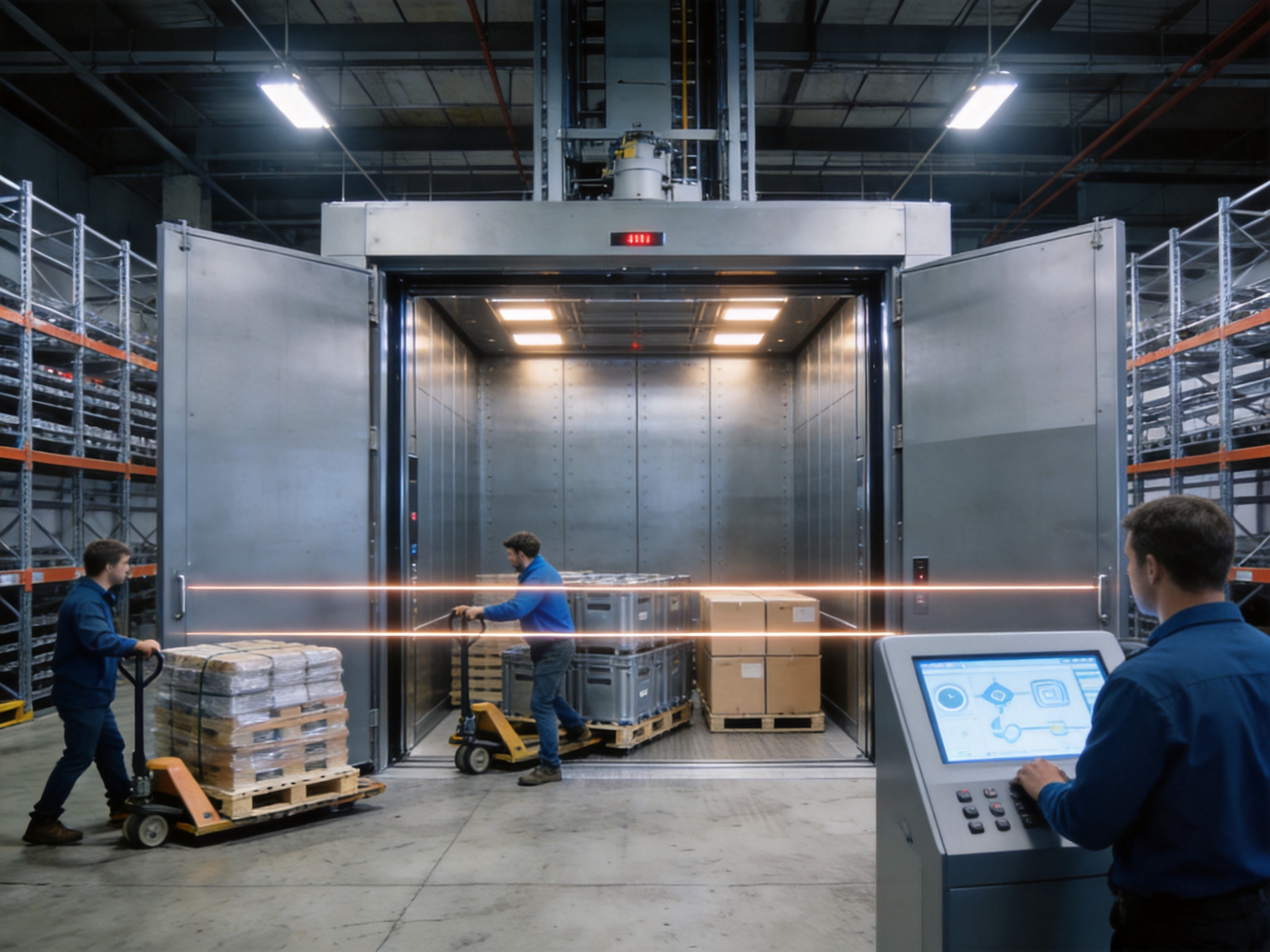
Safety is the foundation of elevator design. For freight elevators, safety requirements are especially important because cargo weight, loading tools, and industrial working conditions can increase operational risk. The product includes multiple safety components and control functions designed according to relevant elevator manufacturing and installation standards.
Safety components such as safety clamps and speed limiters are manufactured according to international codes. These devices are essential in preventing uncontrolled movement and protecting the elevator in abnormal conditions. The speed limiter monitors elevator speed and works with the safety gear to stop the car if overspeed occurs. For a freight elevator carrying heavy goods, this protection is critical.
The system includes terminal forced slow-down protection, up and down overrun protection, final limit protection, down overspeed protection, and up overspeed protection. These functions help ensure that the elevator operates within its intended travel range and speed envelope. If abnormal movement is detected, protective systems can intervene to reduce risk.
Door safety is also important. Freight elevator doors are exposed to frequent use, and goods may pass close to the door edges. Door interlock protection ensures that the elevator does not run unless doors are properly closed and locked. Light curtain protection helps detect obstruction at the entrance and reduces the risk of contact during door closing.
Overload protection is another vital feature. Cargo operators may attempt to load goods beyond the rated capacity, either accidentally or because of production pressure. Overload aiding stop and related control functions help prevent unsafe operation under excessive load. By stopping operation when load limits are exceeded, the system protects the elevator structure, drive system, and users.
The product also includes safety circuit protection, main contactor protection, brake detecting protection, inspection operation, inching operation, emergency car lighting, fire emergency return, auto-landing with fault, and power failure emergency leveling options. These functions create a layered protection system. Instead of relying on one device, the elevator combines mechanical, electrical, and intelligent controls to improve operational safety.
5. Intelligent Control and Functional Flexibility
Modern freight elevators are expected to do more than move up and down. They must integrate with building operations, support different traffic conditions, provide useful information, and simplify management. The product includes a wide range of control, information, safety, and comfort functions.
Control functions include well and floor distance self-tuning, power-on re-leveling, micro-touch car buttons, start protection control, car arrival indication, VVVF drive, VVVF door operator drive, second car operation panel, automatic adjustment of door open holding time, car call cancellation, automatic running, attendant running, duplex control, double-door control, and IC card control options.
These functions support flexible operation in different building types. For example, duplex control can coordinate two elevators to improve traffic efficiency. Double-door control can serve buildings where loading and unloading are required on opposite sides. IC card control can help restrict use to authorized personnel, which is valuable in warehouses, office support areas, hotels, hospitals, and industrial facilities.
Information functions include full collective control, full-load bypass, main floor shutoff, self-diagnosis of breakdown, five-way communication, car bell, floor and direction indicators in the car, floor and direction indicators at halls, voice announcement options, traffic dispatch options, IC card control options, and traction machine monitoring options. These features improve transparency and help managers understand elevator status.
Self-diagnosis is particularly useful for maintenance. When the elevator can identify and report certain faults, technicians can respond more efficiently. This reduces troubleshooting time and supports preventive maintenance. In busy facilities, reducing downtime can directly protect productivity and customer satisfaction.
Comfort functions may seem secondary in a freight elevator, but they still matter. Emergency car lighting, automatic shutoff of ventilation and lighting, repeated door closing, reopening with hall call, express door closing, car stop and door open, door opening extension options, and door close delay all contribute to practical daily use. Workers benefit from clear lighting, predictable door behavior, and easy access during loading.
6. Performance Comparison Table
| Feature | Machine Room Less Freight Elevator | Conventional Freight Elevator | Practical Benefit |
|---|---|---|---|
| Machine Room Requirement | No traditional separate machine room required | Usually requires machine room space | Reduced construction area and greater design flexibility |
| Drive System | Gearless synchronous hoister | Often geared traction or older drive systems | Lower vibration, reduced mechanical loss, improved durability |
| Control Method | VVVF drive and door control | May use less refined control systems | Smoother acceleration, deceleration, and stopping |
| Load Capability | Rated load can reach 3000 kg depending on configuration | Varies by model and may offer lower cargo flexibility | Suitable for broader cargo-handling requirements |
| Building Area Use | Can save construction area by approximately 10% | Requires additional technical space | More usable space for storage, production, or commercial use |
| Energy Performance | Energy saving advantages supported by gearless and VVVF technologies | Higher losses may occur in older geared systems | Lower operating cost and greener building operation |
| Leveling Performance | Specific leveling technology for large loads | May be less accurate under heavy load variation | Easier cart and pallet movement at each floor |
| Maintenance Support | Self-diagnosis, monitoring options, and structured service process | Depends on supplier capability and system age | Faster troubleshooting and improved lifecycle reliability |
7. Energy Efficiency and Environmental Value
Energy efficiency is becoming increasingly important in elevator selection. Buildings are expected to reduce energy consumption, improve operational sustainability, and lower lifecycle cost. A freight elevator can consume significant energy if it is used frequently, especially in logistics and industrial environments. Therefore, energy-saving drive and control technology can make a measurable difference.
The machine room less freight elevator uses a gearless hoister and VVVF control, both of which support efficient operation. Gearless technology reduces mechanical transmission losses, while VVVF control adjusts motor power according to operating demand. Instead of using abrupt starts and stops, the system controls motion smoothly and efficiently.
The product information indicates energy saving of approximately 25% and energy consumption reduction of approximately 35%, depending on application and comparison conditions. While actual performance depends on usage frequency, building height, load profile, and maintenance condition, the design direction is clear: the elevator is built to reduce unnecessary energy waste while maintaining strong cargo performance.
Lower energy consumption brings several benefits. First, it reduces operating expenses over the elevator’s service life. Second, it helps building owners meet sustainability goals. Third, reduced heat and mechanical stress can support component longevity. Fourth, energy-efficient systems often create smoother and quieter operation, improving the working environment.
Environmental value also comes from durability. A longer-lasting elevator with fewer component replacements reduces material waste and maintenance-related resource consumption. The use of strong materials, rust-resistant design, precise manufacturing, and intelligent maintenance support all contribute to a more sustainable lifecycle.
8. Manufacturing Strength: Advanced Production for Reliable Quality
The quality of a freight elevator depends heavily on manufacturing capability. Strong design must be supported by accurate production, strict process control, qualified materials, and systematic inspection. The company behind this product operates as a professional elevator and escalator manufacturing enterprise, with dedicated production capacity for cargo elevators and home lifts. It has developed production experience through years of work in elevator manufacturing, technology, product development, and international customer service.
The manufacturing base is located in Huzhou City, Zhejiang Province, close to Shanghai, giving it logistical advantages for export and customer communication. During its development, the company established professional elevator and escalator production lines and fully automatic panel production equipment. More than 300 employees support production, engineering, service, and business operations.
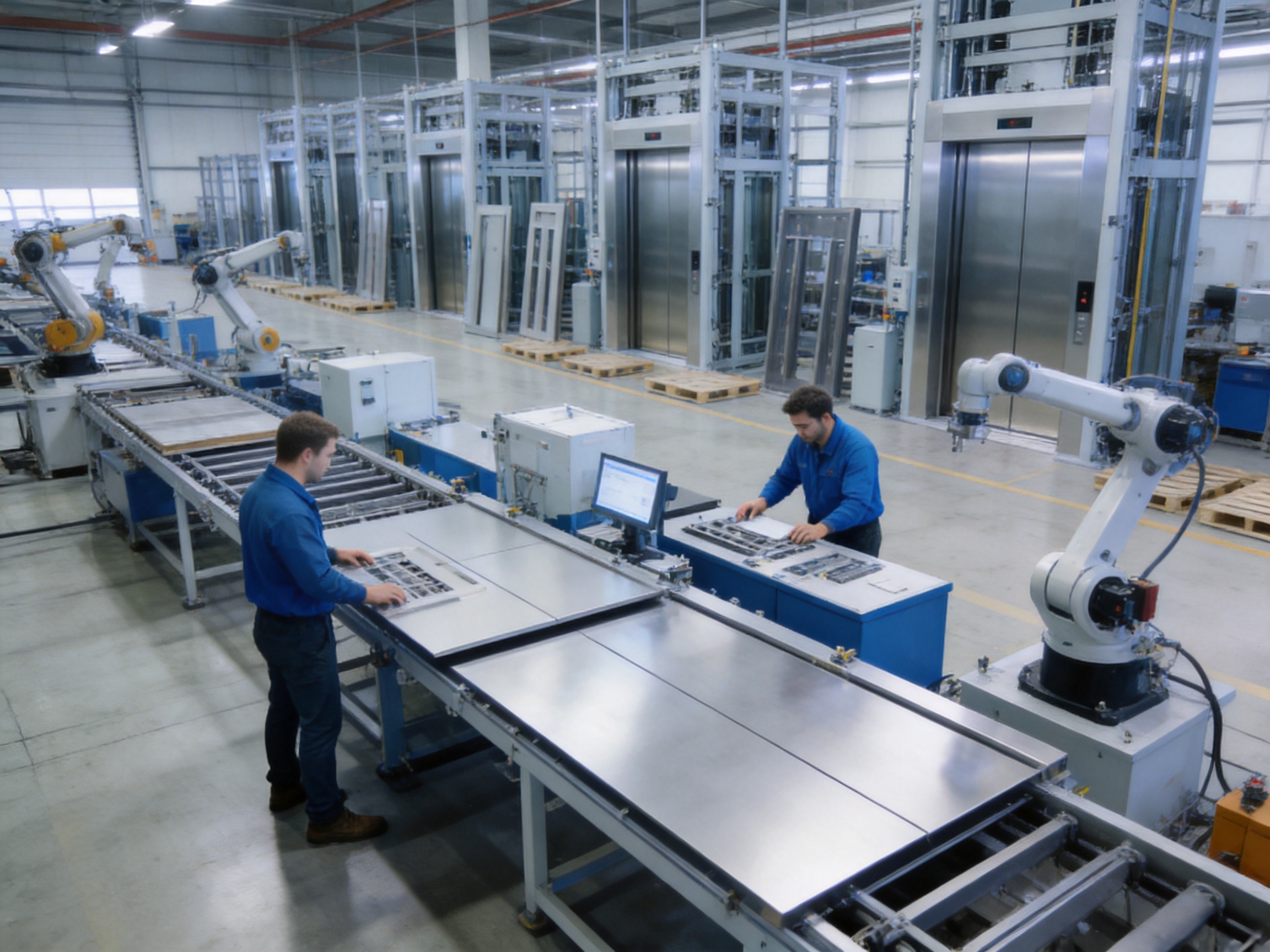
A major strength is the intelligent production base guided by modern industrial park design. The production system integrates design aesthetics, efficient operation, and green environmental planning. Advanced automatic production equipment, combined with big data and Internet of Things concepts, supports intelligent processing, intelligent production, intelligent detection, and intelligent monitoring of industrial procedures.
This matters because elevator manufacturing requires precision. Door panels, car frames, control systems, hoistway components, and mechanical assemblies must match design tolerances. Poor manufacturing accuracy can cause vibration, noise, misalignment, premature wear, or installation difficulties. Intelligent processing and detection help reduce these risks.
The company emphasizes strict quality control and a rigorous detection system covering the whole production process. This approach reflects an industrial philosophy focused on high standards, high precision, and zero defect targets. In freight elevator applications, such quality discipline is especially important because the equipment must carry heavy cargo safely over many years.
9. Intelligent Production and Process Control
Modern elevator customers are not only buying a finished product; they are buying the reliability of the production system behind it. Intelligent manufacturing improves consistency by reducing dependence on manual variation and by allowing better monitoring of key production steps.
Automatic panel production equipment can improve dimensional accuracy and surface consistency. For elevator cars and doors, panels must be strong, straight, and well-finished. Accurate panel processing contributes to better assembly quality, better appearance, and reduced installation adjustment.
Intelligent processing supports repeatable manufacturing of structural and mechanical components. In freight elevators, parts such as car frames, brackets, door structures, and load-bearing elements must be manufactured with dependable accuracy. When production data is monitored, manufacturers can identify deviations early and correct them before they affect final product quality.
Intelligent detection provides another layer of assurance. Detection systems can help verify dimensions, assembly quality, surface condition, and process results. For buyers, this means the elevator is less likely to suffer from avoidable manufacturing defects. For installers, it means parts can fit more smoothly on site, reducing installation time and adjustment work.
Intelligent monitoring of industrial procedures supports traceability and management. If a quality issue appears, process records can help identify the cause and prevent recurrence. Traceability is a mark of mature manufacturing. It gives customers greater confidence that the supplier has control over production rather than relying on final inspection alone.
10. Quality Philosophy and International Service Capability
The company’s quality philosophy is built around high standards, high precision, and a zero-defect objective. These principles are supported by honesty, practicality, perseverance, teamwork, and a commitment to solving customer problems. In the elevator industry, these values are not abstract; they directly affect project success.
Elevator projects often involve architects, consultants, contractors, owners, installers, and maintenance teams. Each project has unique shaft dimensions, load requirements, floor arrangements, door configurations, power conditions, traffic patterns, and local regulations. A supplier must respond with professional technical communication and practical engineering support.
The company serves customers in nearly 60 countries and can provide multilingual service, including Russian, Spanish, English, and Arabic. This international capability is important for export projects because misunderstandings in technical specifications can lead to costly delays. Professional communication helps customers choose suitable products, confirm dimensions, understand installation requirements, and plan maintenance.
The company’s service approach includes timely replies to inquiries, professional and reasonable pricing, careful communication for new product needs, and fast order completion with attention to quality. For freight elevator buyers, this kind of support can be as valuable as product features. A strong supplier helps reduce risk before, during, and after installation.
After-sales service is also emphasized. Like all transport equipment, elevators require regular maintenance to ensure safety and performance. The company provides global unified service standards and maintenance processes, with comprehensive inspection standards. Customer data files can be managed one to one, allowing exclusive maintenance plans to be formulated for different projects.
Intelligent remote monitoring through an elevator operation monitoring system can help keep safety information under control. A 24-hour service team can respond to customer demands quickly. This full-time support is particularly important for freight elevators in production or logistics facilities, where downtime may interrupt business operations.
11. Application Scenarios
The machine room less freight elevator can be used in a wide range of buildings where goods need to move between floors safely and efficiently. Its compact structure, strong load capacity, and cargo-focused design make it suitable for both new construction and certain modernization projects.
11.1 Warehouses and Distribution Centers
In warehouses, vertical cargo movement may involve cartons, pallets, tools, packaging materials, and bulk goods. A reliable freight elevator can connect storage levels, loading areas, and sorting zones. Precise leveling and wide doors help workers move goods with trolleys or pallet equipment more efficiently.
11.2 Factories and Industrial Facilities
Factories often require movement of raw materials, semi-finished products, molds, tools, and finished goods. These items may be heavy, irregular in shape, or sensitive to vibration. The reinforced structure, gearless hoister, and VVVF control help support stable and safe transport in industrial environments.
11.3 Commercial Buildings and Shopping Centers
Retail and commercial buildings need to move stock, display equipment, cleaning machines, waste containers, furniture, and maintenance materials. A freight elevator helps separate cargo flow from passenger traffic, improving building management and customer experience. Machine room less design can also help preserve rentable or usable space.
11.4 Hotels, Hospitals, and Public Buildings
Hotels and hospitals often require back-of-house vertical transportation for laundry, food service, medical supplies, maintenance equipment, and waste handling. Smooth movement and reliable safety features are important in these environments. Access control options can help prevent unauthorized use.
11.5 Renovation and Space-Limited Projects
Buildings undergoing renovation may have limited space for elevator equipment. A machine room less freight elevator can reduce the need for extensive structural changes. This makes it attractive for owners who want to upgrade cargo movement without sacrificing too much building area.
12. User Experience: Ease, Stability, and Practical Operation
Although freight elevators are mainly designed for goods, user experience still matters. Workers interact with the elevator many times each day. If the elevator is slow, inaccurate, noisy, difficult to load, or frequently out of service, productivity suffers. A well-designed freight elevator creates an experience of ease through stable movement, accurate stops, reliable doors, and intuitive controls.
Micro-touch buttons in the car make operation convenient. Floor and direction indicators in the car and at halls help users understand elevator status. Car arrival indication improves workflow by letting workers know when the elevator is ready. Voice announcement options can improve accessibility and situational awareness.
Automatic adjustment of door open holding time supports real loading conditions. Cargo loading may take longer than passenger boarding. If doors close too quickly, workers may need to repeatedly reopen them, wasting time and increasing wear. Door close delay and door opening extension options help adapt the elevator to practical cargo operations.
Repeated door closing and express door closing functions can improve traffic efficiency where appropriate. Reopen with hall call increases convenience when another user requests access. Emergency lighting and ventilation control contribute to safety and energy management.
The elevator’s smooth ride and low vibration also protect the working environment. In factories and warehouses, noise and vibration can contribute to fatigue. A gearless hoister with low-vibration performance helps create a more comfortable and professional facility.
13. Lifecycle Value for Building Owners
The purchase price of a freight elevator is only one part of its total value. Building owners should consider construction cost, space utilization, energy use, maintenance demand, downtime risk, durability, safety, and future adaptability. A machine room less freight elevator can deliver strong lifecycle value because it addresses several of these factors at the same time.
First, it can reduce construction requirements by eliminating the need for a traditional machine room. This may lower civil costs and preserve usable area. Second, gearless and VVVF technologies can reduce energy consumption and improve motion performance. Third, reinforced construction and rust resistance can support long service life. Fourth, intelligent control and self-diagnosis can simplify maintenance and reduce troubleshooting time.
Fifth, the supplier’s manufacturing and service capabilities reduce project risk. An elevator from a manufacturer with advanced production equipment, strict quality control, international communication ability, and structured after-sales service is more likely to perform reliably throughout its lifecycle.
Sixth, the elevator’s functional flexibility allows adaptation to different operating conditions. Options such as duplex control, double-door control, IC card control, traffic dispatch, and remote monitoring can support changing building needs. This adaptability protects the owner’s investment as operational requirements evolve.
14. Why This Product Stands Out in a Competitive Market
In a competitive elevator market, many suppliers claim to offer safe and efficient cargo transportation. However, the difference often lies in the details: drive technology, structural strength, manufacturing quality, control intelligence, service capability, and project support. This machine room less freight elevator stands out because it combines these elements into a practical cargo-focused system.
Compared with competitors using traditional machine-room layouts, it offers space-saving advantages and easier building integration. Compared with older geared drive systems, its gearless synchronous hoister reduces vibration and energy loss. Compared with basic cargo lifts, it provides a more comprehensive elevator system with safety protections, intelligent control, precise leveling, and professional manufacturing support.
Its load sustainability, with rated load capacity configurable up to 3000 kg, gives it a strong position for demanding applications. Its wide door design and reinforced car structure show that it is designed for real cargo handling rather than adapted from passenger equipment. Its VVVF control and specific leveling technology improve daily usability and protect goods.
The manufacturer’s advanced production base further strengthens the product’s competitiveness. Intelligent processing, intelligent detection, automatic equipment, big data concepts, Internet of Things integration, and strict whole-process quality inspection create a foundation for consistent product quality. Buyers are not only choosing an elevator model; they are choosing a production system and service team capable of supporting complex international projects.
15. Practical Selection Considerations
When selecting a freight elevator, buyers should evaluate more than rated load alone. The correct choice depends on cargo type, loading method, building structure, travel height, door arrangement, traffic frequency, safety requirements, and maintenance capability.
Rated load should be chosen according to the heaviest expected cargo, including transport tools such as carts or pallet jacks. Car dimensions should allow goods to enter, turn if necessary, and exit safely. Door width and height should match the largest regular cargo items. Floor leveling accuracy should be verified for heavy-load operation.
For facilities with frequent use, energy efficiency and durability become especially important. A gearless synchronous hoister and VVVF drive are valuable in such conditions. For buildings where access must be controlled, IC card control or attendant running may be useful. For high-traffic cargo movement, duplex control or traffic dispatch options may improve performance.
Maintenance planning should begin before installation. Building owners should confirm service availability, inspection standards, spare parts support, and emergency response procedures. A supplier that provides unified maintenance processes, customer data files, remote monitoring, and 24-hour support can help protect long-term operation.
Finally, buyers should consider the manufacturer’s ability to customize solutions. Different markets, applications, and customers have different requirements. A professional manufacturer that listens carefully, responds in time, and provides practical suggestions can help ensure that the final elevator solution matches the real project rather than forcing the project to fit a standard product.
16. Q&A Section
Q1: What is a machine room less freight elevator?
A machine room less freight elevator is a cargo elevator that does not require a traditional separate machine room. Key equipment is arranged in a compact layout, allowing the elevator to save building space while providing vertical transportation for goods.
Q2: Why is the machine room less design beneficial?
The design can reduce construction area, simplify building planning, and lower civil construction costs. It is especially useful for modern buildings, space-limited projects, and renovation applications where a separate machine room may be difficult or expensive to build.
Q3: What cargo load can this elevator support?
The product information indicates that rated load capacity can be increased from 1600 kg to 3000 kg depending on configuration. This allows the elevator to handle a wide range of cargo transportation needs in warehouses, factories, commercial buildings, and service facilities.
Q4: How does the gearless synchronous hoister improve performance?
The gearless synchronous hoister reduces mechanical loss, vibration, and energy waste compared with many older geared systems. It supports smoother movement, improved durability, lower noise, and better operating efficiency.
Q5: Why is VVVF control important for freight elevators?
VVVF control adjusts motor speed smoothly during starting, running, and stopping. This improves ride stability, reduces cargo movement inside the car, supports accurate stopping, and can reduce energy consumption.
Q6: How does the elevator improve loading and unloading efficiency?
The elevator uses precise leveling technology, strong car structure, and wide door openings. Accurate leveling allows carts and goods to move between the landing floor and elevator car more easily, while wide doors support large cargo access.
Q7: What safety features are included?
Safety features include safety clamps, speed limiters, light curtain protection, overload protection, terminal forced slow-down protection, overrun and final limit protection, overspeed protection, door interlock protection, safety circuit protection, brake detection, emergency lighting, inspection operation, and other protective functions.
Q8: Is the elevator suitable for high-frequency industrial use?
Yes, the reinforced structure, gearless drive, VVVF control, strong load capacity, and intelligent safety functions make it suitable for demanding cargo environments. Final suitability should be confirmed according to project traffic frequency, load profile, and installation conditions.
Q9: How does the manufacturer support product quality?
The manufacturer uses professional production lines, automatic panel production equipment, intelligent processing, intelligent detection, intelligent monitoring, and strict whole-process quality control. These capabilities help improve consistency, accuracy, and reliability.
Q10: What after-sales service advantages are available?
The company provides global unified service standards, maintenance processes, comprehensive inspection standards, one-to-one customer data files, exclusive maintenance planning, remote monitoring options, and 24-hour service response. These services help maintain safety and performance throughout the product lifecycle.
17. Conclusion
A machine room less freight elevator is an advanced answer to the growing need for efficient vertical cargo transportation. By removing the need for a traditional machine room, it saves building space and supports more flexible architectural planning. By using a gearless synchronous hoister and VVVF control, it delivers smooth, efficient, and durable operation. By applying reinforced structure, precise leveling technology, wide door design, and multiple safety functions, it meets the practical requirements of cargo handling in modern buildings.
The product’s advantages are not limited to mechanical design. Its value is strengthened by the manufacturer’s advanced production processes, intelligent manufacturing base, automatic equipment, strict quality philosophy, international service experience, and full-time customer support. These capabilities ensure that the elevator is not only designed well but also manufactured, delivered, and supported with professional discipline.
For warehouses, factories, commercial buildings, hotels, hospitals, public facilities, and renovation projects, this elevator provides a strong combination of space efficiency, safety, load capacity, energy performance, and lifecycle value. In a market where many freight elevators appear similar at first glance, this solution stands out through its compact structure, cargo-specific engineering, intelligent control, and reliable manufacturing foundation.
As buildings become more efficient, logistics become faster, and sustainability becomes more important, freight elevators must evolve. A machine room less freight elevator with gearless technology, intelligent functions, and rigorous manufacturing quality is not only a transportation device; it is a strategic part of modern building operations.
References
1. Elevator Manufacturing and Installation Safety Standards, general principles for traction elevators and freight elevator safety systems.
2. Technical literature on gearless synchronous traction machines and their application in modern elevator systems.
3. Engineering studies on VVVF elevator drive control, energy efficiency, and ride performance.
4. Building transportation planning references for freight elevators in commercial, industrial, and logistics facilities.
5. Maintenance management guidelines for elevator lifecycle safety, inspection, and preventive service.

Related Products
Related News
Built on safety, forging trust in vertical mobility.
lf you have any questions or need help, feel free to contact with our team.
 export@tenau.com.cn
 +86-18601458867
 +86-512-65059883
Elevator & Escalator
Factory Add
East of Xicheng Road, North of Lianyi Road, Nanxun Economic Development Zone, Nanxun District, Huzhou City, Zhejiang Province, P.R.China
Copyright © Tenau Elevator (China) Co., Ltd. All Rightd Reserved.
Custom High Quality Elevator Suppliers and World Brand Elevator Company