

 en
en Español
 русский
 中文简体
中文简体
Panoramic Elevator Solutions for Scenic, Safe, and Efficient Vertical Mobility
Content
- 1 1. Product Positioning: More Than a Vertical Transport Device
- 2 2. Core Aesthetic Advantage: Elegant Structure and Limitless Scenic Views
- 3 3. Safety as the First Principle
- 4 4. Travel Performance and Passenger Comfort
- 5 5. Safety Function Structure
- 6 6. Main Product Advantages at a Glance
- 7 7. Competitive Advantages Over Ordinary Elevator Solutions
- 8 8. Advanced Manufacturing Capability and Industrial Strength
- 9 9. Quality Control: From Components to Complete Elevator Systems
- 10 10. Intelligent Monitoring and Lifecycle Service
- 11 11. Function Details That Improve Real-World Usability
- 12 12. Application Scenarios
- 13 13. Why Machine Room Design Still Matters
- 14 14. Design Customization and Architectural Integration
- 15 15. Reliability Through Experience and International Service
- 16 16. The Passenger Experience: Safety, Scenery, and Confidence
- 17 17. Sustainability and Efficient Operation
- 18 18. Procurement Considerations for Building Owners and Contractors
- 19 19. Q&A Section
- 19.1 Q1: What makes a panoramic elevator different from a conventional elevator?
- 19.2 Q2: Where is this type of elevator most suitable?
- 19.3 Q3: What are the main safety features?
- 19.4 Q4: How does VVVF technology improve the elevator?
- 19.5 Q5: Why should a buyer consider a machine room panoramic elevator?
- 19.6 Q6: How does remote monitoring help building managers?
- 19.7 Q7: Can the elevator design be customized?
- 19.8 Q8: What advantages does the manufacturer provide?
- 19.9 Q9: How does the elevator improve traffic efficiency?
- 19.10 Q10: Is the panoramic elevator only about appearance?
- 20 20. Conclusion
- 21 References
- 22 Product: Panoramic elevator
Panoramic elevators have become an important architectural feature in hotels, shopping centers, commercial complexes, office buildings, cultural venues, transport hubs, and high-end residential developments. Unlike conventional elevators that are designed mainly as enclosed transportation equipment, a panoramic elevator combines vertical mobility with visual experience. It gives passengers an open scenic perspective, allows light to enter the car, and becomes part of the building’s design language. For projects that require both transportation performance and a refined appearance, a machine room panoramic elevator offers a balanced solution: reliable traction technology, stable operation, strong safety control, and a transparent or semi-transparent car structure that enhances the passenger journey.
The panoramic elevator described here is designed around the idea of an elegant structure with broad scenic views. It is intended to serve buildings where aesthetic value matters as much as operating efficiency. In hotels, it can strengthen the guest experience from the first arrival. In supermarkets and shopping malls, it can increase openness and help customers understand the building layout. In business centers, it can become a visual landmark. In exhibition halls and public buildings, it can support smooth passenger flow while contributing to a modern atmosphere. The product is especially suitable for owners, developers, consultants, architects, and contractors who want a safe elevator system that also adds visible value to the building.
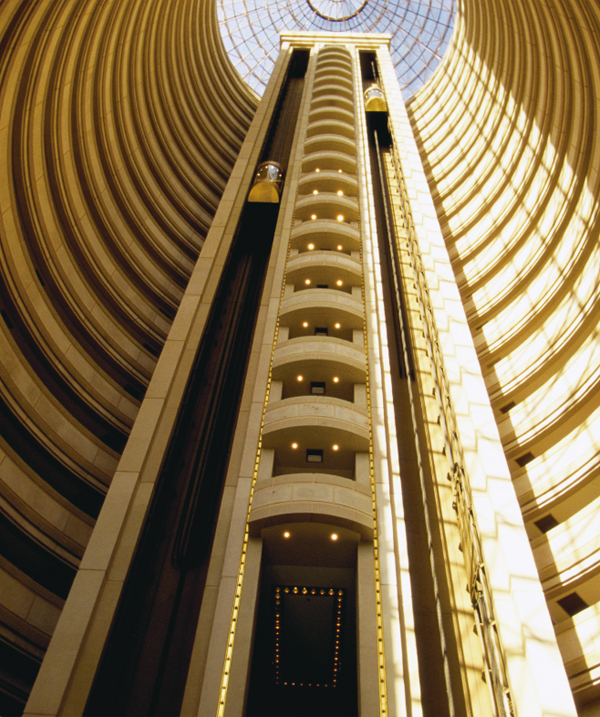
1. Product Positioning: More Than a Vertical Transport Device
A panoramic elevator is often selected because it solves two problems at once. First, it provides dependable vertical transportation. Second, it improves the overall image of the building. A traditional elevator may be hidden in a shaft, but a sightseeing elevator is usually visible from inside or outside the structure. This visibility means that every detail matters: the cabin frame, glass panels, door system, lighting, guide rail arrangement, control system, ride comfort, and safety components must all work together.
The machine room panoramic elevator is positioned as a high-quality solution for medium and large building projects that require long-term stability. A machine room arrangement gives engineers convenient access to major traction and control components, which can simplify inspection, maintenance, and modernization during the life cycle of the equipment. For buildings with enough overhead space or dedicated machine-room planning, this structure can be a strong choice because it supports powerful traction performance, efficient heat dissipation, and organized component layout.
The scenic purpose of the elevator does not reduce its engineering requirements. In fact, it increases them. A transparent or partially transparent cabin can expose vibration, noise, and structural imperfections more easily than an enclosed car. Therefore, the product must achieve a high level of ride smoothness, stable leveling, reliable door movement, and refined finishing. Passengers should feel both visually impressed and physically secure. The best panoramic elevators do not simply show scenery; they also make the movement itself feel calm, controlled, and premium.
2. Core Aesthetic Advantage: Elegant Structure and Limitless Scenic Views
The main visual advantage of a panoramic elevator is the ability to create an open field of view. Depending on the building style, the elevator can be designed with different glass forms, cabin decorations, lighting schemes, and structural outlines. This flexibility allows the elevator to match modern commercial spaces, luxury hotels, urban shopping areas, public atriums, and scenic exterior facades. The product follows a design principle of innovation and fashion, aiming to provide passengers with broad scenic perspectives while maintaining a delicate and refined appearance.
Compared with many ordinary elevator products, a panoramic elevator can actively increase the perceived value of a building. A hotel lobby with a scenic elevator can feel more open and prestigious. A supermarket or retail center can make floor connections more visible, guiding customers naturally between levels. A commercial atrium can use the elevator as a moving visual feature, creating motion within the space. For architectural projects, this is an important difference: the elevator is not only equipment; it is also part of the interior and exterior design.
The product’s design adaptability is also a competitive advantage. Different buildings require different expressions. Some projects need a clean and minimalist glass cabin. Others require stainless steel accents, luxury ceiling designs, warm lighting, or special wall finishes. Some need exterior sightseeing elevators with weather-conscious structures, while others need indoor solutions installed in atriums. The ability to provide different designs according to the building style helps reduce conflict between engineering requirements and architectural creativity.
3. Safety as the First Principle
In elevator selection, safety is never optional. It is the foundation of the entire product. The panoramic elevator emphasizes passenger safety through multiple protection layers, including prevention of unintended car movement, remote monitoring, door anti-derail protection, infrared light curtain systems, overload control, overspeed protection, inspection operation, fault self-diagnosis, and final limit protection. These functions are designed to address risks that may occur during starting, running, stopping, loading, door operation, and maintenance.
One of the important safety features is the UCMP device, which helps prevent unintended car movement. When an elevator stops at a landing and the doors are open, any uncommanded movement can create serious danger. The UCMP protection system is designed to detect abnormal movement and activate protection measures to arrest the car. This is especially important for public buildings where passengers may enter or leave frequently and where the elevator must maintain accurate positioning at the landing.
Door safety is another major focus. Panoramic elevators often operate in high-traffic environments such as malls, hotels, and office buildings. The infrared light curtain system detects people or objects in the entrance area and reacts quickly to obstacles, helping prevent door impact. In addition, the device for prevention of collision and derailment of the car door helps keep the door on its normal track if it is hit. This is valuable because door systems are among the most frequently used elevator components and are often exposed to passenger interference, luggage impact, carts, and other daily stresses.
Remote monitoring through Internet of Things technology provides another layer of safety and management. By collecting operational data, monitoring elevator status, and supporting timely troubleshooting, the system helps building managers understand equipment condition more clearly. This can reduce unexpected downtime, improve maintenance planning, and support safer operation over the elevator’s full service life.
4. Travel Performance and Passenger Comfort
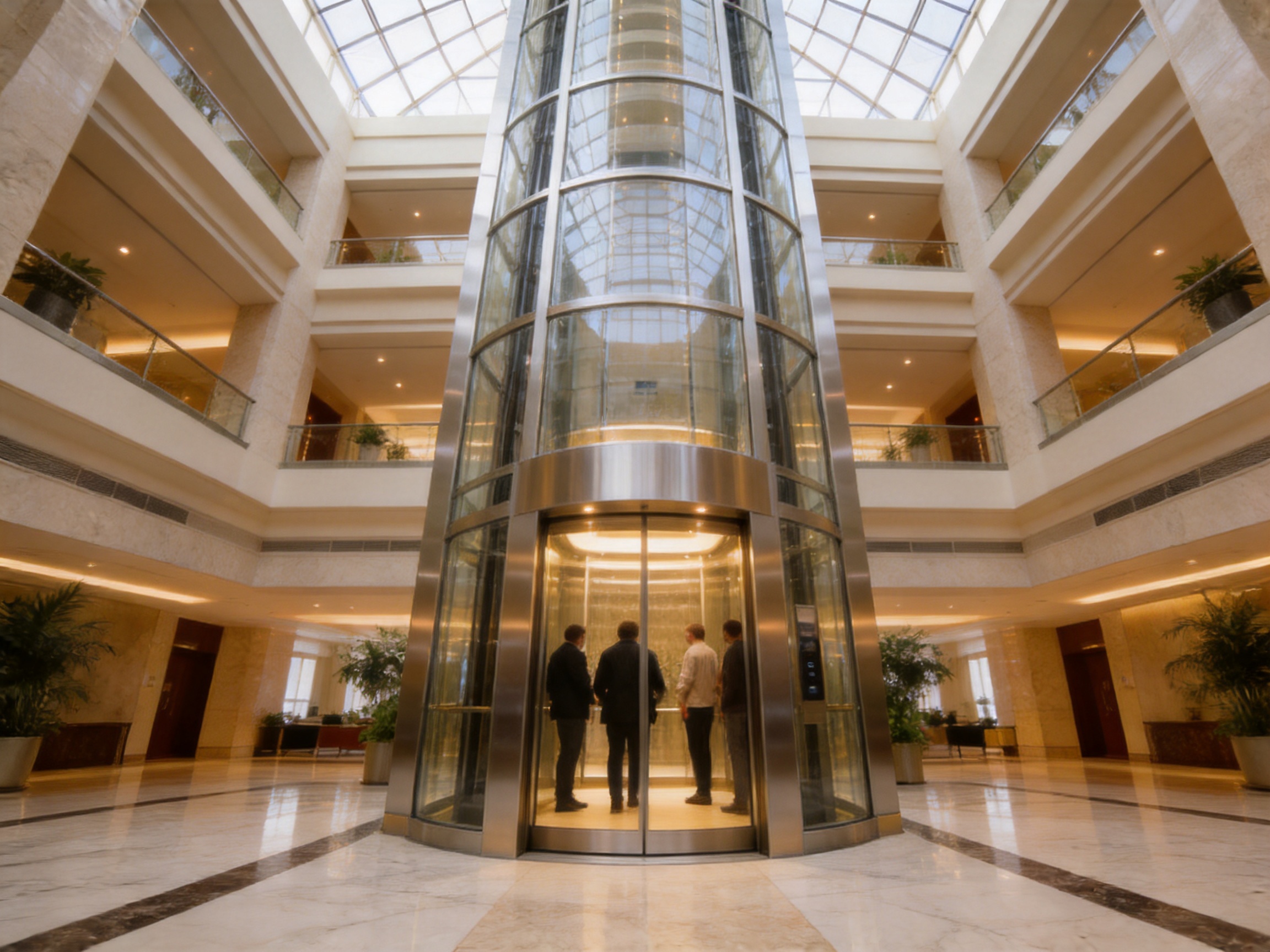
Passenger comfort depends on many engineering details. Smooth acceleration, stable running, accurate leveling, quiet door movement, and predictable stopping all influence the user experience. The panoramic elevator uses VVVF drive technology to adjust motor speed precisely. This creates a smoother speed curve during starting, traveling, and stopping. Instead of sudden movement or uncomfortable vibration, passengers experience more controlled acceleration and deceleration.
The VVVF door operator also improves comfort. Door movement is one of the most noticeable parts of the ride. A refined door machine should open and close gently, sensitively, and reliably. Abrupt door motion may make passengers feel unsafe even if the elevator is technically secure. Precise door speed control improves the impression of quality and also reduces mechanical stress on the door system.
The product includes a range of intelligent travel functions that improve efficiency. Automatic pass without stop allows the car to bypass hall calls when the cabin is crowded or the load is close to the preset value. This helps maintain travel efficiency and prevents overloading. Automatic door opening time adjustment adapts door-open duration according to the difference between landing calls and car calls. Express door closing allows passengers to close the door promptly when appropriate. Car arrival gong provides an audible notice when the car reaches a floor.
For buildings with multiple elevators, group control and duplex control functions can improve dispatching. When three or more same-model elevators are used as a group, the system can choose the most appropriate car to respond, reducing repeated stops and passenger waiting time. Duplex control allows two elevators to respond cooperatively through computer dispatch. These features are particularly useful in hotels, office buildings, and commercial facilities where traffic patterns change throughout the day.
Peak service modes further improve operation. During morning or on-duty peak periods, elevators can be dispatched continuously to the home landing to handle upward traffic. During off-duty peak periods, elevators can be dispatched to upper floors to handle downward traffic. These functions help the building maintain smoother flow during busy periods and reduce passenger frustration.
5. Safety Function Structure
The safety design of the panoramic elevator is built around prevention, detection, response, and recovery. Prevention means avoiding dangerous conditions through good design and control logic. Detection means identifying abnormal conditions such as overload, overspeed, door obstruction, or failure to leave the door zone. Response means stopping, braking, reopening doors, or moving to a designated floor when needed. Recovery means diagnosing faults, recording information, and supporting fast maintenance.
Light curtain protection covers the door height with infrared detection to help protect passengers and objects during door opening and closing. Overload holding stop prevents the elevator from operating when the car is overloaded, using buzzer notification and remaining at the same floor. Anti-stall timer protection helps stop operation if abnormal traction conditions occur. Start protection control stops operation if the elevator does not leave the door zone within the designated time after starting.
Inspection operation allows the car to move at inching speed during maintenance or inspection. This is essential for safe technical work. Fault self-diagnosis helps the controller record recent faults so technicians can identify and remove problems more efficiently. Repeated door closing logic reopens or attempts re-closing when obstruction or interference prevents normal closing, helping maintain safety while supporting practical operation.
Up and down over-travel and final limit protection help prevent the elevator from moving beyond safe travel range. Downward overspeed protection and upward overspeed protection are designed to reduce the risk of uncontrolled movement. These functions work with mechanical and electrical protection systems to help stop or slow the elevator when abnormal speed is detected. Accidental movement prevention helps protect passengers when the car is in an open-door state.
6. Main Product Advantages at a Glance
| Advantage Area | Product Feature | Customer Value |
|---|---|---|
| Visual Experience | Panoramic cabin design with broad scenic views | Improves architectural image and passenger experience |
| Safety | UCMP protection, light curtain, door anti-derail device, overspeed protection | Reduces operational risk and supports safer public use |
| Comfort | VVVF drive and VVVF door operator | Provides smooth running, gentle door movement, and quiet ride quality |
| Efficiency | Group control, duplex control, peak service, automatic pass without stop | Reduces waiting time and improves passenger flow |
| Maintenance | Fault self-diagnosis and remote monitoring | Supports faster troubleshooting and planned service |
| Customization | Multiple designs according to building styles | Matches hotels, supermarkets, malls, offices, and public buildings |
| Manufacturing Strength | Advanced production lines, automatic panel processing, intelligent monitoring | Enhances consistency, precision, and product reliability |
7. Competitive Advantages Over Ordinary Elevator Solutions
Compared with a standard enclosed elevator, the panoramic elevator offers a stronger architectural contribution. It can transform a simple transportation route into a memorable visual journey. In commercial projects, this difference can influence how visitors perceive the building. A transparent elevator moving through an atrium can create a sense of openness and activity, while a conventional hidden elevator may be overlooked. For developers and property owners, the panoramic elevator can support building differentiation and brand positioning.
Compared with low-cost sightseeing elevator alternatives, this product emphasizes a more complete balance of appearance, safety, ride comfort, dispatching intelligence, and manufacturing quality. Some competitors may focus mainly on glass appearance while using basic control features. However, an elevator that is beautiful but uncomfortable, noisy, or frequently out of service will quickly damage the user experience. The discussed product integrates aesthetic design with practical engineering functions such as VVVF control, UCMP protection, IoT monitoring, light curtain protection, and intelligent traffic management.
Compared with products that rely on limited standard designs, the panoramic elevator’s design flexibility is a major advantage. Building styles vary widely. A luxury hotel may require warm lighting and refined interior finishes. A supermarket may need durable materials and a practical cabin layout. A modern office tower may require clean lines and a transparent exterior effect. The ability to adjust the elevator design according to the project supports better architectural integration and reduces the need for compromise.
Compared with manufacturers that lack advanced production capacity, Tenau Elevator (China) Co., Ltd. benefits from specialized elevator and escalator production lines, automatic panel production equipment, and an intelligent production base. Manufacturing strength matters because elevators are long-life equipment with many precision parts. Consistent panel quality, accurate assembly, reliable control wiring, and strict testing procedures all influence long-term operation. A visually impressive elevator must also be mechanically durable and electrically stable.
8. Advanced Manufacturing Capability and Industrial Strength
The company behind this product is located in Huzhou City, Zhejiang Province, in the Nanxun Economic Development Zone. The location is close to Shanghai, creating advantages for logistics, international business communication, and access to supply chains. The organization was established with a clear focus on overseas markets and has developed professional elevator and escalator production capacity. It employs experienced personnel and supports multiple languages, including English, Russian, Spanish, and Arabic, which is valuable for global cooperation.
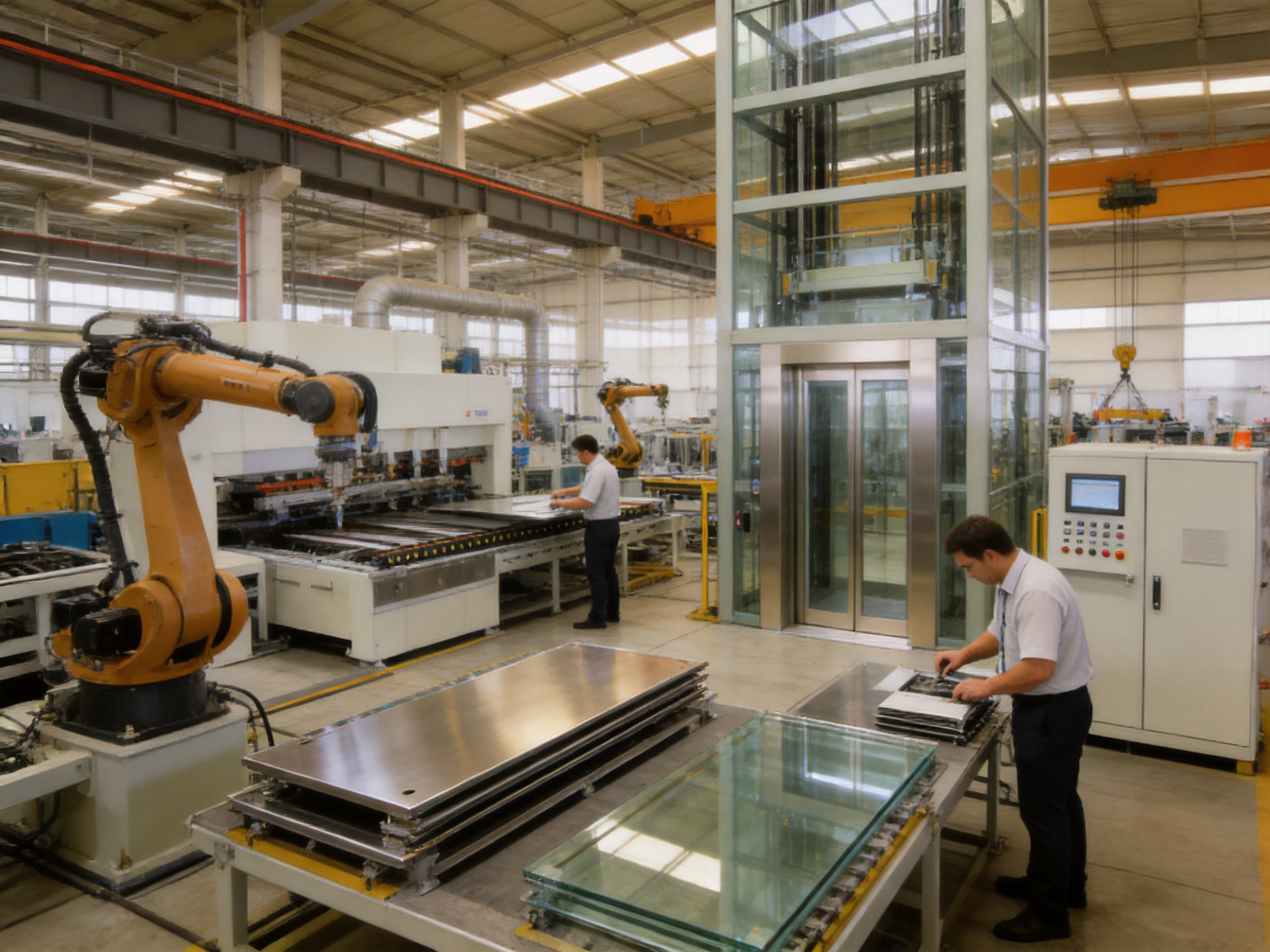
The manufacturing system is supported by professional elevator and escalator production lines as well as fully automatic panel production equipment. Panel production is especially important for panoramic elevators because visual quality is directly seen by passengers. Poor panel accuracy, uneven surfaces, weak finishing, or inconsistent assembly can reduce the premium feel. Automatic production equipment helps improve dimensional accuracy, surface consistency, and processing efficiency.
The company’s production philosophy emphasizes high standards, high precision, and zero defect. This approach is important in elevator manufacturing because safety and reliability depend on a long chain of controlled processes. Traction systems, control cabinets, door operators, car frames, guide systems, cabins, electrical wiring, and safety devices must all meet strict requirements. A weakness in one area can affect the whole elevator. Therefore, a complete quality-control mindset is essential.
The industrial base follows the concept of a modern intelligent production park, integrating design aesthetics, efficient operation, and green environment. This type of production environment is designed not only to improve manufacturing output but also to create stable process control. The Industry 4.0 production system incorporates intelligent processing, intelligent production, intelligent detection, and intelligent monitoring of industrial procedures. By combining automatic production equipment with data-based management and Internet of Things principles, the factory can improve traceability and consistency.
For international customers, these manufacturing strengths reduce project risk. Elevator procurement is not simply a matter of buying equipment; it involves engineering design, production scheduling, testing, shipment, installation coordination, maintenance planning, and after-sales support. A manufacturer with organized production and quality systems is better positioned to deliver consistent results across different markets and building types.
9. Quality Control: From Components to Complete Elevator Systems
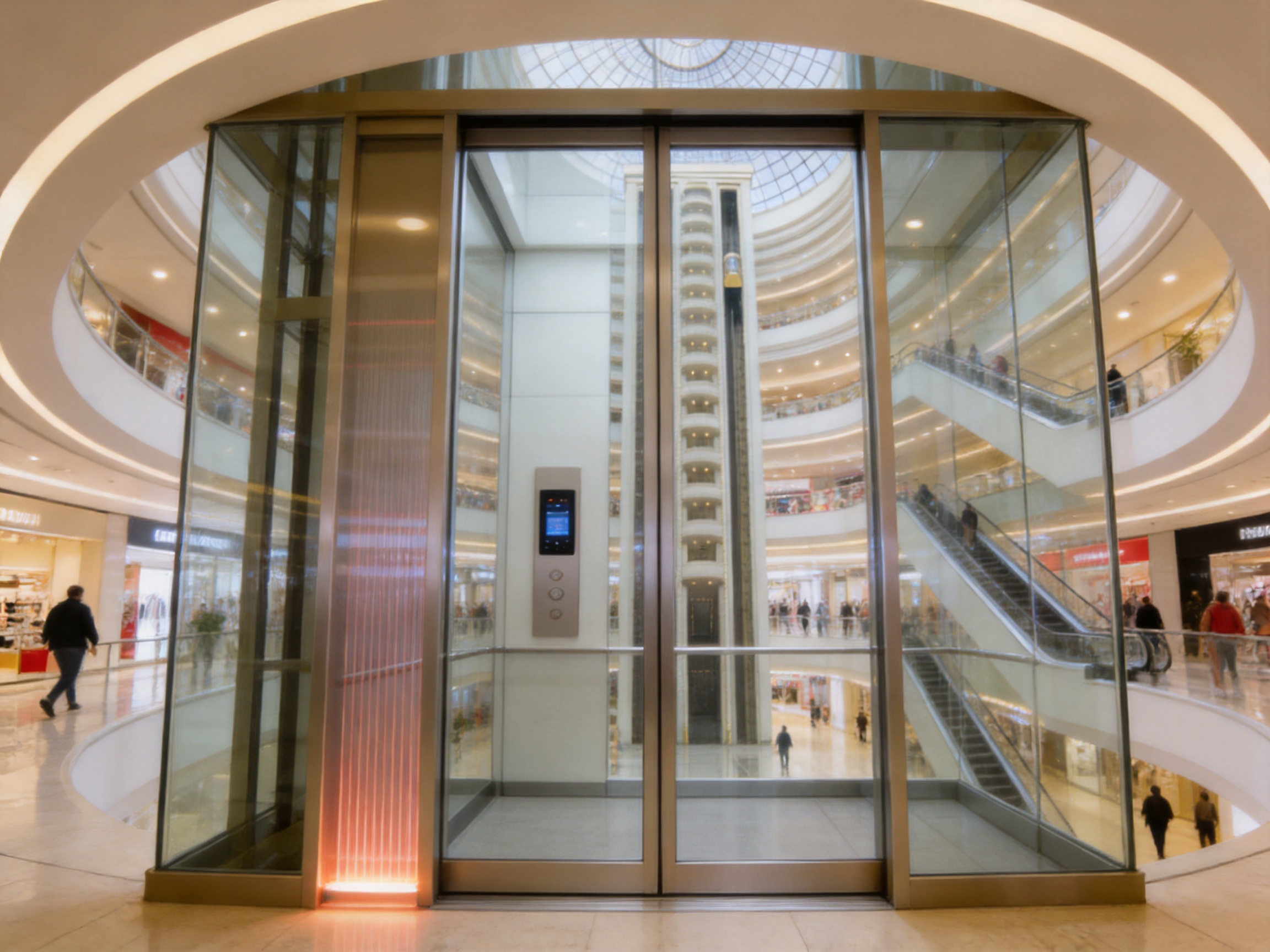
Quality control in panoramic elevator production must cover both visible and invisible aspects. Visible aspects include cabin decoration, glass installation, panel alignment, handrail details, lighting arrangement, ceiling quality, floor finish, door appearance, and overall fit. Invisible aspects include controller logic, motor performance, braking response, wiring safety, safety circuit reliability, guide rail installation accuracy, door lock function, and emergency protection systems. The product must satisfy both architectural expectations and technical standards.
The company observes a rigorous attitude associated with advanced industrial manufacturing and builds a detection system across the whole production process. This means quality is not checked only at the end; it is controlled during processing, assembly, inspection, and testing. In elevator manufacturing, early detection of deviation can prevent costly rework and reduce field problems. For example, accurate panel processing supports better cabin assembly; correct wiring inspection reduces control faults; reliable safety device testing improves passenger protection.
Automatic equipment and intelligent monitoring also support data-based quality management. When production procedures can be monitored, recorded, and evaluated, the manufacturer can identify patterns, improve processes, and reduce variation. This is valuable for overseas projects because equipment may be installed in different climates, voltage conditions, building designs, and usage patterns. Consistency in production provides a stronger foundation for reliable field performance.
A panoramic elevator must be structurally refined because its moving parts are visible. Glass, frame, lighting, and cabin decoration must maintain alignment during long-term use. Door systems must open and close smoothly thousands of times. Control systems must handle variable passenger loads. The overall product must maintain performance under daily commercial operation. Strong factory quality control is therefore one of the product’s most important hidden advantages.
10. Intelligent Monitoring and Lifecycle Service
Elevator value does not end at delivery. For building owners, the real value is measured over years of operation. An elevator that is easy to monitor, maintain, and service can reduce operating pressure. The remote monitoring system based on Internet of Things technology can support automatic monitoring, inspection, and management of elevators within a building. Regular data collection and timely troubleshooting help maintain safe and efficient operation.
Remote monitoring is particularly useful for properties with multiple elevators or high passenger traffic. Facility managers can better understand elevator status, identify abnormal conditions, and plan maintenance before problems become serious. This supports preventive maintenance rather than only reactive repair. For hotels and shopping centers, this is important because elevator downtime can affect guest satisfaction, customer movement, and business image.
The service concept includes global unified service standards and maintenance processes, more comprehensive inspection standards, one-to-one client data files, exclusive maintenance plans, intelligent monitoring, and a full-time service team. This approach recognizes that different buildings have different operating conditions. A hotel elevator may experience different traffic from a supermarket elevator. A public building may need special attention to peak usage. A tailored maintenance plan can improve the reliability of each project.
The company emphasizes all-day customer service throughout the product life cycle. This is valuable for international customers who need timely responses to technical questions, spare parts coordination, installation guidance, and maintenance support. A strong service network also helps protect the investment made by building owners. Elevators are long-term assets, and professional service helps maintain safety, comfort, and visual quality.
11. Function Details That Improve Real-World Usability
Many elevator functions may seem small individually, but together they create a better daily experience. Independent running allows the elevator to ignore hall calls and respond only to commands inside the car through a switch. This can be useful for VIP movement, service operation, or special building management needs. Command register cancel allows passengers to cancel an incorrectly selected floor by pressing the same button twice, reducing unnecessary stops.
Automatic pass without stop improves efficiency when the car is full or nearly full. Instead of stopping at a landing where additional passengers cannot enter, the elevator continues its route. This reduces wasted time for current passengers and helps the dispatch system manage traffic more logically. Automatic door opening time adjustment helps optimize operation by changing door-open duration according to call type, making the elevator more responsive to different situations.
Express door closing is useful when passengers have entered and do not need extended door time. Door open time extending is useful for special cases, such as passengers with luggage, wheelchairs, strollers, or service carts. Reopen with hall call allows the door to restart opening during the closing process when a hall call is activated, improving convenience and reducing passenger anxiety.
Open door in advance and direct parking are optional efficiency features that can reduce waiting and travel time. When the lift decelerates into the door open zone, opening the door in advance can improve flow, while direct parking without crawling enhances travel efficiency and creates a more modern ride feel. These functions demonstrate that passenger experience is not only about the cabin appearance; it also depends on intelligent control logic.
12. Application Scenarios
In hotels, the panoramic elevator can become a signature feature of the lobby or atrium. Guests often judge a hotel by its first impression, and an elegant scenic elevator can communicate quality, openness, and modernity. Smooth operation and quiet travel are especially important in hospitality environments because guests may use the elevator many times during their stay. Safety features such as light curtains, overload protection, and UCMP protection help support reliable public use.
In supermarkets and shopping centers, the elevator helps connect multiple floors while improving visibility. Customers can see different retail areas as they move, encouraging circulation. The elevator can also help families, elderly passengers, and customers with carts move comfortably. Door durability and anti-derail protection are important in these locations because daily use can be intense and unpredictable.
In office buildings, the panoramic elevator adds prestige and can improve internal traffic flow. Group control and peak service functions are useful during morning arrival and evening departure periods. In commercial towers, reliable dispatching can reduce waiting time and improve tenant satisfaction. The scenic view can also make common areas feel more open and dynamic.
In public buildings, exhibition centers, and cultural venues, a panoramic elevator can support accessibility while complementing architectural design. Visitors can enjoy visual connection with the building space, and facility managers can rely on safety and monitoring functions. In transportation-related buildings, clear visibility and efficient movement can help passengers navigate complex spaces.
13. Why Machine Room Design Still Matters
Machine room less elevators are popular in many modern buildings because they save space. However, machine room elevators still have important advantages in certain applications. A machine room provides a dedicated area for major equipment, which can improve accessibility for inspection and maintenance. It can also allow more flexible arrangement of traction machines, control cabinets, and related components. For panoramic elevators installed in buildings where long-term service access and stable heat management are priorities, a machine room design can be very practical.
In a panoramic elevator, visible quality and ride stability are closely connected. A machine room arrangement can support robust traction design and easier service procedures. Maintenance technicians can inspect major components in a dedicated environment rather than working only in restricted shaft spaces. This may reduce maintenance complexity and support safer technical operations. For building owners who plan for decades of use, maintainability is an important factor.
The choice between machine room and machine room less design should be based on building conditions, passenger demand, maintenance strategy, and architectural goals. For projects where space is available and long-term service convenience is valued, the machine room panoramic elevator remains a strong and reliable solution.
14. Design Customization and Architectural Integration
One of the defining strengths of a panoramic elevator is its ability to adapt visually. The elevator can be configured to match the project’s architectural language. Glass form, cabin profile, lighting style, door type, metal finishes, ceiling design, and flooring can be selected or adjusted to suit the building. This is important because a panoramic elevator is usually placed in a prominent position. It must look intentional, not added as an afterthought.
Architectural integration also involves technical coordination. The elevator must fit the shaft or supporting structure, meet safety requirements, provide suitable ventilation, align with landing doors, and coordinate with building power and control systems. For exterior panoramic elevators, designers must consider environmental conditions, facade coordination, structural support, and weather-related details. For indoor atrium elevators, visual balance, lighting reflection, and passenger flow are important.
The manufacturer’s ability to communicate professionally with customers, listen to project views, and provide useful suggestions is valuable during customization. Elevator design decisions should not be made in isolation. They require cooperation among owners, architects, consultants, contractors, and suppliers. A manufacturer with experience serving many countries can help identify practical solutions and avoid design problems that may appear during installation or operation.
15. Reliability Through Experience and International Service
Experience matters in elevator manufacturing because each project may present different conditions. The company has cooperated with clients from nearly 60 countries over many years. Such experience helps it understand different technical requirements, customer expectations, communication styles, and project processes. International work also requires flexible service capability, including multilingual communication and timely response to inquiries, feedback, and technical issues.
The organization’s philosophy emphasizes honesty, practicality, perseverance, teamwork, and continuous improvement. These values are important in engineering-based industries because successful elevator projects require responsibility at every stage. A supplier must respond patiently to problems, provide professional pricing and technical advice, finish orders with speed and quality, and address both major and minor issues. Customers benefit when the manufacturer treats each project as a long-term relationship rather than a one-time transaction.
The product’s reliability is supported not only by equipment design but also by the company’s ability to deliver complete solutions. Customers may need a single elevator or a complete set of equipment. They may require standard products or customized designs. They may operate in hotels, malls, factories, offices, residential buildings, or public facilities. A broad production platform and strong technical team can provide more adaptable support.
16. The Passenger Experience: Safety, Scenery, and Confidence
For passengers, the panoramic elevator experience is immediate and sensory. They notice the view, the brightness, the openness, and the movement. If the ride starts smoothly, travels quietly, stops accurately, and opens the doors gently, passengers feel confident. If the cabin is visually elegant and well-lit, the building feels more premium. If the elevator handles crowds efficiently, users feel that the building is well managed.
Safety features also influence confidence, even when passengers do not see them directly. Light curtains, overload holding stop, overspeed protection, unintended movement prevention, door anti-derail protection, and fault diagnosis all work in the background. A well-designed elevator makes safety feel natural. It does not alarm passengers; it simply operates predictably and securely.
The scenic view changes the emotional character of vertical transportation. Instead of feeling enclosed, passengers can see the building environment or outside scenery. This can reduce discomfort for some users and make the ride more enjoyable. In commercial buildings, this sense of openness can increase dwell time and improve the perceived quality of the space.
17. Sustainability and Efficient Operation
Modern building owners increasingly consider energy efficiency, maintenance efficiency, and long-term sustainability. VVVF control helps optimize motor operation by adjusting speed precisely rather than relying on less efficient control methods. Smooth acceleration and deceleration can reduce mechanical stress and support longer component life. Intelligent dispatching functions, such as group control and duplex control, can reduce unnecessary running and repeated stopping, helping improve operational efficiency.
Efficient maintenance also contributes to sustainability. Remote monitoring and fault diagnosis help reduce unnecessary emergency visits and support planned service. Accurate detection of operational issues can prevent small problems from becoming major failures. Durable door systems and protective devices can reduce component damage caused by daily use. A well-maintained elevator stays in service longer and uses resources more effectively over its life cycle.
The company’s intelligent production base, advanced automatic equipment, and green industrial park concept also reflect a broader commitment to efficient manufacturing. When production is more precise and defects are reduced, material waste and rework can also be reduced. Quality manufacturing is therefore connected to sustainability as well as reliability.
18. Procurement Considerations for Building Owners and Contractors
When selecting a panoramic elevator, buyers should evaluate more than appearance. Important factors include safety features, ride comfort, control system capability, door reliability, customization options, manufacturing quality, installation support, maintenance service, spare parts availability, and supplier experience. A low initial price may become expensive if the elevator has frequent faults, poor ride comfort, limited support, or weak safety configuration.
Building owners should consider passenger traffic patterns. A hotel may need quiet luxury and smooth ride quality. A mall may need high durability and efficient traffic handling. An office building may require peak dispatching functions. A public venue may need strong safety and accessibility features. The elevator configuration should match real use conditions.
Contractors and consultants should coordinate early with the manufacturer regarding shaft dimensions, machine room requirements, power supply, landing door positions, glass structure, installation sequence, and maintenance access. Early coordination helps prevent design conflicts and delays. For customized panoramic elevators, communication between architectural and engineering teams is especially important.
After-sales service should also be reviewed before purchase. A panoramic elevator is a visible asset; if it is out of service, the problem is obvious to every visitor. Therefore, reliable maintenance planning, remote monitoring, fast troubleshooting, and clear technical communication are essential. The supplier’s commitment to long-term support can be as important as the product itself.
19. Q&A Section
Q1: What makes a panoramic elevator different from a conventional elevator?
A panoramic elevator is designed to provide scenic views through glass or partially transparent structures. It serves as both transportation equipment and an architectural feature. A conventional elevator is usually enclosed and hidden inside the building, while a panoramic elevator is often visible and contributes to the space’s visual identity.
Q2: Where is this type of elevator most suitable?
It is suitable for hotels, supermarkets, shopping centers, office buildings, public venues, exhibition halls, cultural buildings, and atriums. It is especially valuable where the elevator should improve both passenger movement and building appearance.
Q3: What are the main safety features?
Main safety features include UCMP protection against unintended car movement, infrared light curtain protection, door anti-derail protection, overload holding stop, overspeed protection, inspection operation, fault self-diagnosis, start protection control, and final limit protection.
Q4: How does VVVF technology improve the elevator?
VVVF drive technology precisely adjusts motor speed, helping create smooth acceleration, stable travel, and comfortable stopping. A VVVF door operator also improves door opening and closing by making movement gentler and more sensitive.
Q5: Why should a buyer consider a machine room panoramic elevator?
A machine room design can provide convenient access to main traction and control equipment, support organized maintenance, and offer stable component arrangement. It is a strong choice for buildings where space is available and long-term service accessibility is important.
Q6: How does remote monitoring help building managers?
Remote monitoring can collect operational data, support automatic inspection, detect abnormal conditions, and assist timely troubleshooting. This helps reduce unexpected downtime and supports safer, more efficient elevator management.
Q7: Can the elevator design be customized?
Yes. The panoramic elevator can be designed according to building style, including cabin decoration, glass arrangement, lighting, finishes, and structural appearance. Customization helps the elevator integrate with hotels, malls, offices, and public buildings.
Q8: What advantages does the manufacturer provide?
The manufacturer provides professional production lines, automatic panel processing equipment, intelligent production systems, strict quality control, international service experience, multilingual support, and lifecycle maintenance concepts. These strengths help improve product consistency and project reliability.
Q9: How does the elevator improve traffic efficiency?
Efficiency functions include automatic pass without stop, automatic door opening time adjustment, express door closing, group control, duplex control, on-duty peak service, off-duty peak service, direct parking, and optional door opening in advance.
Q10: Is the panoramic elevator only about appearance?
No. Appearance is important, but the product also focuses on safety, comfort, intelligent control, manufacturing quality, maintenance support, and lifecycle reliability. A good panoramic elevator combines visual value with strong engineering performance.
20. Conclusion
The machine room panoramic elevator is a refined solution for buildings that require both reliable vertical transportation and a strong visual experience. Its elegant structure, broad scenic views, and adaptable design make it suitable for hotels, supermarkets, shopping centers, offices, and public spaces. At the same time, its technical configuration supports practical daily operation through VVVF drive, VVVF door control, intelligent dispatching, remote monitoring, and multiple safety protections.
Its competitive advantage lies in balance. It is not merely a decorative glass elevator, nor is it only a technical machine hidden from view. It is a complete mobility product that combines architectural beauty, passenger comfort, safety assurance, intelligent operation, and manufacturing reliability. For developers and building owners, this balance can increase property value, improve user satisfaction, and reduce long-term operational risk.
Behind the product is a manufacturer with professional elevator and escalator production capacity, advanced automatic equipment, intelligent manufacturing concepts, strict quality control, international experience, and a service-oriented philosophy. These strengths are essential because elevator quality depends not only on design but also on production discipline, inspection systems, installation support, and lifecycle maintenance.
For projects that want to create a memorable passenger journey while maintaining strong safety and performance, the panoramic elevator offers a practical and visually impressive choice. It turns vertical movement into an experience, supports the flow of people through modern buildings, and reflects the growing demand for equipment that is functional, beautiful, intelligent, and reliable.
References
Barney, G. C. Elevator Traffic Handbook: Theory and Practice. Spon Press.
Strakosch, G. R., and Caporale, R. S. The Vertical Transportation Handbook. Wiley.
International Organization for Standardization. ISO Standards for Lift Safety and Performance.
European Committee for Standardization. EN 81 Safety Rules for the Construction and Installation of Lifts.
National Elevator Industry, Inc. Elevator and Escalator Industry Field Safety and Maintenance Guidelines.
Construction Specifications Institute. Guidelines for Vertical Transportation Systems in Commercial Buildings.
Product: Panoramic elevator

Related Products
Related News
Built on safety, forging trust in vertical mobility.
lf you have any questions or need help, feel free to contact with our team.
 export@tenau.com.cn
 +86-18601458867
 +86-512-65059883
Elevator & Escalator
Factory Add
East of Xicheng Road, North of Lianyi Road, Nanxun Economic Development Zone, Nanxun District, Huzhou City, Zhejiang Province, P.R.China
Copyright © Tenau Elevator (China) Co., Ltd. All Rightd Reserved.
Custom High Quality Elevator Suppliers and World Brand Elevator Company