

 en
en Español
 русский
 中文简体
中文简体
Stainless Steel Car Elevators for Dealerships and Parking Garages
Content
- 1 Purpose-Built Vertical Transportation for Vehicles
- 2 Key Advantages Over Conventional Car-Lifting Solutions
- 3 Advanced Technology and Control Integration
- 4 Safety Features for Vehicle and Driver Protection
- 5 Design Flexibility for Dealerships and Parking Garages
- 6 Manufacturing Strength and Quality Control
- 7 Product Feature Summary
- 8 Custom Engineering and Project Planning
- 9 Operation, Maintenance, and Lifecycle Support
- 10 Why Manufacturing Capability Matters to Buyers
- 11 Comparison with Basic or Adapted Alternatives
- 12 Installation and Commissioning Considerations
- 13 Frequently Asked Questions
- 13.1 What type of elevator is the TO-J22H?
- 13.2 What is the rated load?
- 13.3 Can the elevator accommodate different vehicle sizes?
- 13.4 Can vehicles enter and exit from different sides?
- 13.5 What type of floor is provided?
- 13.6 How does the elevator support smooth operation?
- 13.7 Is the elevator suitable for customer-facing dealerships?
- 13.8 Can access be restricted?
- 13.9 What maintenance functions are included?
- 13.10 What standards and management systems support production?
- 13.11 How should a project begin?
- 14 Conclusion
- 15 References
- 16 Product: Stainless Steel Car Elevator for 4S Dealership and Parking Garage
Modern dealerships, vehicle showrooms, service centers, logistics facilities, and multi-level parking garages increasingly require more than a conventional passenger elevator. They need a vertical transportation system designed around the dimensions, weight, turning radius, entry requirements, and operating habits of automobiles. The TO-J22H stainless steel car elevator is developed for this specialized purpose. It provides a practical solution for moving vehicles safely and efficiently between floors while maintaining a professional appearance suitable for customer-facing environments.
Unlike a standard passenger elevator, a car elevator must accommodate large and irregular loads, tolerate repeated vehicle movement, provide sufficient door width, and deliver accurate floor leveling. It must also support drivers who enter and leave the car while the elevator is operating as part of a busy building. The system therefore combines a heavy-duty car frame, reinforced steel construction, high-performance drive technology, safety monitoring, adaptable door configurations, and a floor finish suited to high-wear applications.
The elevator is suitable for 4S dealerships, automotive exhibition centers, repair facilities, commercial parking garages, residential developments with vehicle storage, industrial buildings, and other projects where ramps are impractical or space is limited. Its configuration can be adapted according to the building structure, vehicle size, rated load, entrance arrangement, operating frequency, and interior design requirements.
Purpose-Built Vertical Transportation for Vehicles
Automobiles create different demands from people or ordinary freight. Their loads are concentrated through four tires, their external dimensions vary substantially, and the driver needs clear visual guidance when positioning the vehicle inside the car. A well-designed car elevator must therefore provide a strong and stable platform, smooth acceleration and deceleration, accurate stopping, reliable door protection, and adequate clearance around the vehicle.
The TO-J22H addresses these requirements through an integrated system rather than relying on a modified passenger elevator. Its reinforced car frame is designed for heavy vehicle transportation, while the riffled plate floor creates a durable and slip-resistant surface for tires. Stainless steel finishing options can be selected for projects that require a clean, professional, and corrosion-resistant appearance.
With a rated load capability of up to 3T, the elevator can accommodate many passenger cars, sport utility vehicles, light commercial vehicles, and other common automotive models. Final capacity, dimensions, and configuration should be confirmed through project-specific engineering because vehicle weight, cabin size, door arrangement, shaft structure, and local code requirements all influence the final design.
The system is also intended to reduce the dependence on ramps. A ramp can occupy considerable floor area and may create difficult gradients, complicated circulation paths, and increased construction costs. A car elevator provides direct floor-to-floor movement within a more compact vertical shaft, helping designers use valuable land and internal space more efficiently.
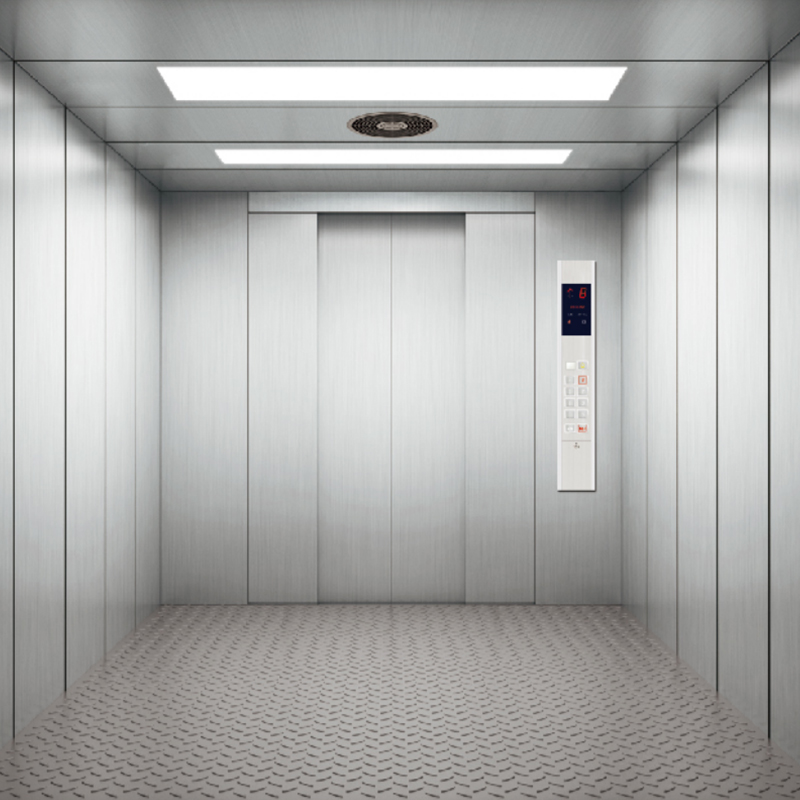
Stainless Steel Car Elevator for 4S Dealership and Parking Garage
Key Advantages Over Conventional Car-Lifting Solutions
Dedicated Heavy-Duty Construction
A major advantage of a dedicated car elevator is that its structure is engineered around vehicle transportation from the beginning. The TO-J22H uses a reinforced steel car frame and a heavy-duty structural arrangement to withstand the dynamic effects associated with vehicle entry, stopping, and exit. This differs from systems that simply enlarge a passenger elevator without fully addressing the operational stresses created by automobiles.
The reinforced construction contributes to stability during loading and unloading. A vehicle may enter with its weight distributed unevenly, particularly when the driver makes a small steering correction or when the car is positioned close to one side of the platform. The elevator structure, guide arrangement, and control system must work together to maintain reliable movement under these conditions.
3T Rated Load Capability
The product supports a rated load of up to 3T, offering a practical capacity for a broad range of vehicles. This capacity gives project owners more flexibility than a lower-load platform intended only for compact passenger cars. It can be particularly valuable in dealerships and parking facilities where the vehicle inventory changes frequently and the elevator must serve different body types.
Rated load is only one part of capacity planning. The available cabin width, depth, height, door opening, approach space, and turning path also affect usability. For this reason, the elevator can be customized by considering the performance and dimensions of the cars expected at the site. This approach helps avoid the limitations that occur when a standard platform is selected without studying the actual vehicle fleet.
Wide-Access Door Configuration
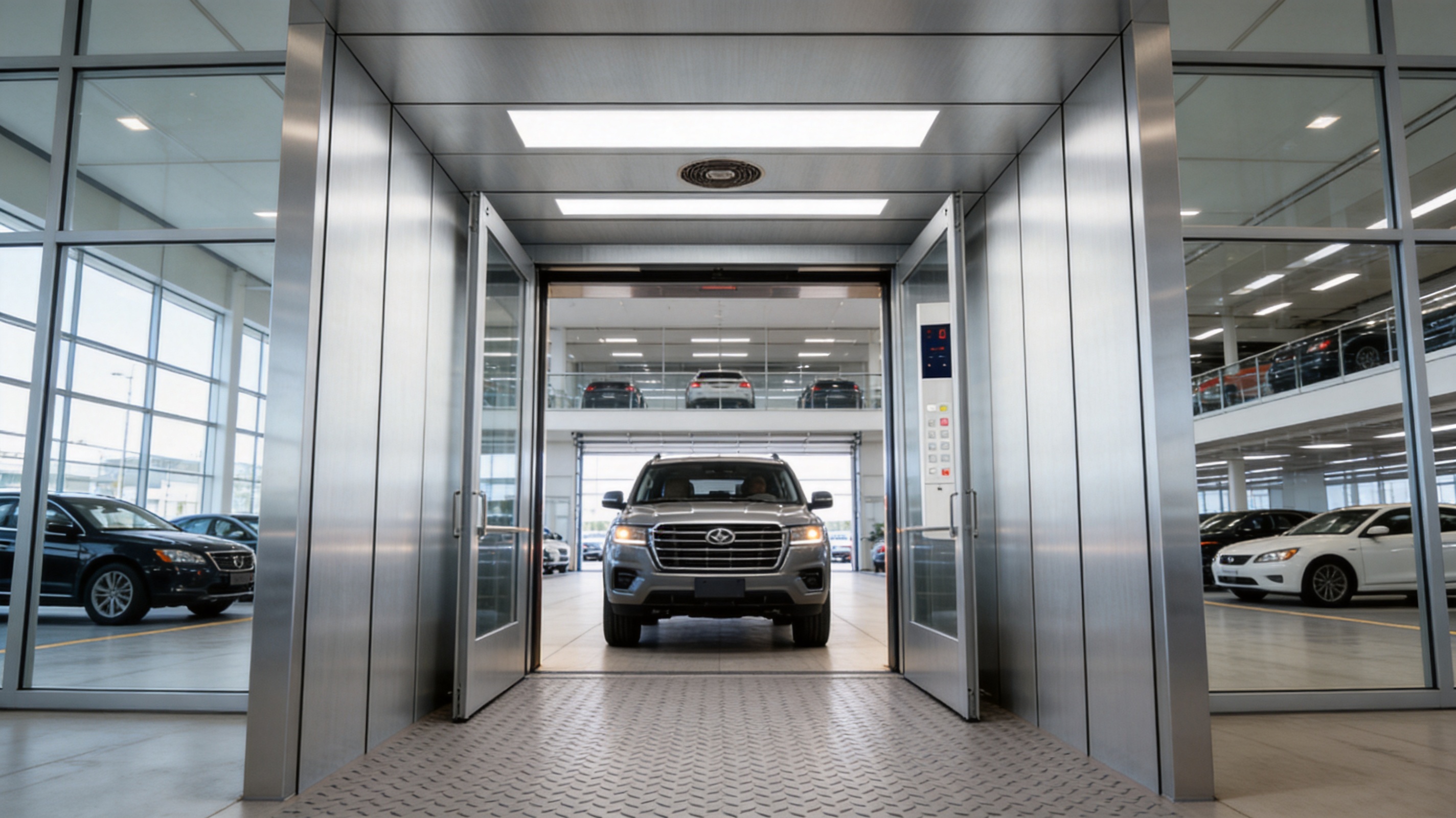
Large-capacity transportation requires generous access. The TO-J22H supports wide-access doors and can be configured with doors opening at both the front and back. This arrangement can create a through-car layout, allowing a vehicle to enter from one side and leave from the opposite side. In a parking garage or dealership, this can simplify traffic circulation and reduce the need for vehicles to reverse inside the cabin.
Front and rear opening can also support different building layouts. For example, a dealership may use one side for customer-facing display areas and the opposite side for service or storage access. In a parking structure, dual access can improve the connection between separate drive aisles or facilitate one-way traffic management.
Smooth and Stable Travel
Vehicle occupants notice sudden starting, stopping, vibration, or uneven leveling. More importantly, abrupt movement can make vehicle loading uncomfortable and can increase the risk of positioning errors. The TO-J22H uses advanced variable-frequency speed adjustment and intelligent energy-saving control to support smooth acceleration, stable travel, and controlled deceleration.
The drive system is combined with mechanical processing precision and a high-performance braking system. These features help the elevator deliver consistent movement during repeated operation. Smooth travel is especially important in a busy facility where the car elevator may operate throughout the day and where different drivers use the system without specialized training.
Accurate Floor Leveling
Precise floor leveling is essential for vehicle elevators. A small difference between the elevator floor and the building floor can create an uncomfortable bump for tires and may affect the driver's ability to enter or leave safely. The TO-J22H includes power-on re-leveling and car stop-and-open accuracy features to support a continuous, even transition between the elevator cabin and the landing.
Accurate leveling also helps protect the cabin threshold, landing sill, and vehicle tires. By maintaining a reliable interface between floors, the system can make loading more predictable and reduce unnecessary mechanical impact during daily operation.
Durable Flooring for High-Wear Environments
Vehicle tires carry dust, water, oil residue, gravel, and other contaminants into a car elevator. The floor must resist wear while providing suitable traction. A riffled plate floor is included for demanding operating conditions. Its raised pattern supports grip and helps create a robust surface for frequent vehicle traffic.
Stainless steel finishes are available where appearance, hygiene, corrosion resistance, or ease of cleaning is important. This is particularly useful in automotive showrooms, premium dealerships, commercial garages, and mixed-use developments where the elevator is visible to customers. The interior can be coordinated with the architectural design while retaining the strength required for vehicle transportation.
Advanced Technology and Control Integration
Variable-Frequency Speed Adjustment
Variable-frequency control allows the elevator to regulate motor speed more precisely than basic fixed-speed operation. The system can manage the transition between start, travel, leveling, and stop stages, reducing mechanical shock and improving ride quality. For a car elevator, this control is important because the transported load is heavy and may contain a driver and passengers.
Controlled speed adjustment can also support energy management. The elevator does not need to operate at full speed during every phase of travel. Intelligent control can coordinate movement according to floor distance, loading conditions, and stopping requirements, helping reduce unnecessary energy consumption while maintaining operational performance.
Intelligent Energy-Saving Control
Energy efficiency is increasingly important for commercial and industrial buildings. The TO-J22H incorporates intelligent energy-saving control as part of its system integration. This approach considers the relationship between the drive system, motor operation, braking, standby behavior, and dispatch logic.
Energy-saving performance depends on the complete installation, including building traffic patterns, travel frequency, rated load, motor selection, maintenance condition, and local electrical standards. Nevertheless, an integrated control architecture gives project owners a stronger foundation for reducing operating costs than a collection of unrelated components.
Power-On Re-Leveling
Building conditions, load changes, and repeated use can influence the position of an elevator car relative to a floor. Power-on re-leveling enables the system to make controlled corrections when necessary. This is especially useful for a vehicle elevator because the transition between the cabin and the landing must remain as even as possible.
Re-leveling is managed through the elevator control and safety logic. It should never be regarded as a substitute for proper installation or maintenance. Instead, it works as part of a broader system that includes accurate sensors, reliable drive control, mechanical alignment, and regular inspection.
Operational Interfaces
The elevator can include micro-touch buttons, floor indicators, and car direction indicators. A dual car operation panel can be used when the cabin size or traffic pattern requires drivers to control the elevator from more than one position. This can improve accessibility within a large cabin and make operation more convenient when the driver is positioned away from the primary panel.
Optional voice announcements can provide audible guidance regarding floor arrival, direction, or operating status. This is useful in facilities with frequent visitors, unfamiliar drivers, or limited visibility during vehicle positioning. Clear visual and audible information can reduce confusion and support more consistent operating behavior.
Flexible Control Modes
The product supports several operating configurations, including standard, ground, and table types. These configurations provide flexibility when the elevator must be integrated into different building structures or traffic plans. The final choice depends on the relationship between the shaft, landing levels, pit arrangement, overhead space, and surrounding circulation.
Attendant running and duplex control are also available for facilities with higher traffic or specialized management procedures. Attendant operation can be useful in a dealership where staff members move customer vehicles, while duplex control can help coordinate two elevators serving the same building or parking system.
Safety Features for Vehicle and Driver Protection
Safety is the most important consideration in a vehicle elevator because the system combines a heavy moving load with human occupants and valuable property. The TO-J22H uses global code-compliant safety components and high-security car frame construction. The exact safety package should be selected according to the applicable laws, standards, inspection procedures, and site conditions in the destination market.
Door Interlock Protection
Door interlocks are designed to prevent elevator movement when the landing or car doors are not in the required secured position. This is fundamental to safe operation. In a car elevator, the door opening is large and the vehicle may be close to the entrance, so reliable interlocking is particularly important.
The system also supports double door control, allowing front and rear entrances to be managed according to the selected operating arrangement. Door opening time extension can be used when a larger vehicle needs additional time to enter or when an attendant is guiding the driver.
Brake Detection and Main Contactor Protection
Main contactor protection and brake detecting protection help monitor essential parts of the lifting and stopping system. These functions are intended to identify abnormal conditions and prevent unsafe operation. The brake system must provide dependable stopping performance under the specified rated load and operating conditions.
Safety monitoring is most effective when it is combined with qualified installation, correct adjustment, routine inspection, and timely replacement of worn components. The elevator's protective functions should be tested according to the maintenance program and applicable regulatory requirements.
Traction Machine Monitoring
Traction machine monitoring provides additional oversight of the elevator's drive equipment. Monitoring can help maintenance personnel identify unusual operating conditions and respond before a small issue develops into a major interruption. In a commercial parking facility, early attention to abnormal behavior can improve availability and reduce unexpected service disruption.
IC Card Access Control
Some facilities require restricted access. An IC card control option can help limit elevator use to authorized drivers, employees, residents, or service personnel. In a dealership, access control may separate public display areas from workshop or storage levels. In a residential project, it may help connect the car elevator with a private parking floor.
Access management can also support operating records and internal procedures. The exact access system should be coordinated with the building's security platform and local data protection requirements.
Inspection and Inching Modes
Inspection and inching operations support technical service and maintenance activities. These modes allow qualified personnel to operate the elevator under controlled conditions when checking components, adjusting equipment, or carrying out service tasks. Such functions are not intended for ordinary users and must be restricted to trained professionals following approved safety procedures.
Design Flexibility for Dealerships and Parking Garages
Dealership Applications
Automotive dealerships often need to display vehicles on multiple levels while preserving valuable ground-floor space. A car elevator can connect underground parking, service areas, customer delivery zones, and showroom floors. Its stainless steel finish can support a polished visual environment, while the heavy-duty floor and structure provide the performance required for daily vehicle movement.
The through-car option is particularly useful when vehicles must move between a public entrance and a rear service area. It can reduce reversing maneuvers and help create a more organized circulation plan. The elevator can also be coordinated with dealership operating procedures, including attendant running, controlled access, and scheduled maintenance.
Parking Garage Applications
In parking garages, the elevator can connect separate parking levels where a ramp would consume too much space or be difficult to construct. Dual-opening doors can support one-way traffic patterns, while duplex control can improve service capacity in larger facilities. Floor indicators, voice announcements, and extended door timing can help drivers who are unfamiliar with the building.
Because parking facilities experience frequent daily use, reliability and maintenance access are essential. The TO-J22H is designed around high-capacity service with durable materials, monitoring functions, and a maintenance strategy that can be tailored to operating conditions.
Residential and Mixed-Use Projects
Private vehicle elevators are becoming more common in high-end residential and mixed-use developments. They can provide direct access to private parking levels, improve land-use efficiency, and support architectural designs that do not allow conventional ramps. Stainless steel interior options can complement premium finishes, while IC card access can help control entry.
For residential applications, noise, travel comfort, access control, emergency procedures, and visual integration must receive special attention. The system can be configured according to the building's traffic volume and the expected vehicle types.
Industrial and Service Facilities
Repair centers, vehicle storage buildings, fleet facilities, and industrial sites may need to move cars and light commercial vehicles between floors. The rated capacity, durable floor, and reinforced frame make the elevator suitable for demanding environments when the final configuration is correctly engineered for the intended fleet.
Industrial facilities may also benefit from attendant controls, restricted access, and remote monitoring. These features can help integrate the elevator into a broader equipment management program.
Manufacturing Strength and Quality Control
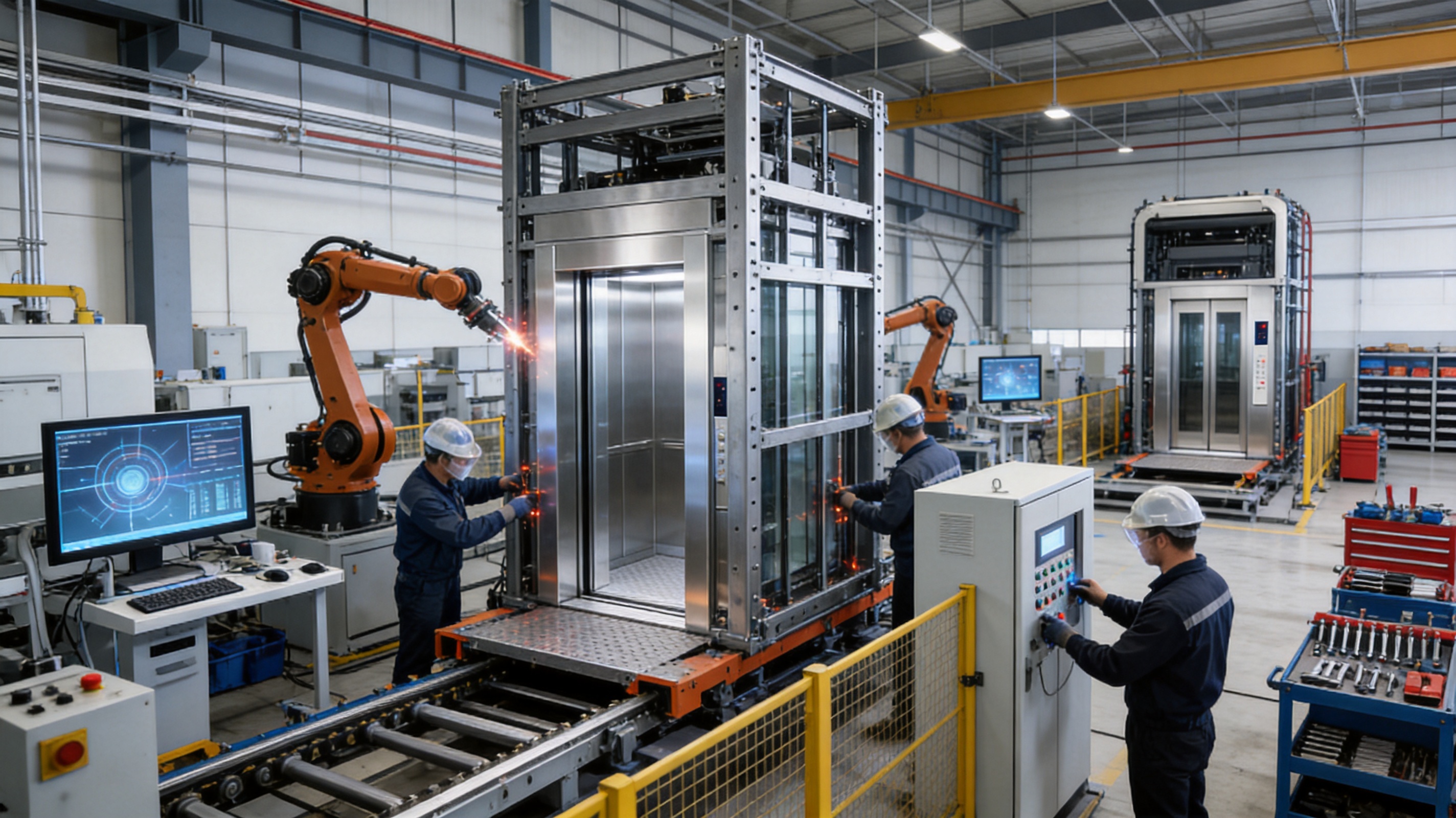
The performance of a car elevator depends on more than its visible cabin or control panel. Structural components, guide systems, drive equipment, electrical cabinets, doors, safety parts, and finishing materials must work together with consistent tolerances. Tenau Elevator (China) Co., Ltd. combines design, research and development, manufacturing, marketing, installation, and after-sales service within one comprehensive organization.
The company's manufacturing base is located in Nanxun, Zhejiang Province, within the Shanghai-Nanjing-Suzhou-Hangzhou economic circle. This location provides access to an established industrial supply chain, engineering talent, logistics resources, and manufacturing infrastructure. The company operates a large-scale production base supported by professional technical teams and automated production capabilities.
German-Inspired Engineering and Industry 4.0 Manufacturing
The company originates from Germany and applies international technology and rigorous management practices to elevator development. Its manufacturing approach incorporates Industry 4.0 concepts, automated production lines, big data, and Internet of Things technology. These tools support greater visibility across production processes and help connect design information, manufacturing activities, inspection records, and service data.
For a specialized product such as a car elevator, digital manufacturing can improve repeatability in steel processing, component assembly, electrical integration, and quality inspection. It can also support better documentation and traceability, which are valuable when a project involves customized dimensions or non-standard finishes.
Integrated Research and Development
Research and development is important because car elevators must adapt to different vehicle sizes, building layouts, and regional regulations. An integrated engineering team can evaluate the relationship between rated load, cabin dimensions, traction or drive performance, door arrangement, control logic, safety devices, and structural requirements.
This integrated approach helps avoid a common weakness in fragmented supply models, where the cabin, control system, and mechanical equipment are treated as separate products. Coordinated development allows the complete elevator to be assessed as one operating system.
Automated Production and Process Consistency
Automated production lines can improve consistency in repetitive operations and reduce the variation associated with manual fabrication. Steel plates, frames, brackets, doors, and other components can be processed according to controlled specifications. This is particularly relevant to heavy-duty car elevators, where structural accuracy and assembly quality influence smooth travel and long-term performance.
Automation does not eliminate the need for skilled personnel. Experienced engineers and technicians remain essential for design review, process supervision, welding quality, electrical integration, final adjustment, and project-specific customization. The strongest manufacturing model combines automation with professional human oversight.
Closed-Loop Quality Management
A full closed-loop quality control system links inspection, production feedback, corrective action, and continuous improvement. If a deviation is discovered, the information can be reviewed and used to improve the relevant process rather than being treated as an isolated event. This supports stable product quality across different batches and project configurations.
The company's management systems comply with ISO9001, ISO14001, and OHSMS18001 standards. These standards relate respectively to quality management, environmental management, and occupational health and safety management. Their use demonstrates an organized framework for controlling processes, environmental responsibilities, and workplace safety.
Environmental and Occupational Considerations
Environmental protection is part of the company's stated mission. Responsible manufacturing includes attention to material use, production efficiency, waste management, energy consumption, and long-term product durability. A durable elevator that remains serviceable for many years can also reduce the environmental impact associated with premature replacement.
Occupational health and safety management is equally important in manufacturing and installation. Heavy elevator components require controlled handling, appropriate equipment, trained workers, and documented procedures. These practices contribute to safer production and more reliable project delivery.
Product Feature Summary
| Feature | TO-J22H Capability | Practical Project Benefit |
|---|---|---|
| Application | Dealerships, parking garages, service centers, residential and industrial facilities | Supports multiple vehicle transportation scenarios |
| Rated load | Up to 3T, subject to final engineering confirmation | Accommodates many passenger cars, SUVs, and light vehicles |
| Car frame | Reinforced heavy-duty steel construction | Improves structural stability under vehicle loading |
| Floor | Riffled plate with stainless steel finish options | Provides durability, traction, and professional appearance |
| Doors | Wide-access configuration with optional front and rear opening | Supports large vehicles and through-car traffic |
| Drive control | Variable-frequency speed adjustment and intelligent energy-saving control | Promotes smooth travel and efficient operation |
| Leveling | Power-on re-leveling and accurate stopping | Creates a more even vehicle transition at each floor |
| User interface | Micro-touch buttons, indicators, optional voice announcements, and dual panels | Improves usability for drivers and attendants |
| Security | IC card control and traction machine monitoring options | Supports controlled access and equipment oversight |
| Maintenance | Inspection, inching, remote monitoring, and customized service programs | Supports planned maintenance and faster fault response |
Custom Engineering and Project Planning
Every car elevator project should begin with a detailed site and vehicle assessment. The design team needs to review the number and type of vehicles, maximum vehicle weight, vehicle height and width, expected traffic volume, floor-to-floor distance, shaft dimensions, pit depth, overhead clearance, entrance direction, power supply, fire strategy, drainage, ventilation, and local inspection requirements.
The project should also define how drivers will use the elevator. Will customers operate it themselves, or will trained attendants move every vehicle? Will vehicles enter and exit through the same door, or is a through-car arrangement preferred? Is the elevator located in a public area, a restricted service zone, or a private residential garage? These questions influence the control panel arrangement, door timing, access control, indicators, and safety instructions.
Cabin Dimensions
Cabin dimensions should not be selected only according to the smallest expected vehicle. The design should consider the largest vehicle, door opening clearance, mirror position, loading tolerance, driver movement, and safe distance from the cabin walls. Additional clearance can make the elevator easier to use and reduce the risk of contact with interior surfaces.
Where the elevator is intended for changing vehicle fleets, a flexible internal design is more valuable than a tightly optimized cabin that supports only one vehicle category. The final dimensions must remain consistent with the shaft and structural limitations of the building.
Traffic Flow
Traffic flow affects both productivity and safety. A same-side entrance and exit may be sufficient for a low-volume private facility. A front-and-rear arrangement can be more efficient in a busy dealership or parking garage because it reduces reversing and allows a clearer one-way circulation pattern.
For larger projects, duplex control or multiple elevators may be considered. The control strategy should be coordinated with traffic management, access control, attendant procedures, and emergency operation.
Finishes and Appearance
The car interior is part of the building environment. A riffled plate floor is suitable for practical, high-wear operation, while stainless steel wall or door finishes can provide a more refined appearance. The choice of material should consider cleaning frequency, exposure to moisture and contaminants, lighting, signage, and the architectural character of the facility.
In a customer-facing dealership, the elevator should communicate cleanliness, precision, and reliability. In an industrial garage, durability and ease of maintenance may take priority. The availability of specialized finishes allows the same fundamental elevator platform to serve different design objectives.
Operation, Maintenance, and Lifecycle Support
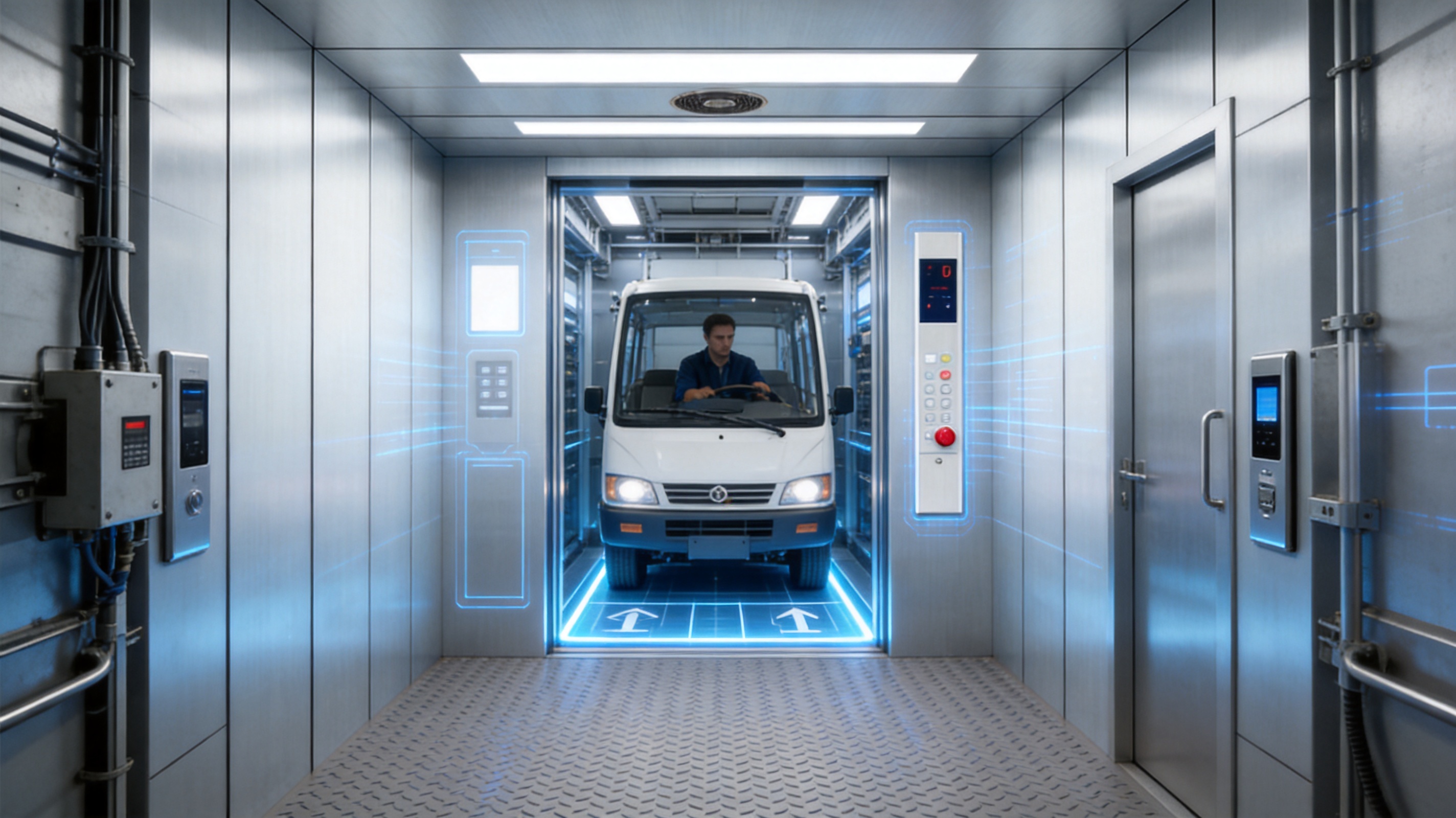
A car elevator is a long-term asset, and its value depends on reliable operation throughout its service life. Tenau provides standardized global service procedures, tailor-made maintenance strategies, remote monitoring, emergency support, scheduled inspections, and technical assistance. These services are intended to cover the complete lifecycle of the equipment rather than focusing only on delivery and installation.
Preventive Maintenance
Preventive maintenance helps identify wear before it affects availability or safety. Typical service activities may include checking doors and interlocks, inspecting guide components, verifying brake performance, reviewing electrical connections, testing safety circuits, examining the floor and thresholds, and confirming the accuracy of leveling and indicators. The exact program must follow the installation manual, local standards, and the conditions of use.
High-traffic facilities may require more frequent inspection than private installations. Dust, moisture, temperature variation, vehicle fluids, and frequent door cycles can affect components over time. A maintenance plan based on actual usage is more effective than applying the same schedule to every project.
Remote Monitoring
Remote monitoring can provide real-time information about elevator status and selected operating conditions. When properly configured, it enables service teams to recognize faults, review operating data, and prepare the appropriate tools or spare parts before arriving on site. This can reduce diagnostic time and support faster restoration of service.
Remote monitoring should be integrated with the building owner's communication and cybersecurity policies. Data access, user permissions, network reliability, and emergency communication procedures should be established during project planning.
Emergency Response
Round-the-clock standby support is valuable for commercial facilities where a disabled car elevator can interrupt vehicle delivery, parking access, or service operations. Fast-response procedures are designed to address technical issues promptly and, where possible, resolve them during the first service intervention.
Emergency procedures should also be clearly communicated to building operators. Drivers must know how to stop, request assistance, and follow instructions if an abnormal condition occurs. Trained personnel should be responsible for releasing vehicles and restoring the elevator after an incident.
Lifecycle Management
Complete lifecycle care may include engineering consultation, installation coordination, commissioning, operator training, periodic maintenance, modernization advice, spare-parts support, and eventual equipment renewal. This approach helps preserve the original investment and ensures that the elevator continues to match changing operational requirements.
Why Manufacturing Capability Matters to Buyers
When selecting a car elevator, buyers often compare rated load, cabin size, price, and delivery time. These factors are important, but manufacturing capability can have an equally significant influence on long-term value. A supplier with integrated design, production, installation, and service resources is better positioned to coordinate the complete project.
First, integrated manufacturing can simplify technical communication. Instead of assigning structural, electrical, and finishing questions to unrelated suppliers, the customer can work with one organization responsible for the complete system. This can reduce the risk of conflicting specifications and make project changes easier to manage.
Second, a strong manufacturing base can support customization without abandoning process control. Car elevators frequently require non-standard dimensions, different door arrangements, special finishes, or customized control functions. The supplier must be capable of adapting the system while maintaining quality documentation and testing procedures.
Third, manufacturing data and quality records help support after-sales service. When a project includes customized parts, accurate documentation makes it easier to identify replacement components, understand the original configuration, and plan future maintenance.
Fourth, investment in automated production, digital systems, and quality management indicates a commitment to repeatable performance. While no manufacturing system eliminates the need for site-specific inspection and commissioning, controlled processes provide a stronger foundation for reliable delivery.
Comparison with Basic or Adapted Alternatives
Basic vehicle lifting platforms may appear attractive because of their simple construction or lower initial cost. However, they may offer fewer options for traffic control, accurate leveling, remote monitoring, access management, and continuous commercial operation. They may also provide less flexibility in cabin size, dual-side access, or interior finishing.
A converted passenger elevator may have suitable doors and controls for people but may not be optimized for vehicle tire loading, heavy dynamic forces, or the larger clearances required by automobiles. A dedicated car elevator begins with the correct operating objective and integrates the structure, control, drive, floor, and safety systems accordingly.
Ramps provide continuous access without mechanical lifting equipment, but they require extensive building area and may create long travel paths. They can also increase construction complexity where the site is narrow, the terrain is constrained, or underground parking is planned. A vertical elevator can make better use of a compact footprint and provide direct movement between selected levels.
The most suitable choice depends on the project. A careful comparison should consider capital cost, construction area, traffic volume, vehicle types, energy use, maintenance, user experience, safety requirements, and the long-term value of the building space recovered by avoiding a ramp.
Installation and Commissioning Considerations
Installation quality has a direct effect on elevator performance. Before equipment arrives, the shaft, pit, overhead area, landing openings, power supply, drainage, ventilation, and access routes should be prepared according to approved drawings. Dimensional accuracy at the site is important because the elevator components must align with the building structure.
During installation, qualified technicians assemble the car frame, guide components, doors, drive equipment, electrical cabinet, safety devices, control panels, indicators, and finishing materials. Each system must be adjusted and tested as an integrated unit. The car should be checked under appropriate load conditions, and door operation, leveling, braking, emergency functions, and safety circuits should be verified.
Commissioning should include operator training. Staff should understand normal operation, access control, attendant mode, emergency communication, inspection restrictions, cleaning requirements, and procedures for reporting abnormal sounds, vibration, door behavior, or leveling changes.
The final acceptance process must follow the laws and inspection requirements of the installation location. Project documentation should include technical specifications, maintenance instructions, test records, approved drawings, operating procedures, and information about recommended spare parts.
Frequently Asked Questions
What type of elevator is the TO-J22H?
The TO-J22H is a dedicated car elevator designed to transport automobiles between floors. It is intended for applications such as 4S dealerships, parking garages, service centers, vehicle storage facilities, residential developments, and industrial buildings.
What is the rated load?
The elevator is capable of handling a rated load of up to 3T. The final rated load and dimensions must be confirmed through engineering based on the vehicle fleet, building structure, local regulations, and selected configuration.
Can the elevator accommodate different vehicle sizes?
Yes. The elevator can be custom designed by considering the performance, dimensions, height, width, weight, and intended use of the vehicles. The largest expected vehicle should be used when determining cabin dimensions and door clearance.
Can vehicles enter and exit from different sides?
Yes. A dual-opening configuration with doors at the front and back is available. This through-car arrangement can simplify traffic flow and reduce the need for vehicles to reverse inside the elevator.
What type of floor is provided?
The standard concept includes a riffled plate floor for durable, high-wear operation. Stainless steel finish options are also available for projects requiring a more professional appearance or easier cleaning.
How does the elevator support smooth operation?
Variable-frequency speed adjustment, intelligent control, mechanical precision, and a high-performance braking system work together to support smooth acceleration, steady travel, controlled stopping, and accurate floor leveling.
Is the elevator suitable for customer-facing dealerships?
Yes. The elevator can combine durable construction with stainless steel interior options, clear indicators, optional voice announcements, access control, and attendant operation. These features can support both professional appearance and practical vehicle movement.
Can access be restricted?
An IC card control option is available for facilities that need to restrict operation to authorized users. The access arrangement should be coordinated with the building's wider security and management system.
What maintenance functions are included?
Inspection and inching modes support technical service. The system can also include traction machine monitoring, remote status monitoring, scheduled inspections, customized maintenance strategies, and emergency support.
What standards and management systems support production?
The manufacturer states that its management systems comply with ISO9001, ISO14001, and OHSMS18001 standards. Its production approach also incorporates automated manufacturing, Industry 4.0 practices, big data, Internet of Things technology, and closed-loop quality control.
How should a project begin?
The project should begin with a site survey and vehicle assessment. Important information includes vehicle dimensions and weight, traffic volume, floor heights, shaft size, pit and overhead conditions, door direction, power supply, access requirements, finish preferences, and local code obligations.
Conclusion
The TO-J22H stainless steel car elevator is designed to provide a complete vertical transportation solution for automobiles rather than a simple lifting platform. Its 3T rated load capability, reinforced steel car frame, riffled plate floor, optional stainless steel finishes, wide-access doors, and front-and-rear opening arrangement address the practical requirements of dealerships, parking garages, service facilities, and other vehicle-related buildings.
Advanced variable-frequency speed adjustment, intelligent energy-saving control, accurate leveling, power-on re-leveling, brake protection, door interlocks, access control, monitoring functions, and flexible operating modes further distinguish the system from basic alternatives. These features support a safer, smoother, and more manageable experience for drivers, attendants, building owners, and maintenance teams.
The product's value is strengthened by the manufacturer's integrated capabilities in research and development, engineering, automated production, Industry 4.0 manufacturing, quality management, installation, and lifecycle service. By combining customized design with controlled manufacturing and ongoing technical support, the company can address the specific requirements of each project while maintaining a consistent approach to safety and reliability.
For any project considering a vehicle elevator, the best result comes from matching the equipment to the actual vehicle fleet, traffic pattern, building structure, local standards, and long-term maintenance plan. With that engineering process in place, a dedicated stainless steel car elevator can improve space utilization, simplify vehicle circulation, enhance the appearance of a facility, and provide dependable floor-to-floor transportation for years of operation.
References
1. Product technical information for the TO-J22H car elevator, including capacity, construction, controls, operating modes, and safety functions.
2. International quality management principles associated with ISO 9001.
3. International environmental management principles associated with ISO 14001.
4. Occupational health and safety management principles associated with ISO 45001 and OHSMS18001 frameworks.
5. General engineering practices for the design, installation, inspection, and maintenance of vehicle elevators and vertical transportation systems.
6. General Industry 4.0 manufacturing principles, including automation, production traceability, data integration, and Internet of Things technologies.
Product: Stainless Steel Car Elevator for 4S Dealership and Parking Garage

Related Products

Related News
Built on safety, forging trust in vertical mobility.
lf you have any questions or need help, feel free to contact with our team.
 export@tenau.com.cn
 +86-18601458867
 +86-512-65059883
Elevator & Escalator
Factory Add
East of Xicheng Road, North of Lianyi Road, Nanxun Economic Development Zone, Nanxun District, Huzhou City, Zhejiang Province, P.R.China
Copyright © Tenau Elevator (China) Co., Ltd. All Rightd Reserved.
Custom High Quality Elevator Suppliers and World Brand Elevator Company