

 en
en Español
 русский
 中文简体
中文简体
TO-M011 Elevator Landing Doors: Safe, Durable, and Adaptable Entrance Solutions
Content
- 1 Understanding the Role of an Elevator Landing Door
- 2 Product Overview of the TO-M011
- 3 Key Advantages of the TO-M011
- 4 Advanced Manufacturing Capabilities
- 5 Materials, Fabrication, and Quality Control
- 6 Advantages Compared with Conventional or Poorly Coordinated Alternatives
- 7 Applications Across Building Types
- 8 Installation and Commissioning Considerations
- 9 Maintenance and Lifecycle Performance
- 10 Environmental and Management Strengths
- 11 Why Select a Comprehensive Elevator Manufacturer?
- 12 Recommended Procurement Process
- 13 Technical Questions Customers Should Ask
- 14 Q&A
- 14.1 What is the TO-M011?
- 14.2 Which buildings can use the TO-M011?
- 14.3 Is the TO-M011 suitable for hospital elevators?
- 14.4 Can the landing door appearance be coordinated with a building interior?
- 14.5 How does the landing door contribute to elevator safety?
- 14.6 What manufacturing advantages support the TO-M011?
- 14.7 Does the manufacturer provide more than landing doors?
- 14.8 Can the TO-M011 be used in a modernization project?
- 14.9 What information should be supplied when requesting a quotation?
- 14.10 Why is installation quality important?
- 14.11 How should the landing door be maintained?
- 14.12 What makes a comprehensive supplier valuable for international projects?
- 15 Conclusion
- 16 References
- 17 Product: TO-M011
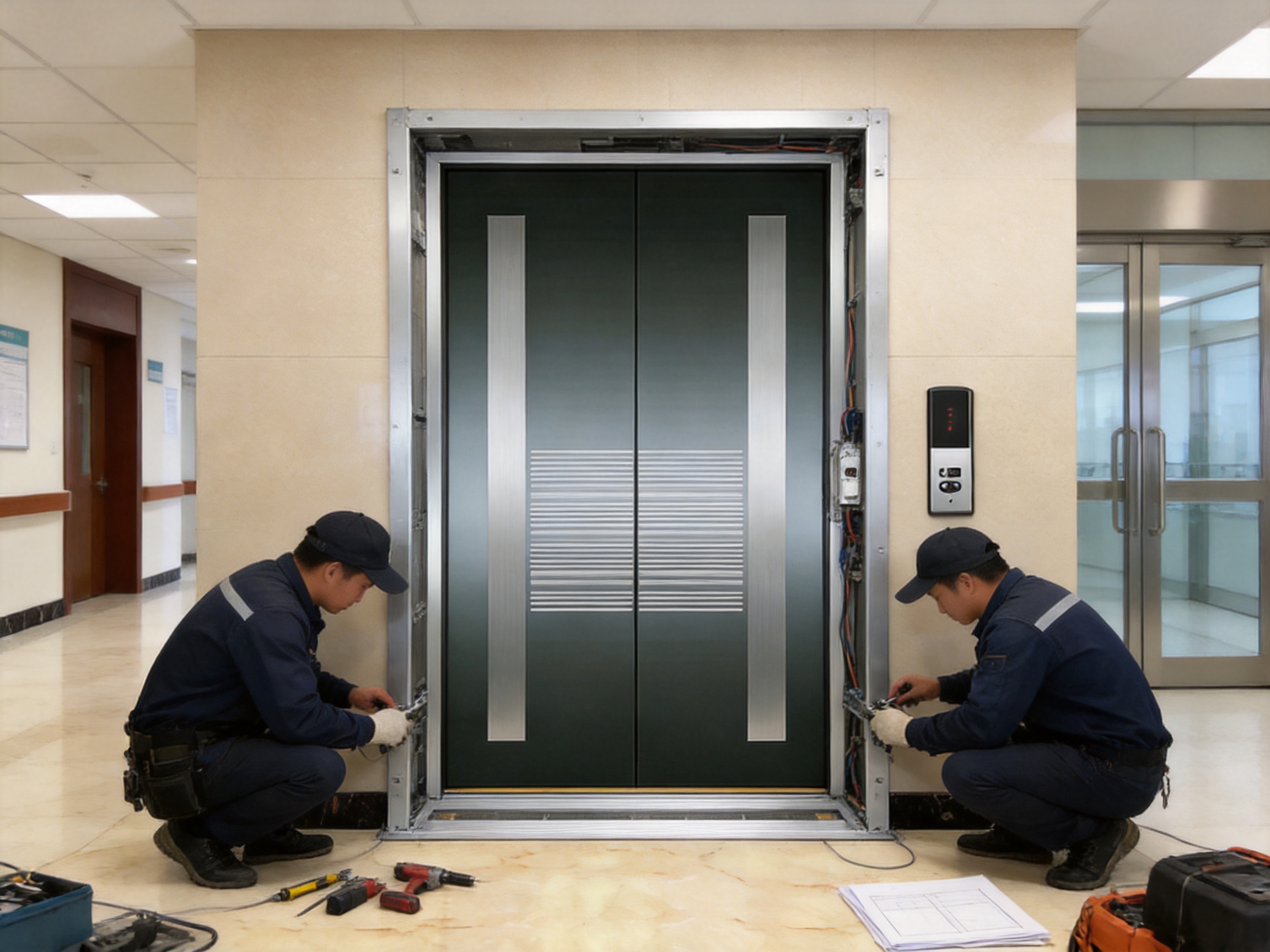
Elevator landing doors are among the most important visible and functional components of a vertical transportation system. They protect passengers at every floor, coordinate with the elevator car door, contribute to the building’s architectural appearance, and influence the long-term operating performance of the entire elevator installation. The TO-M011 elevator landing door is designed for projects that require a dependable entrance solution combined with a clean appearance, practical adaptability, and professional manufacturing support.
As part of the elevator landing door category, the TO-M011 is suitable for applications where safety, smooth operation, dimensional coordination, and consistent finishing are essential. It can be considered for residential buildings, commercial properties, hotels, public facilities, offices, hospitals, transportation buildings, and other projects using passenger or service elevators. Its value is not limited to the door panel itself. A landing door is a complete functional interface involving panels, frames, locking arrangements, guide systems, sill coordination, protective finishes, and installation accuracy.
The product is supplied by Tenau Elevator (China) Co., Ltd., a comprehensive elevator manufacturer integrating design, research and development, manufacturing, marketing, installation, and after-sales service. The company combines international technology concepts with German Industry 4.0 intelligent manufacturing, automated production lines, digital data management, Internet of Things technology, and closed-loop quality control. These capabilities provide a strong foundation for producing elevator components that must work reliably as part of a coordinated system.
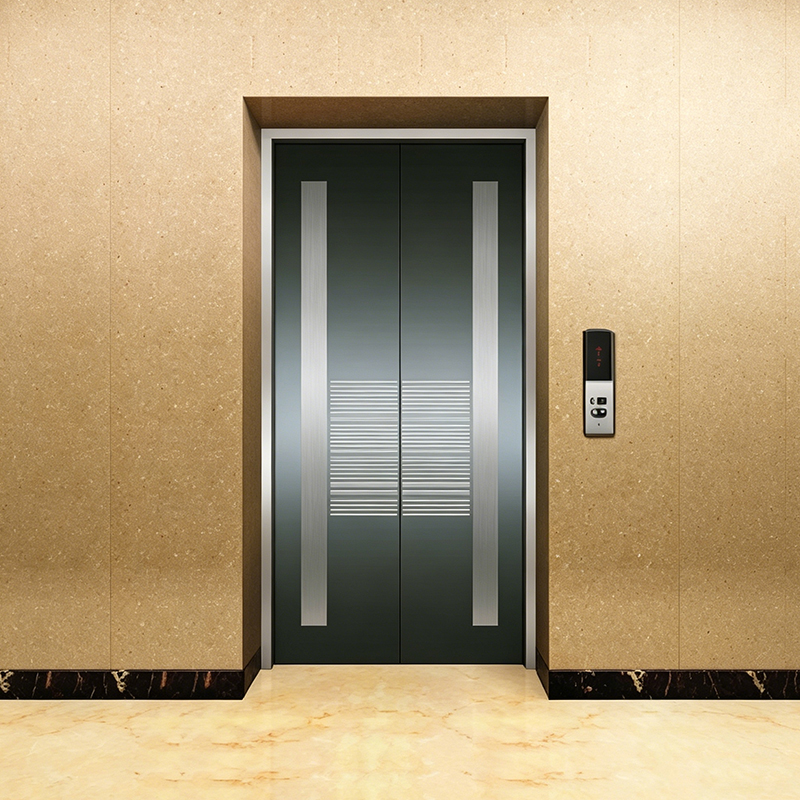
TO-M011
Understanding the Role of an Elevator Landing Door
An elevator landing door is installed at each landing entrance. When the elevator car is not correctly positioned at a floor, the landing door must remain closed and locked to prevent access to the shaft. When the car arrives and the control system confirms the appropriate safety conditions, the landing door opens together with the car door. This sequence must be coordinated accurately for every trip, during both normal passenger service and repeated daily operation.
Although landing doors may appear simple from the outside, they combine several engineering requirements. The door must have suitable structural strength, maintain stable alignment, cooperate with the car door operator, resist repeated movement, and maintain an appropriate relationship with the landing sill. It must also provide a neat transition between the elevator entrance and the surrounding wall, floor, or decorative finish.
In a modern building, the landing door is also part of the interior design. Its visible panels and frame can influence the appearance of a lobby, corridor, hospital floor, hotel entrance, or residential common area. For this reason, customers often evaluate landing doors according to both technical performance and visual compatibility. The TO-M011 offers a practical platform for projects seeking an entrance component that can be coordinated with different architectural environments.
The door is also an important part of elevator safety. Its locking and interlocking functions must be correctly integrated with the elevator control system. The elevator should not run under normal operation if a landing door is not securely closed and locked. Likewise, the door should not be opened unless the elevator car is in the correct landing zone and the required safety conditions are satisfied. Proper installation, adjustment, inspection, and maintenance remain essential regardless of the selected landing door model.
Product Overview of the TO-M011
The TO-M011 is an elevator landing door solution developed for use in elevator entrance applications. It is intended to support the requirements of a complete elevator system rather than function as an isolated decorative component. Its design concept emphasizes dependable operation, coordinated installation, practical maintenance, and compatibility with a range of project requirements.
Because elevator projects differ in building structure, traffic demand, entrance dimensions, decorative concepts, and local regulations, the final configuration should be confirmed according to the project specification. Door opening arrangement, clear opening, frame dimensions, panel finish, sill conditions, fire or smoke-related requirements, electrical interfaces, and installation details may need to be reviewed before production. This project-oriented approach helps ensure that the landing door is correctly matched with the elevator car, shaft, controller, and building entrance.
The TO-M011 can be evaluated as a suitable option for passenger elevators and other elevator applications requiring a professionally manufactured landing entrance. It may be considered where the purchaser needs a combination of functional reliability and coordinated appearance. The product can support new elevator installations as well as certain modernization or replacement projects, subject to dimensional and technical verification.
A significant advantage of selecting a manufacturer with complete elevator capabilities is that the landing door can be discussed in relation to the broader elevator system. The supplier understands the relationship between landing doors, car doors, elevator controllers, guide systems, shafts, cabins, and installation procedures. This can reduce communication gaps that sometimes occur when individual components are sourced from unrelated suppliers.
| Evaluation Area | TO-M011 Value | Project Benefit |
|---|---|---|
| Safety integration | Designed as part of a complete elevator entrance system | Supports coordinated door locking, interlocking, and control functions |
| Manufacturing support | Produced by a comprehensive elevator manufacturer | Provides access to engineering, production, installation, and service resources |
| Architectural coordination | Suitable for project-specific appearance and dimensional discussions | Helps align the entrance with lobby, corridor, and interior design requirements |
| Operational durability | Manufactured through controlled production processes | Supports consistent assembly and repeatable operating performance |
| Project adaptability | Can be reviewed for different elevator applications | Allows customers to confirm the correct arrangement, size, finish, and interface |
| Lifecycle support | Backed by installation and after-sales service capabilities | Helps simplify commissioning, maintenance, and technical communication |
Key Advantages of the TO-M011
Reliable Door Safety Coordination
The primary purpose of an elevator landing door is to close and protect the landing opening when the elevator car is elsewhere in the shaft. The TO-M011 is intended to work within a coordinated elevator safety system in which the landing door, car door, control cabinet, safety circuits, and position-detection devices operate together.
This coordinated approach is important because landing door safety cannot be evaluated only by looking at the visible panel. The locking mechanism, interlock contact, door operator interface, guide arrangement, and installation accuracy all influence performance. A properly manufactured door provides a stable foundation for correct commissioning and regular inspection.
For building owners, reliable door coordination can contribute to safer daily use and fewer avoidable service interruptions. For elevator contractors, a well-integrated landing door can make system testing and commissioning more straightforward. For passengers, the benefit is a door that opens and closes in a predictable manner while maintaining a secure barrier between the landing and the shaft.
Consistent Manufacturing Quality
Elevator doors are exposed to frequent cycles. In a busy commercial building, a door may open and close hundreds or thousands of times over a period of use. Even in a residential building with lower traffic, the component must continue to function after years of repeated movement. Consistency in panel fabrication, frame production, hardware installation, and final adjustment is therefore essential.
Tenau applies a full closed-loop quality control concept covering design, material handling, manufacturing, inspection, assembly, testing, delivery, installation, and after-sales feedback. This type of process helps transform quality from a final inspection activity into a continuing production responsibility. Problems identified during installation or service can be used as feedback for engineering and manufacturing improvements.
The company’s stated compliance with ISO9001, ISO14001, and OHSMS18001 reflects a management framework covering quality, environmental responsibility, and occupational health and safety. These standards do not replace product-specific testing or local code compliance, but they demonstrate an organized approach to business and production management.
Professional Appearance for Different Buildings
An elevator entrance is often one of the most frequently seen elements in a building. It may be located in a lobby with stone flooring, a residential corridor with warm decorative materials, a hotel with a carefully coordinated interior, or a hospital where cleanability and visual order are priorities.
The TO-M011 can be discussed with the project team in relation to panel appearance, frame treatment, visible hardware, and surrounding finishes. Final options should be confirmed according to the available product configuration and project requirements. This allows architects, developers, and elevator contractors to evaluate the door as part of the complete interior rather than as an independent item.
A coordinated landing entrance can make the elevator system look more integrated. This is particularly important in panoramic and observation elevator environments, commercial buildings, hospitality projects, and premium residential developments where visual details influence the perceived quality of the property.
Adaptability to Project Requirements
Elevator projects rarely have identical conditions. A new office building may use standard entrances throughout the building, while a hospital may require a larger opening and robust service performance. A villa elevator may have limited space and special interior finishes. A cargo or car elevator may require different dimensions and operating considerations.
The TO-M011 can be evaluated according to the specific use case, shaft arrangement, landing construction, elevator capacity, speed, door opening, and local regulatory requirements. The most effective procurement process begins with a technical review that confirms the clear opening, wall thickness, sill level, fixing points, door type, electrical connections, and relationship with the car door.
This adaptability is an advantage over products sold only as fixed, inflexible assemblies. A professional supplier can help the customer identify which elements should remain standardized and which elements require project-specific adjustment. Standardization supports production efficiency, while controlled customization helps the product fit the actual building conditions.
Maintenance-Oriented Design Thinking
Door components should be accessible for inspection, adjustment, cleaning, and replacement of wearing parts. Maintenance personnel need to examine the locking arrangement, guides, rollers, sill area, fasteners, and operating clearances. A landing door that is difficult to inspect can increase maintenance time and make minor problems more difficult to identify.
The TO-M011 is supported by a manufacturer that provides installation and after-sales service as part of its business scope. This system-level support can help customers understand recommended inspection routines, adjustment procedures, spare-part requirements, and troubleshooting methods. Actual maintenance intervals should always follow the manufacturer’s documentation, elevator regulations, and the conditions of use.
Advanced Manufacturing Capabilities
German Industry 4.0 Intelligent Manufacturing
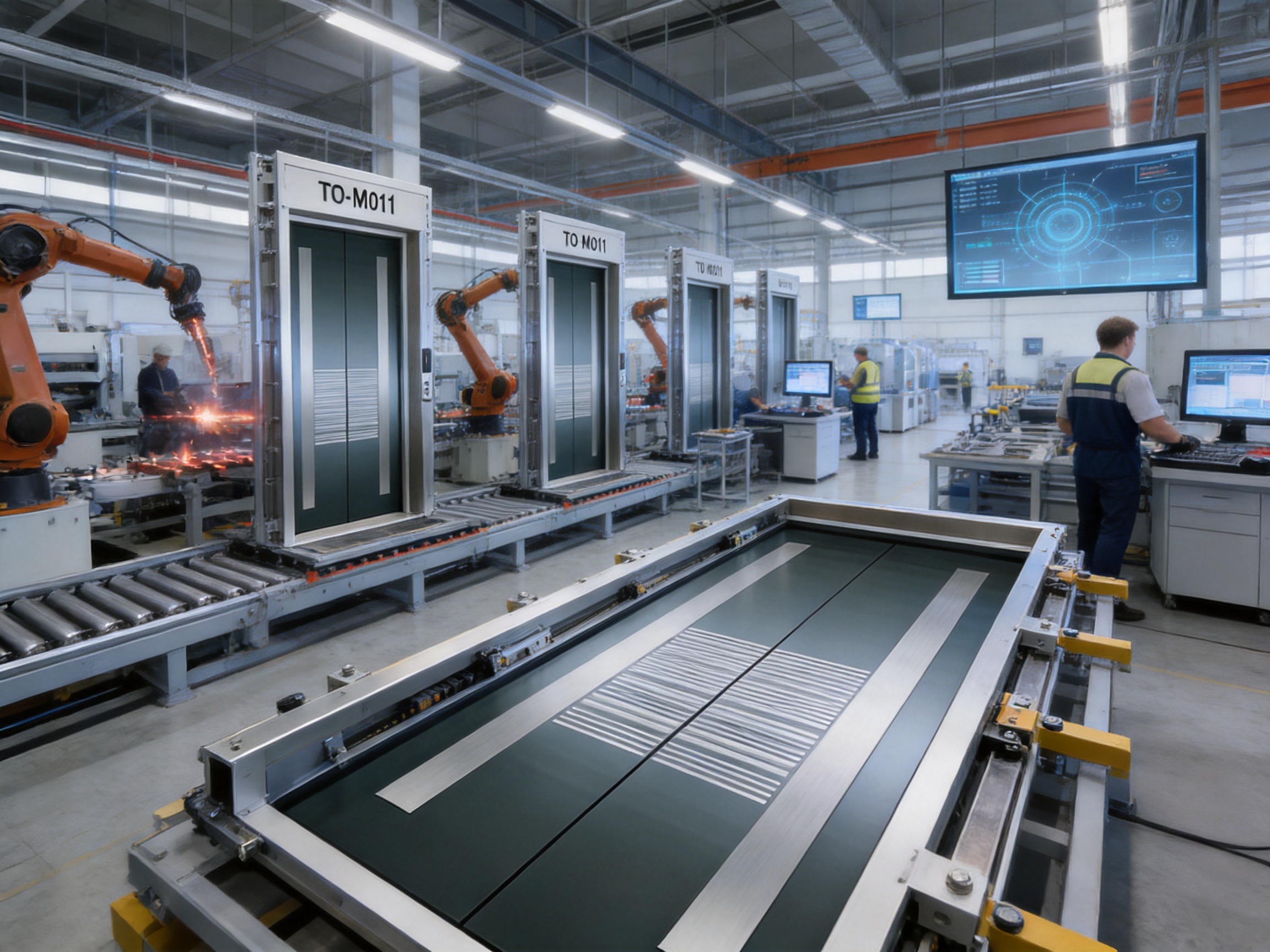
Tenau’s manufacturing strategy incorporates German Industry 4.0 intelligent manufacturing principles. Industry 4.0 generally refers to the integration of automation, digital information, connected equipment, production data, process monitoring, and intelligent decision-making into industrial operations.
For elevator landing doors, this approach can improve the consistency of cutting, forming, welding, surface treatment, assembly, and inspection. Digital production information can help connect engineering drawings with manufacturing instructions. Automated or semi-automated equipment can reduce variation between batches. Process data can support traceability and help production teams identify deviations earlier.
Intelligent manufacturing is especially valuable for elevator components because small dimensional differences can influence installation and operation. A panel that is not square, a frame that is not aligned, or a fixing position that is inconsistent can create additional work at the installation site. Better process control helps reduce such risks before the product leaves the factory.
Automated Production Lines
Automated production lines are useful when a manufacturer needs to balance repeatability with a broad range of elevator products. Automated equipment can support stable processing while programmable systems allow adjustments for different dimensions and specifications. The result is a production environment that is better suited to both standard products and controlled project customization.
For the TO-M011, production consistency may involve the relationship between door panels, frames, guide components, locking hardware, and mounting interfaces. Each part must be produced within an appropriate tolerance and assembled in the correct sequence. Automated operations can assist with repeatable positioning, while skilled technicians remain important for verification, finishing, adjustment, and final quality assessment.
Automation can also improve workplace safety by reducing unnecessary exposure to heavy materials, repetitive handling, and high-risk operations. This connects manufacturing efficiency with the company’s occupational health and safety management goals.
Digital Data and Traceability
Digital data management supports the creation, storage, and review of production information. This may include engineering revisions, material records, inspection results, assembly information, and delivery documentation. A structured data process helps technical teams work from the correct version of a project specification.
Traceability is valuable when a customer requires replacement parts, additional doors for a later building phase, or technical clarification after installation. The supplier can use available project and production information to improve communication. It can also support the analysis of recurring issues and the development of corrective actions.
In international projects, digital records are particularly useful because the manufacturer, distributor, installer, consultant, and building owner may be located in different countries. Clear documentation helps reduce misunderstandings regarding dimensions, finishes, operating arrangements, and installation requirements.
Internet of Things and Connected Elevator Management
Tenau identifies Internet of Things technology and big data as elements of its intelligent elevator ecosystem. Connected technologies can support equipment monitoring, service management, operational analysis, and the development of more responsive maintenance programs.
A landing door is one component within this ecosystem. Although the door itself is a mechanical and electromechanical assembly, its condition can influence elevator availability and passenger experience. Door reopening, incomplete locking, abnormal operating noise, or repeated leveling-related interruptions may provide useful information for maintenance teams when the elevator system is designed for suitable monitoring.
Connected service capabilities should be confirmed according to the specific elevator model and project configuration. Even where advanced remote monitoring is not used, the manufacturer’s digital approach can still improve documentation, communication, and internal quality management.
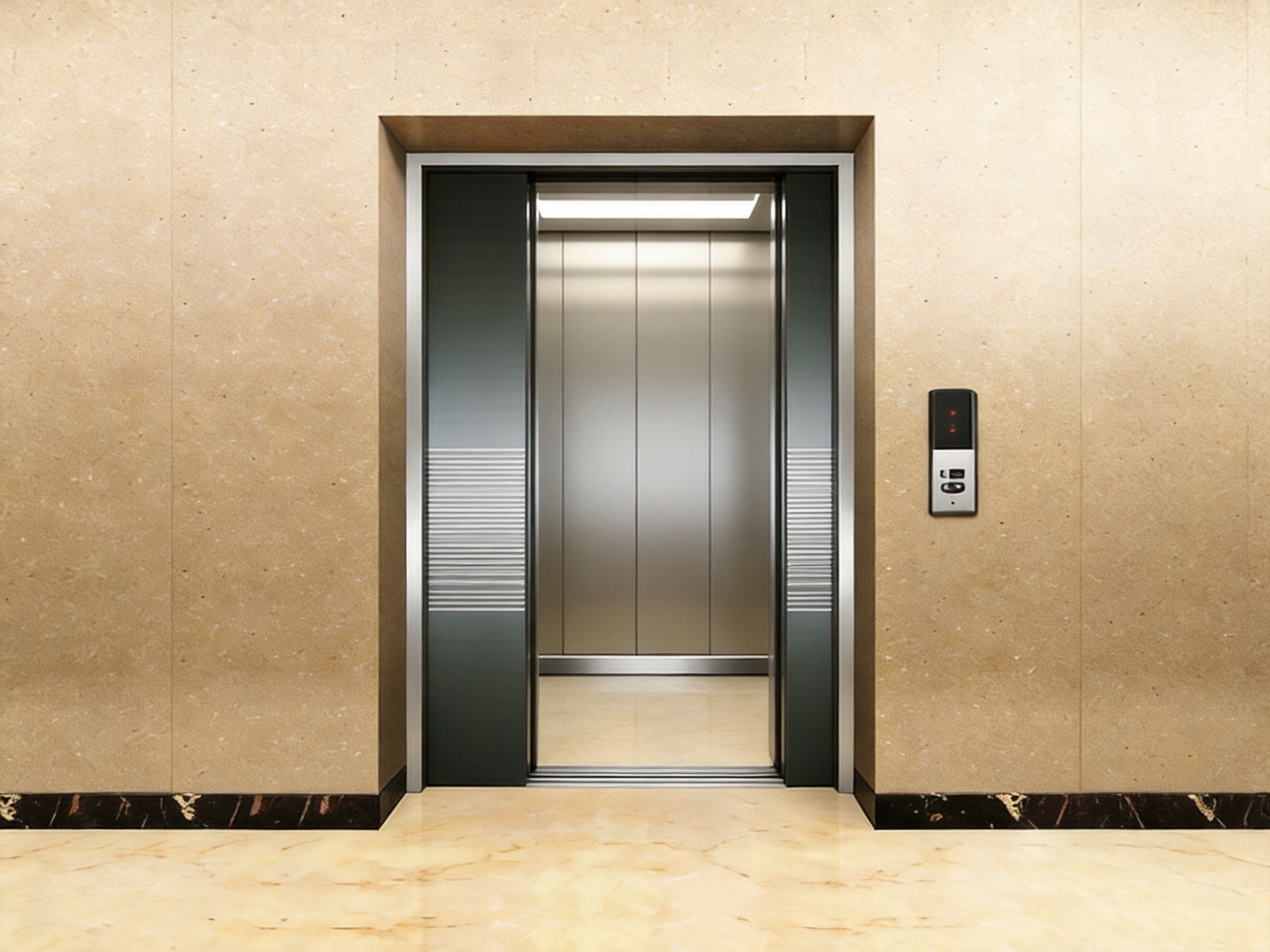
Materials, Fabrication, and Quality Control
The performance of a landing door depends on the correct selection and processing of materials. Door panels and frames must have suitable rigidity, dimensional stability, surface quality, and resistance to the conditions of the installation environment. Hardware must be compatible with the required movement and safety functions. Finishes must be selected with consideration for appearance, cleaning, corrosion exposure, and long-term use.
Material selection should be confirmed in accordance with the project specification. Different buildings may require different surface treatments or decorative solutions. A standard indoor installation may have different requirements from a coastal building, an industrial facility, a parking structure, or a healthcare environment.
During fabrication, sheet processing, forming, welding, grinding, finishing, and assembly must be managed carefully. Poor processing can lead to visible deformation, uneven gaps, coating problems, or unstable alignment. Professional inspection should therefore examine not only the finished appearance but also the dimensions, fasteners, movement, and interface with other elevator components.
A quality control system should include incoming material checks, process inspections, assembly verification, functional testing, and final review. The precise inspection plan will depend on the product design and applicable standards. Important checks may include panel dimensions, frame squareness, guide alignment, lock operation, contact behavior, sill coordination, surface quality, and packaging protection.
Closed-Loop Quality Management
The closed-loop quality concept used by Tenau connects the stages of product development, manufacturing, delivery, installation, and service. This is important because an elevator component may perform differently if installation conditions, shaft tolerances, building settlement, contamination, or maintenance practices vary.
When feedback is collected from the field, the manufacturer can use it to improve drawings, instructions, materials, assembly methods, or inspection procedures. A closed-loop system is more effective than a process that ends at shipment because it recognizes that product quality includes the complete customer experience.
For purchasers, this means that the supplier’s capabilities should be evaluated beyond the factory floor. Questions should include how technical issues are handled, how replacement components are identified, how installation support is provided, and how product feedback is incorporated into future production.
Advantages Compared with Conventional or Poorly Coordinated Alternatives
The TO-M011’s main competitive advantage is the combination of product functionality and manufacturer-level support. A landing door supplied without reliable technical coordination may create difficulties during installation, commissioning, and maintenance. By contrast, a door supplied by a comprehensive elevator manufacturer can be evaluated together with the elevator car, controller, cabin, shaft, and safety system.
Another advantage is process consistency. Products made through uncontrolled or highly manual processes may show greater variation in dimensions, finish, or hardware installation. This can increase adjustment work at the project site. Intelligent manufacturing and documented inspection help improve repeatability, especially when multiple entrances must be installed in the same building.
System integration also distinguishes professional elevator landing doors from generic architectural doors. A landing door must satisfy elevator-specific safety and operating requirements. It is not simply a door placed across a wall opening. The locking mechanism, door contacts, car-door coupling, control logic, and shaft protection functions must be treated as one coordinated system.
The TO-M011 also benefits from the company’s broad product portfolio. Tenau provides passenger elevators, freight elevators, escalators, moving walks, high-speed and ultra-high-speed elevator solutions, and related elevator components. This broad experience can help the manufacturer understand different traffic patterns, building types, elevator capacities, and installation environments.
Compared with a supplier focused only on a single mechanical component, a comprehensive elevator company may offer more efficient communication for projects that include multiple elevator types or a combination of elevators and escalators. The customer can coordinate entrance finishes, technical documentation, spare parts, installation planning, and service arrangements through a more unified channel.
Applications Across Building Types
Residential Buildings
In residential buildings, landing doors must provide dependable daily operation while fitting into shared corridors and elevator lobbies. Appearance, cleaning convenience, noise control, and long-term maintenance are common considerations. The TO-M011 can be reviewed for apartment buildings, condominiums, and other residential developments where multiple floors require consistent entrance treatment.
Residential elevators may experience concentrated usage during morning and evening periods. A reliable door system helps maintain elevator availability and reduces inconvenience for residents. Consistent manufacturing is also valuable when many landing doors are installed in one project because visual differences between floors can be noticeable.
Office and Commercial Buildings
Commercial and office buildings often have higher traffic intensity and stronger expectations for appearance. Elevator entrances are visible to employees, visitors, customers, and tenants. The landing door must support repeated operation while maintaining a professional appearance in the lobby.
In these buildings, service coordination is important. If a door issue causes an elevator to be removed from service, traffic capacity may be reduced. A manufacturer with installation and after-sales capabilities can help support commissioning, preventive maintenance, and troubleshooting planning.
Hotels and Hospitality Properties
Hotels use elevator entrances as part of the guest experience. The door finish, frame appearance, movement, and operating sound can influence how guests perceive the quality of the building. The TO-M011 can be considered where the customer needs a landing entrance that can be coordinated with a carefully designed interior.
Hotel elevators may operate for long hours and serve guests carrying luggage, housekeeping teams, restaurant staff, and service personnel. The correct door arrangement and performance requirements should therefore be confirmed according to the intended passenger and service uses.
Hospitals and Healthcare Buildings
Hospitals require elevators that can support patients, visitors, medical teams, carts, and equipment. Landing entrances may be exposed to frequent operation and demanding service conditions. Clear openings, robust construction, smooth operation, and appropriate surface selection are important considerations.
The TO-M011 may be evaluated for hospital elevator projects after confirming the necessary dimensions, traffic requirements, finish, cleaning expectations, and relevant healthcare or building regulations. The complete elevator solution should be designed to support the movement of beds, stretchers, wheelchairs, and service equipment where required.
Industrial, Freight, and Service Facilities
Freight and service elevators may face more demanding loading conditions than ordinary passenger elevators. Carts, materials, tools, and equipment can increase the risk of impact or contamination around the entrance. The landing door specification should reflect the intended load, operating frequency, protection requirements, and maintenance environment.
Tenau’s experience with freight elevators and broad elevator solutions provides a useful foundation for discussing landing doors in industrial and service applications. The final selection should be based on engineering review rather than on appearance alone.
Luxury Residential and Villa Projects
Villa elevators and premium residential projects often place greater emphasis on interior coordination. The landing door may need to complement stone, wood, metal, glass, or other decorative materials. Space conditions can also vary significantly from standard commercial buildings.
For these projects, early coordination between the architect, interior designer, elevator supplier, and building contractor is recommended. Confirming the frame, wall interface, floor finish, sill height, and decorative boundaries before construction helps prevent visible gaps or difficult modifications during installation.
Car Elevators and Special Transportation Systems
Car elevators require careful consideration of opening dimensions, vehicle movement, loading patterns, impact risk, and user guidance. Their landing doors may need to coordinate with traffic management systems and building access arrangements. A complete manufacturer can assist in evaluating how the landing door interacts with the broader car elevator solution.
Installation and Commissioning Considerations
Even a well-manufactured landing door can perform poorly if the shaft, wall opening, sill, or frame is not prepared correctly. Installation begins with a review of the approved drawings and site conditions. The installer should verify the opening dimensions, reference lines, floor levels, wall strength, fixing points, and relationship between the landing and car door.
The landing door frame must be positioned accurately. If the frame is out of plumb or not properly secured, the panels may rub, the gaps may become uneven, or the lock may not operate consistently. The sill must be installed at the correct height and alignment so that the bottom of the panels and the car entrance coordinate properly.
After mechanical installation, the door should be adjusted and tested as part of the complete elevator system. The installer should check opening and closing movement, panel alignment, lock engagement, interlock signals, car-door coordination, emergency unlocking functions, and operating clearances. Testing should follow the manufacturer’s procedures and applicable local regulations.
Construction dust, paint, cement residue, and other contaminants should be kept away from guides, sills, locks, and moving parts. Protective packaging should remain in place until appropriate stages of the project, while ensuring that temporary materials do not obstruct movement or ventilation.
Coordination with Other Trades
Landing door installation often involves coordination with structural contractors, wall finish teams, flooring installers, electrical contractors, and interior designers. The final appearance depends on the relationship between the door frame and the surrounding wall. The sill area must also be coordinated with floor levels and finished materials.
Early communication can prevent common problems such as insufficient wall support, incorrect finished floor height, concealed fixing conflicts, or decorative materials that interfere with panel movement. A project meeting before installation is especially useful for buildings with stone cladding, special wall systems, large-format tiles, or customized interiors.
Maintenance and Lifecycle Performance
Regular maintenance helps preserve the safety and operating performance of the TO-M011 and the complete elevator system. Maintenance personnel should follow the manufacturer’s documentation and local elevator regulations. The frequency of service depends on traffic intensity, environmental conditions, elevator speed, door size, operating cycles, and building use.
Typical maintenance activities may include cleaning the sill and guide areas, inspecting fasteners, checking panel alignment, verifying lock operation, reviewing electrical contacts, examining rollers or guides, and confirming that the door opens and closes without abnormal resistance. Any unusual noise, vibration, hesitation, incomplete locking, or repeated reopening should be investigated promptly.
Cleaning should use methods and materials appropriate for the installed finish. Abrasive tools or aggressive chemicals may damage the surface. In hospitals, food-related facilities, coastal properties, or industrial environments, the cleaning and inspection program may need to be adapted to local conditions.
Preventive maintenance is generally more effective than waiting for a failure. Small changes in door movement or alignment can indicate wear, contamination, loose hardware, or building movement. Early correction may reduce downtime and prevent additional stress on the operator, lock, panels, and car-door system.
Spare Parts and Technical Support
Long-term availability of suitable spare parts is an important consideration when selecting elevator landing doors. Customers should clarify which wearing components are recommended for stock, how parts are identified, and how technical support is provided after the warranty period.
Tenau’s integrated business model includes installation and after-sales service. This can be valuable for international customers that require assistance with commissioning, troubleshooting, replacement components, or future modernization. Clear communication of the product alias, project number, door arrangement, dimensions, and installation date can help service teams identify the correct information.
Environmental and Management Strengths
Elevator products are long-life components, so environmental responsibility should be considered throughout their lifecycle. Efficient production, controlled material use, reduced rework, responsible waste handling, and durable finishes can all contribute to a more sustainable product strategy.
Tenau identifies ISO14001 environmental management as part of its management system. Environmental management provides a framework for recognizing and controlling environmental impacts associated with manufacturing activities. It also supports continual improvement in resource use, production practices, and compliance management.
Durability is another environmental benefit. A landing door that remains functional for a long period, receives proper maintenance, and can be repaired rather than prematurely replaced may reduce the material and energy demands associated with frequent replacement. Actual lifecycle performance depends on design, installation quality, usage, maintenance, and the surrounding environment.
Occupational health and safety management is also important in manufacturing and installation. The company’s stated OHSMS18001 compliance reflects attention to workplace safety systems. Safer processes can improve production continuity, employee well-being, and the reliability of project execution.
Why Select a Comprehensive Elevator Manufacturer?
Purchasing a landing door from a comprehensive elevator manufacturer offers several practical advantages. First, the supplier understands the full elevator system. This supports better coordination between the landing door and the car door, controller, safety circuit, cabin, shaft, and installation procedure.
Second, a complete manufacturer can provide broader engineering support. Customers may need advice on passenger elevators, hospital elevators, home elevators, cargo elevators, car elevators, escalators, moving walks, or high-speed elevator applications. A supplier with experience across these categories can help maintain consistency across a larger building or development program.
Third, a manufacturer with its own research, development, production, and service capabilities can respond more effectively to technical questions. Product changes, documentation updates, project variations, and after-sales feedback can be handled through a more connected internal structure.
Tenau’s location in Nanxun, Zhejiang Province, places its manufacturing base within the Shanghai-Nanjing-Suzhou-Hangzhou economic circle. This region provides access to industrial resources, engineering talent, logistics networks, and a developed manufacturing ecosystem. The company exports products to many countries and regions, giving it experience in international business communication and project requirements.
For customers comparing suppliers, the most useful evaluation should consider more than price. Product quality, design support, manufacturing capability, documentation, installation guidance, spare-parts planning, delivery performance, compliance support, and after-sales responsiveness all influence the total cost of ownership.
Recommended Procurement Process
Step One: Define the Application
Begin by identifying the building type, elevator function, passenger or load requirements, traffic pattern, number of floors, environmental conditions, and architectural expectations. A hospital elevator, office elevator, cargo elevator, and villa elevator may require different landing door considerations.
Step Two: Confirm Dimensions and Door Arrangement
Provide the supplier with the required clear opening, door height, landing wall conditions, shaft dimensions, floor levels, and opening arrangement. The project should also confirm whether the doors are center-opening, side-opening, telescopic, or another approved arrangement. The final arrangement must match the elevator car door and control system.
Step Three: Review Materials and Finishes
Discuss visible panel materials, frame treatment, color, texture, corrosion exposure, cleaning requirements, and coordination with the building interior. Samples or approved finish schedules may be useful for projects with demanding architectural requirements.
Step Four: Review Regulations and Safety Requirements
Confirm the applicable elevator codes, building regulations, fire-related requirements, accessibility provisions, and inspection procedures. The door specification should be reviewed by the responsible elevator engineer and local authority where required.
Step Five: Approve Drawings and Interfaces
Before production, approve the technical drawings, fixing details, sill arrangement, electrical interfaces, lock configuration, installation clearances, and decorative boundaries. This step reduces the risk of costly changes after materials arrive at the construction site.
Step Six: Plan Installation and Service
Agree on delivery conditions, packaging, site storage, installation responsibilities, commissioning procedures, training, warranty terms, and spare-part support. A clear responsibility matrix helps ensure that the landing door is installed, adjusted, tested, and accepted correctly.
Technical Questions Customers Should Ask
When comparing elevator landing door suppliers, customers should ask how the product is manufactured, inspected, packed, documented, installed, and serviced. Important questions include whether the supplier provides approved drawings, how dimensional tolerances are controlled, what tests are completed before shipment, and how project variations are managed.
Customers should also ask which materials and finishes are available, how the door is protected during transportation, what maintenance instructions are supplied, and whether replacement parts can be obtained in the future. For international projects, it is helpful to confirm the language of documentation, communication channels, export experience, and technical support arrangements.
The following checklist can support an initial evaluation:
| Question | Reason for Asking |
|---|---|
| Is the landing door designed for the selected elevator system? | Ensures correct coordination with the car door, controller, and safety circuit |
| Are project drawings available before production? | Allows the building team to verify dimensions and interfaces |
| How are materials and finishes controlled? | Supports consistent appearance and suitability for the installation environment |
| What inspection and testing are completed? | Helps confirm manufacturing and functional quality |
| Who provides installation and commissioning support? | Clarifies responsibilities and reduces site coordination risks |
| How are spare parts identified? | Supports efficient future maintenance and repair |
| Does the supplier provide after-sales assistance? | Helps protect long-term elevator availability |
Q&A
What is the TO-M011?
The TO-M011 is an elevator landing door designed for use at elevator entrances. It is intended to provide a secure shaft barrier, coordinate with the elevator car door and control system, and contribute to the appearance of the building entrance.
Which buildings can use the TO-M011?
The product can be considered for residential, commercial, office, hotel, hospital, public, industrial, service, and other elevator projects, subject to confirmation of dimensions, operating requirements, applicable regulations, and the selected technical configuration.
Is the TO-M011 suitable for hospital elevators?
It may be suitable for hospital elevator projects after the customer confirms the required clear opening, traffic intensity, service conditions, finish, cleaning requirements, and relevant regulations. Hospital applications should be reviewed as complete elevator systems because patient beds, stretchers, carts, and equipment may require special dimensions and operating arrangements.
Can the landing door appearance be coordinated with a building interior?
Project teams can discuss available panel finishes, frame treatments, and architectural coordination with the supplier. Final options depend on the product configuration and project specification. The door frame, sill, wall finish, and floor finish should be coordinated during the design stage.
How does the landing door contribute to elevator safety?
The landing door helps prevent access to the shaft when the elevator car is not correctly positioned at the floor. Its lock and interlock functions must be integrated with the elevator control and safety systems. Correct installation, commissioning, inspection, and maintenance are essential to achieve the intended safety performance.
What manufacturing advantages support the TO-M011?
The product is supported by a manufacturer with design, research and development, manufacturing, installation, marketing, and after-sales capabilities. The company also uses German Industry 4.0 intelligent manufacturing concepts, automated production lines, big data, Internet of Things technology, and closed-loop quality control.
Does the manufacturer provide more than landing doors?
Yes. Tenau provides passenger elevators, panoramic and observation elevators, hospital elevators, home and villa elevators, cargo elevators, car elevators, escalators, moving walks, elevator parts, cabin interiors, and high-speed elevator solutions.
Can the TO-M011 be used in a modernization project?
It may be considered for modernization or replacement work, but compatibility must be verified carefully. Existing shaft dimensions, car-door equipment, controller interfaces, landing wall conditions, sill levels, and local inspection requirements should all be reviewed before approval.
What information should be supplied when requesting a quotation?
Customers should provide the elevator type, number of floors, quantity of landing doors, clear opening, door height, opening arrangement, shaft and wall information, required finish, operating conditions, local standards, delivery location, and any special requirements. Drawings and photographs of the site can also help the supplier prepare a more accurate proposal.
Why is installation quality important?
Incorrect frame alignment, sill height, panel adjustment, lock installation, or electrical connection can cause poor movement, uneven gaps, noise, repeated reopening, or safety faults. Professional installation and commissioning are therefore as important as factory manufacturing quality.
How should the landing door be maintained?
Maintenance should follow the manufacturer’s instructions and local regulations. It commonly includes cleaning the sill and guide area, checking fasteners and alignment, inspecting locking and electrical contacts, reviewing movement, and correcting abnormal noise or resistance. Maintenance intervals should reflect traffic, environment, and elevator usage.
What makes a comprehensive supplier valuable for international projects?
A comprehensive supplier can coordinate product design, manufacturing, documentation, delivery, installation, commissioning, and after-sales communication. This can simplify projects involving several elevator types or multiple buildings and can reduce the risks associated with sourcing disconnected components from different suppliers.
Conclusion
The TO-M011 elevator landing door is a practical solution for projects that require dependable entrance protection, coordinated elevator operation, professional appearance, and manufacturing support. Its value comes from the combination of a dedicated landing door product and the broader capabilities of an integrated elevator manufacturer.
Tenau Elevator (China) Co., Ltd. supports its products through design, research and development, intelligent manufacturing, automated production, quality management, installation, and after-sales service. Its manufacturing approach incorporates German Industry 4.0 concepts, digital information, big data, Internet of Things technology, and closed-loop quality control. The company also identifies ISO9001, ISO14001, and OHSMS18001 management standards as part of its operating framework.
For architects, developers, elevator contractors, distributors, and building owners, the TO-M011 can be evaluated as part of a complete elevator entrance strategy. The most successful result will come from early technical coordination, accurate dimensional confirmation, suitable finish selection, professional installation, complete commissioning, and planned maintenance.
When these factors are managed together, an elevator landing door can provide more than a finished entrance. It can support safe passenger movement, reliable building operation, architectural consistency, and long-term serviceability across residential, commercial, healthcare, industrial, hospitality, and specialized elevator applications.
References
Tenau Elevator (China) Co., Ltd. Company information and product category materials supplied for the TO-M011 elevator landing door.
ISO 9001, Quality Management Systems—Requirements.
ISO 14001, Environmental Management Systems—Requirements with Guidance for Use.
OHSMS 18001, Occupational Health and Safety Management System reference framework.
International elevator safety and accessibility standards applicable to landing doors, door locks, interlocks, and elevator entrances.
Industry 4.0 manufacturing principles relating to automation, production data, connected equipment, traceability, and intelligent quality management.
Product: TO-M011

Related Products
Related News
Built on safety, forging trust in vertical mobility.
lf you have any questions or need help, feel free to contact with our team.
 export@tenau.com.cn
 +86-18601458867
 +86-512-65059883
Elevator & Escalator
Factory Add
East of Xicheng Road, North of Lianyi Road, Nanxun Economic Development Zone, Nanxun District, Huzhou City, Zhejiang Province, P.R.China
Copyright © Tenau Elevator (China) Co., Ltd. All Rightd Reserved.
Custom High Quality Elevator Suppliers and World Brand Elevator Company