

 en
en Español
 русский
 中文简体
中文简体
Heavy-Duty Public Traffic Escalators for Subway and Airport Standards
Content
- 1 Designed for High-Intensity Public Transportation Environments
- 2 Space Efficiency and Inclination Considerations
- 3 Technical Performance at a Glance
- 4 Passenger Safety as a Systematic Design Objective
- 5 Reinforced Step-Chain and Roller Engineering
- 6 Drive System and Transmission Capacity
- 7 Energy Efficiency and Operating Cost Management
- 8 Outdoor and Semi-Outdoor Application Capability
- 9 Customization for Airports, Subways, and Major Buildings
- 10 Manufacturing Strength and Quality Management
- 11 Why the Design Can Compete in Demanding Projects
- 12 Installation Planning and Project Coordination
- 13 Maintenance and Lifecycle Reliability
- 14 Passenger Comfort and Operational Experience
- 15 Application Examples
- 16 Environmental Responsibility and Intelligent Manufacturing
- 17 Global Project Support
- 18 Selection Guide for Project Owners
- 19 Frequently Asked Questions
- 19.1 What type of facility is this escalator designed for?
- 19.2 What is the difference between the 35-degree description and the 30-degree technical specification?
- 19.3 What is the rated speed of the test-tower installation?
- 19.4 What is the step width?
- 19.5 Why are four horizontal steps used?
- 19.6 How does the roller arrangement support maintenance?
- 19.7 What braking protection is provided?
- 19.8 Where are the emergency stop switches located?
- 19.9 Can the escalator be customized for a specific building?
- 19.10 Can it be installed outdoors?
- 19.11 How does the manufacturer support quality?
- 19.12 Is the escalator energy efficient?
- 19.13 What should be confirmed before ordering?
- 20 Conclusion
- 21 References
- 22 Product: Heavy Duty Public Traffic Escalator for Subway & Airport Standards
Modern transportation facilities depend on efficient vertical circulation. Subway stations, airports, railway terminals, shopping complexes, convention centers, and large public buildings must move thousands of people safely, continuously, and comfortably. In these environments, an escalator is more than a convenience. It is a vital part of the passenger-flow system, and its design directly influences safety, capacity, operating costs, accessibility, and the overall experience of travelers.
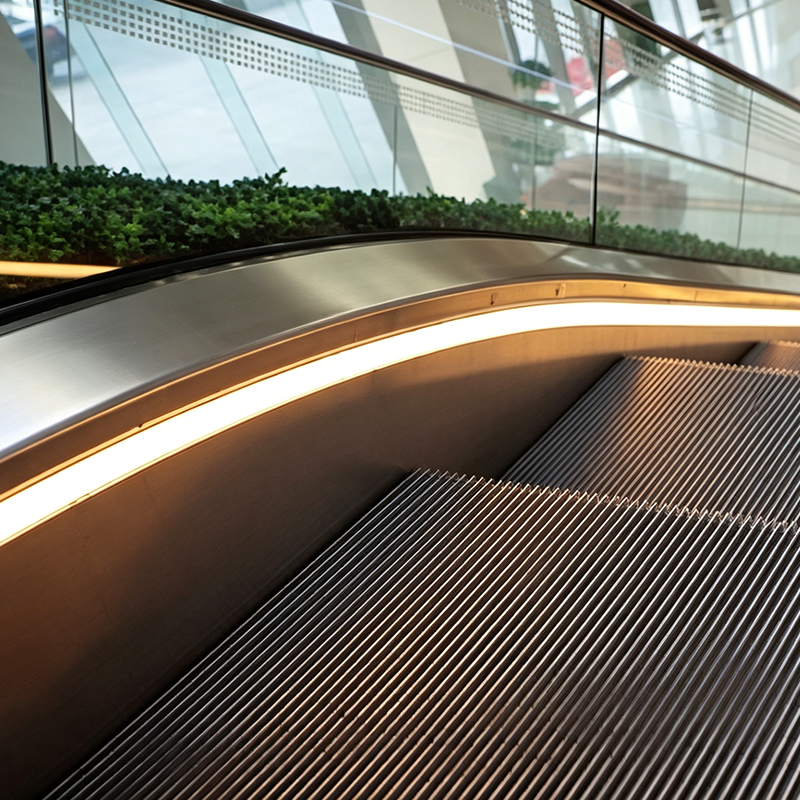
The heavy-duty public traffic escalator described in this article is engineered for demanding transportation environments. It combines a reinforced structure, high-capacity drive system, durable step-chain components, monitored handrail movement, emergency stopping devices, and maintenance-oriented mechanical design. Its outside-type configuration and public transportation classification make it suitable for applications where equipment must withstand frequent operation and substantial passenger loads.
The product is also notable for its high lifting capability. The escalator test-tower installation reaches a traveling height of 25,000 millimeters, demonstrating the ability to address large vertical transportation requirements. A 1,000-millimeter step width, a rated speed of 0.65 meters per second, four horizontal steps, and a dual 37-kilowatt traction-machine arrangement provide a balanced combination of capacity, stability, and operational strength.
Although many escalators are designed primarily for commercial buildings with moderate traffic, public transportation escalators must meet a more demanding set of expectations. They need to operate for extended periods, tolerate repeated starting and stopping, provide stable passenger movement, and remain serviceable over a long working life. This heavy-duty design addresses these requirements through a combination of structural engineering, intelligent control, reinforced transmission components, and systematic manufacturing quality control.
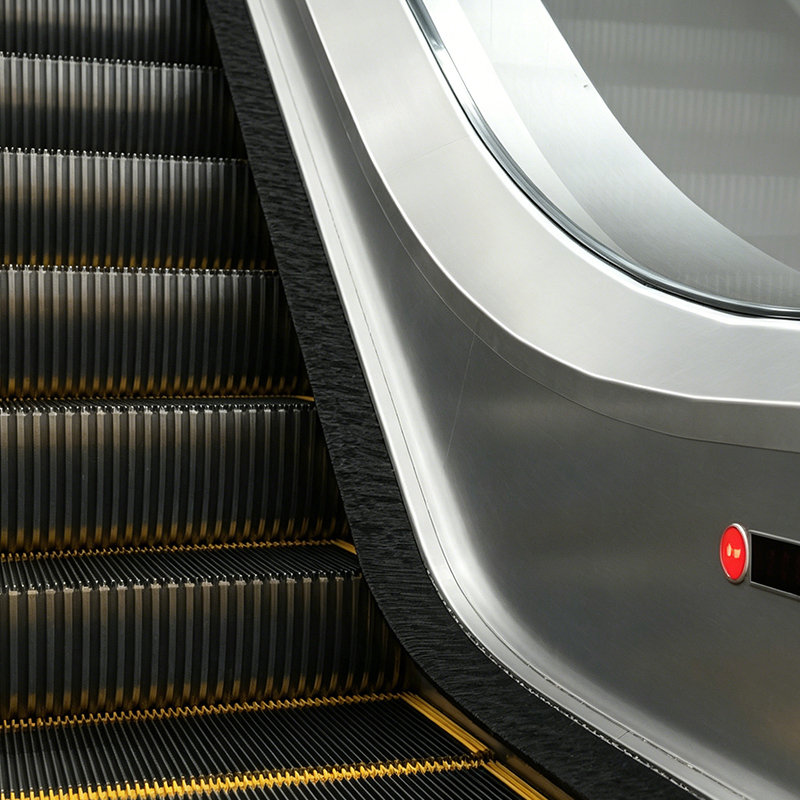
Heavy Duty Public Traffic Escalator for Subway & Airport Standards
Designed for High-Intensity Public Transportation Environments
Public transportation facilities experience traffic patterns that differ significantly from ordinary office buildings. Passenger demand may rise sharply during morning and evening commuting periods, flight departures, train arrivals, special events, holidays, and emergency situations. An escalator installed in such a location must be prepared for heavy traffic even when average daily usage appears moderate.
The product is identified as an outside-type heavy-duty escalator for public transportation applications. This classification reflects its intended operating environment: subway stations, airports, railway stations, transport interchanges, and other locations where reliability and passenger throughput are fundamental design priorities.
Its structural concept is intended to withstand frequent use while maintaining smooth movement. The step chain, drive system, rollers, handrail mechanism, brakes, and control devices are all treated as interconnected parts of one transportation system. This approach is important because the failure or deterioration of one component can affect passenger comfort, operational continuity, and maintenance efficiency.
The escalator test-tower installation has a traveling height of 25 meters and a horizontal span of 51,847 millimeters. These dimensions demonstrate the product’s ability to serve substantial vertical connections rather than only short inter-floor transitions. In a subway station, this capability can be applied to connections between concourse levels and platforms. In an airport, it can support circulation between departure halls, arrival areas, transfer zones, and connecting walkways.
A 1,000-millimeter step width provides a practical passenger path for public facilities. It allows users to stand on one side while other passengers pass when local operating rules and site conditions permit. It also creates a more comfortable experience for travelers carrying hand luggage, backpacks, shopping bags, or small personal items.
The design emphasizes operational continuity. Instead of treating the escalator as a simple chain of steps, the engineering approach considers traction, turning radius, handrail synchronization, braking, roller loading, emergency access, and component replacement. This integrated design can help operators reduce avoidable downtime and maintain dependable service across the equipment’s life cycle.
Space Efficiency and Inclination Considerations
Escalator layout has a direct effect on construction cost and building utilization. In transportation facilities, available floor area is often restricted by structural columns, platform clearances, fire exits, utility corridors, ticketing zones, and passenger circulation requirements. A more compact escalator arrangement can help architects and engineers use the available site more effectively.
The product description presents a 35-degree space-saving escalator concept for locations where floor area is limited. A steeper incline can reduce the horizontal length required to overcome a given vertical height. This may be useful in office buildings, compact commercial developments, mezzanine connections, and selected public-building applications where the relevant safety code permits that configuration.
The technical specification for the public transportation test-tower installation lists an inclined angle of 30 degrees. This distinction is important. The 35-degree description represents a space-saving product concept, while the published test-tower data identifies a 30-degree configuration for the heavy-duty public transportation model. Final inclination, step arrangement, landing geometry, and operating parameters should always be confirmed according to the project design, applicable regulations, passenger-flow requirements, and local authority approvals.
A 30-degree escalator angle is widely associated with comfortable passenger movement in demanding public environments. It offers a balanced relationship between vertical transportation efficiency, perceived comfort, boarding and exiting behavior, and available building space. The actual selection should be based on the complete project context rather than on inclination alone.
The ability to adapt the equipment to different architectural requirements is a competitive advantage. Transportation projects rarely have identical structural conditions. Some require a long outdoor installation; others involve underground stations, elevated platforms, connecting bridges, or constrained indoor spaces. A manufacturer that can support different layouts, finishes, handrail colors, side-panel materials, step widths, and control arrangements gives project owners more flexibility.
Technical Performance at a Glance
The following specifications describe the escalator installed in the escalator test tower. They provide a reference for understanding the product’s scale, drive capacity, and principal mechanical configuration.
| Item | Specification |
|---|---|
| Type | Outside-type heavy-duty escalator for public transportation |
| Traveling height | 25,000 millimeters |
| Horizontal span | 51,847 millimeters |
| Inclined angle | 30 degrees |
| Step width | 1,000 millimeters |
| Rated speed | 0.65 meters per second |
| Quantity of flat steps | 4 |
| Traction machine power | 37 kilowatts × 2 |
| Inverter power | 75 kilowatts |
| Diameter of step main roller | 100 millimeters |
| Diameter of step secondary roller | 100 millimeters |
| Handrail drive mode | Sprocket-driven |
The use of two 37-kilowatt traction machines provides substantial drive capacity for a large public transportation installation. The 75-kilowatt inverter supports controlled motor operation and can contribute to smooth acceleration, deceleration, and energy management when properly configured with the complete control system.
The rated speed of 0.65 meters per second is suited to the efficient movement of passengers while supporting controlled boarding and exiting. In a public facility, speed must be considered together with step width, landing design, passenger density, visibility, handrail movement, emergency systems, and local regulations.
Four horizontal steps are installed to enlarge the transition and buffer distance at the upper and lower landings. This arrangement helps passengers adapt to the change between the inclined step band and the level landing area. It also provides additional space for boarding and exiting, which is especially valuable in busy stations and terminals.
The 100-millimeter diameter specification for both the main and secondary step rollers reflects a robust roller arrangement. Larger, durable rollers can support stable movement and reduce localized loading when combined with suitable bearings, axles, guides, lubrication, alignment, and manufacturing tolerances.
Passenger Safety as a Systematic Design Objective
Passenger safety depends on the interaction of mechanical construction, electronic monitoring, operating procedures, signage, maintenance, and building design. No single device can replace a complete safety strategy. For this reason, the escalator incorporates several layers of protective design intended to assist operators and protect passengers during normal and abnormal conditions.
Handrail Speed Monitoring
The handrail must move in coordination with the steps so that passengers can maintain a stable grip while riding. Handrail speed monitoring helps detect abnormal differences between handrail movement and step movement. If an unsafe condition is detected, the control system can initiate an appropriate response according to the configured safety logic.
Handrail movement is supported by a sprocket-driven arrangement. The product design also describes a V-shaped handrail concept. This profile reinforces tensile strength, increases the contact area at the handrail rotary end, enlarges frictional engagement, and supports effective handrail movement. A carefully engineered handrail drive can help reduce slippage and improve long-term operational consistency.
Step Demarcation and Passenger Awareness
Step demarcation helps passengers identify the edges and boundaries of individual steps. Clear visual markings are particularly important in crowded stations, airports with luggage traffic, and facilities where passengers may be distracted by signs, mobile devices, announcements, or flight information.
Step visibility should be coordinated with lighting, landing design, comb-plate visibility, side panels, and facility signage. The escalator can be customized with different step finishes and side-panel materials to align with the visual and functional requirements of the site.
Emergency Stop Switches
Emergency stop switches are positioned at the upper and lower entrances and exits. Additional emergency stop switches are also placed at intervals of approximately five meters on the outer cover plate. This arrangement is intended to give passengers, staff, or maintenance personnel more opportunities to stop the escalator quickly when a sudden event occurs.
Emergency stopping systems are particularly important in long installations and outdoor or semi-outdoor environments where the distance between landings may be considerable. The location and accessibility of the switches should be coordinated with the final installation drawings, local safety standards, operational procedures, and station-management practices.
Auxiliary Braking
The escalator includes an auxiliary brake positioned in the upper machine-room area. It operates according to a friction-based principle through a wedge and brake disc installed on the drive spindle. An auxiliary braking arrangement provides an additional braking layer beyond the primary stopping function.
Redundant or supplementary braking is valuable in public transportation equipment because the escalator may carry a large number of passengers and may be installed over a significant vertical distance. Proper inspection, adjustment, testing, and replacement of wear components remain essential to ensure that the braking system performs as intended.
Horizontal Steps and Transition Safety
The four horizontal steps extend the buffer distance during passenger movement. This design gives riders more time to adjust their posture before entering or leaving the escalator. It can also help reduce abrupt changes in foot position at the upper and lower transition areas.
Transition safety is influenced by many factors, including step speed, handrail speed, comb-plate condition, landing length, lighting, passenger density, and the presence of baggage. The four-step arrangement should therefore be viewed as one part of a broader safety system designed for public traffic.
Reinforced Step-Chain and Roller Engineering
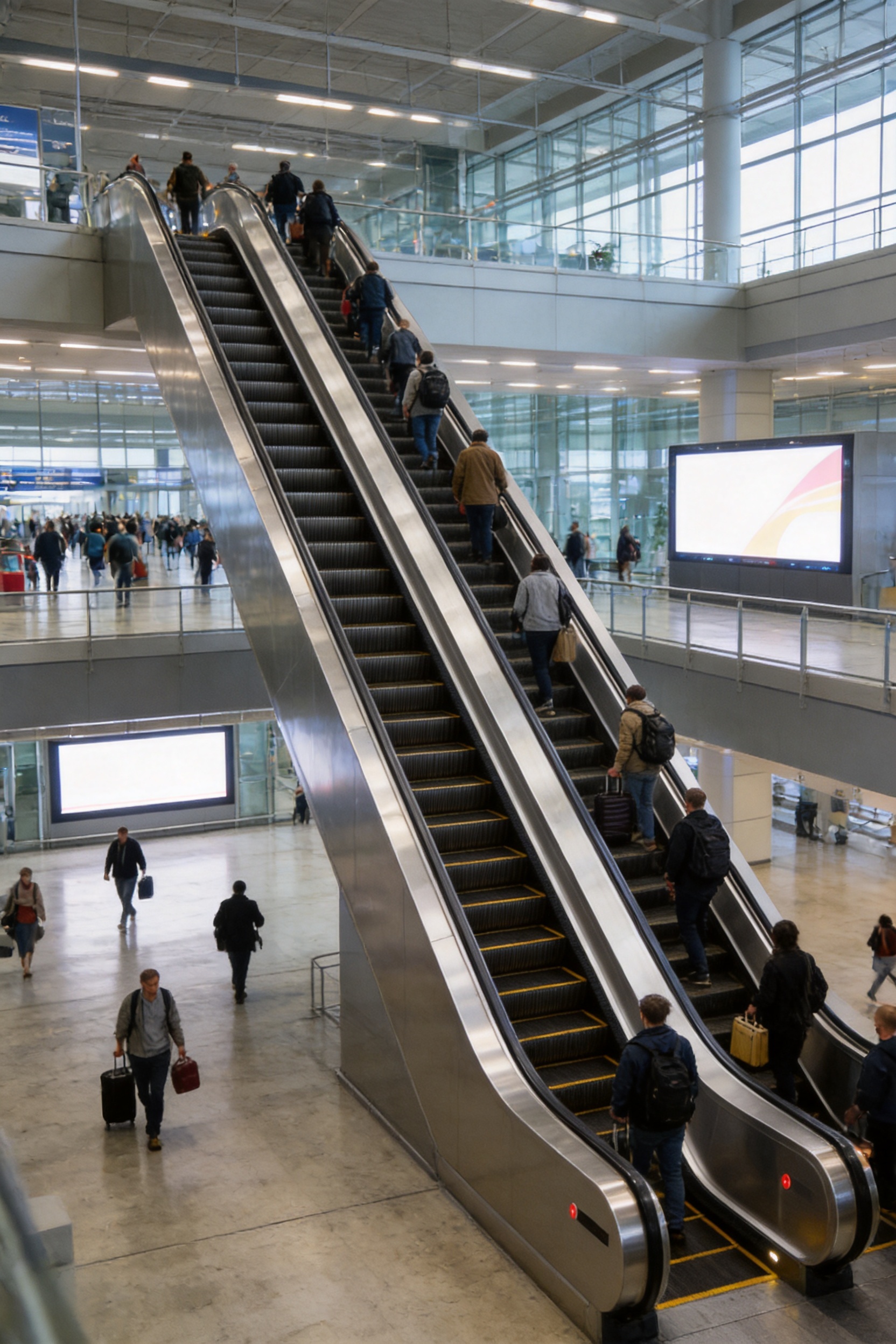
The step chain is one of the most important load-bearing and motion-transmitting components in an escalator. It must carry repeated passenger loads while traveling through straight sections, curved transitions, and turning areas. The product uses reinforced materials and structural design intended to increase tensile strength and improve resistance to long-term operating stress.
A notable feature is the positioning of the roller outside the step chain. The main and secondary rollers have a diameter of 100 millimeters. This configuration is intended to reduce compressed loading on the main wheel and extend the service life of the roller. The separation of roller and chain functions can also support easier inspection and more targeted maintenance.
The roller can be renewed independently, which may help reduce repair time. In traditional maintenance situations, replacing a larger assembled component may require more extensive disassembly and longer equipment shutdowns. An independently replaceable roller can allow service teams to address wear at the component level, subject to the manufacturer’s maintenance instructions and the condition of surrounding parts.
Maintenance-oriented design is especially important in subway and airport applications. Operators may have limited access windows, often scheduling work overnight or during short periods of reduced traffic. A component that can be inspected and replaced efficiently can contribute to improved availability and lower labor requirements.
Durability is not determined by material strength alone. It also depends on accurate machining, heat treatment where applicable, dimensional control, alignment, lubrication, surface finishing, bearing quality, and correct assembly. These elements must work together so that the step chain and rollers move smoothly without excessive vibration, friction, or uneven loading.
Drive System and Transmission Capacity
The drive system converts motor power into controlled escalator movement. In a heavy-duty unit, the drive must deliver sufficient torque during starting, acceleration, continuous operation, and passenger loading. It must also withstand repeated operating cycles without excessive temperature rise, vibration, or mechanical wear.
The public transportation test-tower installation uses two 37-kilowatt traction machines. The combined arrangement provides a substantial power reserve for a large installation with a 25-meter traveling height and a 1,000-millimeter step width. The dual-machine concept can also support balanced power transmission when engineered and controlled correctly.
The product design increases the driving force and turning space of the transmission system. The turning radius is enlarged to create additional room for the transmission path, while the drive spindle diameter is increased to improve bearing capacity. These changes can help distribute mechanical stress more effectively and support stable movement through the drive section.
A larger drive spindle can be beneficial when the equipment is exposed to high torque, frequent operation, and substantial passenger loading. However, the spindle must be integrated with suitable bearings, couplings, gear components, shafts, keys, seals, and structural supports. The complete drive assembly should be inspected as a system during commissioning and periodic maintenance.
The 75-kilowatt inverter allows the traction motors to be operated with controlled electrical characteristics. Variable-frequency control can support smooth starts and stops, help manage operating speed, and contribute to energy-saving strategies. The final control behavior depends on the selected drive parameters, load conditions, standby configuration, safety circuit, and project requirements.
Energy Efficiency and Operating Cost Management
Public transportation escalators may operate for long hours each day. Energy consumption can therefore represent a significant portion of operating cost, particularly in facilities with many escalators and moving walks. An energy-conscious design should combine efficient motors, suitable inverter control, standby operation, and intelligent operating policies.
The product incorporates high-efficiency motor concepts and standby mode. When passenger demand is low, a properly configured standby function can reduce unnecessary energy use while keeping the escalator ready for operation. Depending on the control strategy, the equipment may operate at reduced speed or respond to passenger detection and facility commands.
Energy management must be balanced with passenger convenience and safety. In a subway station during peak hours, continuous operation may be more appropriate than standby operation. In an airport transfer corridor with variable traffic, controlled standby may offer greater savings. A site-specific control program can take into account passenger volume, operating schedules, lighting, temperature, and security requirements.
Mechanical efficiency also contributes to energy performance. Correct roller alignment, smooth chain movement, effective lubrication, low-friction bearings, and proper handrail engagement reduce resistance in the system. Preventive maintenance is therefore not only a reliability measure; it can also help avoid unnecessary energy consumption caused by mechanical drag or component deterioration.
Operators should evaluate total cost of ownership rather than purchase price alone. Initial equipment cost, installation, energy use, inspection, spare parts, labor, downtime, component life, and modernization requirements all influence the long-term economics of an escalator. A durable product with maintenance-friendly components may provide better value over its operating life.
Outdoor and Semi-Outdoor Application Capability
The product category identifies the escalator as an outdoor escalator, while its technical type is described as an outside-type heavy-duty public transportation unit. Outdoor and semi-outdoor installations introduce additional challenges compared with fully enclosed indoor systems.
Rain, humidity, dust, temperature variation, solar exposure, wind, airborne particles, and drainage conditions can affect mechanical and electrical components. Outdoor escalators require careful attention to cover design, corrosion protection, sealing, drainage, electrical enclosures, surface treatment, lighting, and maintenance access.
Site planning should include protection from standing water, proper drainage around the lower pit, safe access to machine rooms, adequate ventilation, and inspection provisions for exposed components. The selected materials and finishes should be appropriate for the local climate and the expected environmental conditions.
Outdoor public transportation facilities also require strong visibility. Passengers should be able to identify the direction of travel, step edges, handrails, emergency devices, and landing areas in changing weather and lighting conditions. Customizable side panels, handrail colors, step finishes, and lighting arrangements can help integrate the escalator into the surrounding architecture while preserving functional visibility.
Because outdoor conditions vary widely, final material selection should be agreed during the engineering stage. Coastal environments, industrial zones, cold regions, and high-humidity locations may require different corrosion-protection and enclosure solutions. A complete project specification should address these factors before production begins.
Customization for Airports, Subways, and Major Buildings
One of the product’s practical advantages is its ability to accommodate aesthetic and functional customization. Transportation facilities often have strict architectural identities and must coordinate every visible element with wall finishes, floor materials, lighting, signage, advertising zones, and wayfinding systems.
Available customization areas may include step finishes, handrail colors, side-panel materials, balustrade treatments, protective covers, control interfaces, and installation arrangements. These options allow the escalator to support both the visual language and operational objectives of the facility.
Airports may prioritize a clean, modern appearance, resistance to luggage-related wear, strong lighting, and simple integration with passenger information systems. Subway operators may focus on vandal resistance, ease of cleaning, high-frequency operation, emergency access, and long-term maintainability. Shopping centers and office buildings may place greater emphasis on appearance, quietness, compact layout, and coordination with interior design.
Customization should never compromise safety or maintainability. Decorative materials must not obstruct inspection points, emergency devices, ventilation, drainage, or access panels. The most effective approach is to customize visible surfaces and user-interface elements while preserving the standardized engineering principles of the structural and safety systems.
Manufacturing Strength and Quality Management
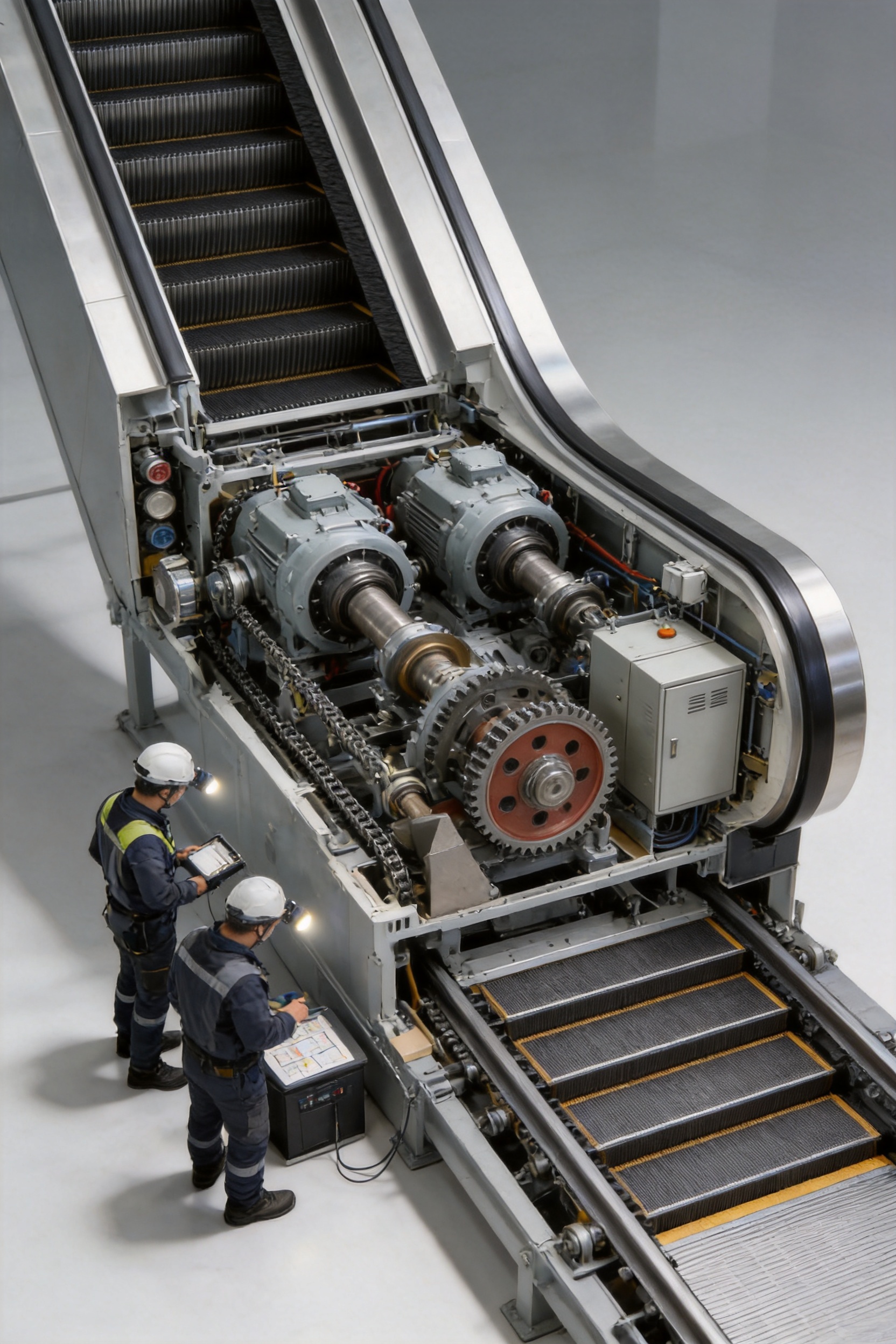
Advanced product performance depends on the manufacturer’s ability to control the entire process from design through after-sales service. The company behind this product is a comprehensive elevator manufacturer integrating design, research and development, manufacturing, marketing, installation, and service.
Its manufacturing base uses intelligent production concepts associated with Industry 4.0. Automated production lines, data collection, connected equipment, and closed-loop quality management can improve consistency and traceability across the manufacturing process. These capabilities are particularly valuable for escalators because the equipment contains many large, precisely aligned, and mutually dependent components.
Design and research teams can use engineering analysis to evaluate structural strength, drive capacity, roller loading, step-chain behavior, handrail movement, braking performance, and installation constraints. Manufacturing teams then translate those designs into fabricated frames, drive systems, steps, chains, rollers, balustrades, controls, and safety components.
A closed-loop quality system means that information from inspection, production, installation, and service can be used to improve later stages. For example, a recurring installation issue may lead to a design adjustment, a revised assembly procedure, improved packaging, or a more detailed commissioning checklist. This feedback cycle is more effective than treating quality as a final inspection conducted only after production is complete.
The company reports compliance with ISO9001, ISO14001, and OHSMS18001 management standards. ISO9001 relates to quality management, ISO14001 addresses environmental management, and OHSMS18001 refers to occupational health and safety management. These systems can provide a framework for documented procedures, risk management, process monitoring, environmental responsibility, and workplace safety.
Quality management is especially important for export projects. Products may be installed in countries with different climatic conditions, building practices, electrical systems, inspection procedures, and transportation regulations. Consistent documentation, traceable production, and professional technical communication help reduce risks during international project delivery.
The company also maintains capabilities in low-speed, medium-speed, high-speed, and ultra-high-speed elevator development, in addition to passenger elevators, freight elevators, escalators, moving walks, and related solutions. This broad product experience can support a more complete understanding of vertical transportation planning.
Why the Design Can Compete in Demanding Projects
Competition in the escalator market is not determined by a single specification. Project owners and consultants normally evaluate safety, durability, passenger capacity, service response, energy use, customization, documentation, installation capability, and supplier reliability together.
This heavy-duty escalator offers several characteristics that can strengthen its position in competitive procurement.
High-Capacity Public Traffic Configuration
The outside-type heavy-duty classification, 1,000-millimeter step width, dual traction-machine arrangement, and 25-meter test-tower height demonstrate a configuration aimed at large public facilities rather than light-duty private use. This makes the product relevant to subway and airport projects where passenger flow and operating hours are demanding.
Maintenance-Oriented Roller Structure
The external roller arrangement and independently renewable roller design can simplify targeted maintenance. Reducing the need to replace large assemblies may help shorten service periods, manage spare-parts inventory, and control lifecycle costs.
Additional Braking and Emergency Controls
The auxiliary brake and strategically positioned emergency stop switches provide multiple layers of response capability. These features are valuable in long escalators and high-density passenger environments, where rapid intervention may be essential.
Strong Transmission Engineering
The enlarged turning radius, increased drive spindle diameter, and reinforced step-chain structure address the mechanical stresses associated with heavy traffic. A product that emphasizes load distribution and component durability can offer a stronger operational foundation than a conventional light-duty design.
Adaptable Appearance and Installation
Customizable steps, handrails, and side panels allow the escalator to fit a wide range of architectural settings. This is an advantage when a project requires technical performance without sacrificing a coherent visual identity.
Integrated Manufacturing and Service Capability
Design, research, production, installation, and after-sales service under one organizational structure can improve communication and accountability. It can also reduce the risk of disconnected responsibilities between equipment suppliers, installers, and service providers.
These advantages do not eliminate the need for project-specific verification. Every major installation should be reviewed against local codes, fire and life-safety requirements, accessibility rules, electrical standards, environmental conditions, structural loads, inspection procedures, and passenger-flow calculations.
Installation Planning and Project Coordination
Escalator installation should begin with accurate site information. The project team needs to confirm the traveling height, horizontal span, inclination, step width, upper and lower landing dimensions, machine-room arrangement, support points, access routes, power supply, drainage, ventilation, fire protection, and maintenance clearances.
For an outside or semi-outdoor escalator, the site survey should also identify exposure to wind, rainfall, snow, dust, salt spray, direct sunlight, and temperature extremes. The supporting structure must be capable of carrying the escalator’s dead load, passenger load, dynamic forces, and maintenance loads.
Coordination with architects is necessary for balustrade alignment, ceiling clearances, floor finishes, handrail interfaces, lighting, signage, and protective barriers. Coordination with electrical engineers is required for power capacity, inverter operation, grounding, emergency circuits, control panels, communication systems, and backup arrangements where applicable.
Transport authorities and facility operators should participate in the review of emergency devices, access panels, evacuation procedures, inspection routes, and operational controls. The final arrangement should enable trained personnel to reach critical components safely and efficiently.
Before handover, the escalator should undergo commissioning and testing. Typical checks include step alignment, comb-plate condition, handrail speed, emergency stops, brake response, safety circuits, noise and vibration, direction controls, lighting, drainage, protective covers, and operation under representative loading conditions. Test procedures must follow the applicable standards and approved project documentation.
Maintenance and Lifecycle Reliability
Even the strongest escalator requires systematic maintenance. Preventive maintenance helps identify wear before it becomes a safety or availability problem. Service teams should inspect the step chain, rollers, guides, drive components, handrails, brakes, comb plates, safety switches, electrical cabinets, inverter systems, lighting, fasteners, and structural connections.
Inspection intervals should be determined by operating hours, passenger volume, environmental exposure, local regulations, and the manufacturer’s service recommendations. A subway escalator operating continuously in a dusty underground environment may require a different maintenance schedule from an airport unit operating in a clean, climate-controlled terminal.
Rollers deserve particular attention because they influence step movement, noise, vibration, and load distribution. Signs of flat spots, unusual noise, excessive play, surface damage, or abnormal wear should be investigated promptly. The independent renewal design can support efficient replacement, but service personnel must also examine the chain, axle, guide tracks, bearings, and adjacent components.
Handrail inspection should include surface condition, tension, speed synchronization, drive engagement, and the condition of the rotary ends. The V-shaped handrail concept is intended to improve tensile strength and frictional contact, but correct adjustment and cleaning remain necessary for reliable operation.
Brake inspection is essential. Both primary and auxiliary brake functions should be checked according to approved procedures. Brake discs, wedges, friction surfaces, sensors, actuators, and control circuits must be maintained within specified conditions. Emergency stop switches should be tested for accessibility and correct response without interrupting normal public operation unnecessarily.
Maintenance records should document inspections, adjustments, replaced parts, faults, test results, and technician observations. Digital records can help operators identify recurring issues, schedule parts in advance, and make better decisions about modernization or replacement.
Passenger Comfort and Operational Experience
Passenger perception is shaped by more than speed. Smooth acceleration, steady step movement, appropriate handrail synchronization, low vibration, manageable noise, clear markings, good lighting, and a clean appearance all contribute to confidence and comfort.
The precision-engineered step chain and drive system are intended to support quiet and stable operation. The enlarged transmission space and durable rollers can help reduce irregular mechanical movement when the system is correctly aligned and maintained.
Passenger comfort is particularly important in airports, where travelers may be carrying luggage, assisting children, or moving between flights under time pressure. In subway stations, smooth operation can help manage large passenger flows without creating hesitation at the entrances and exits.
Handrail color and side-panel finishes can improve visual guidance. Strong contrast between the step demarcation and step surface can help passengers identify safe standing areas. Clear directional signs and appropriate landing lighting should complement the escalator’s physical design.
Quiet operation is also valuable in enclosed stations, terminals, offices, and commercial areas. Excessive vibration or noise may indicate wear, misalignment, insufficient lubrication, damaged rollers, or drive-system issues. Regular monitoring can protect both passenger comfort and mechanical reliability.
Application Examples
Subway and Metro Stations
Subway stations often require escalators to connect deep platforms with concourses, ticket halls, entrances, and interchange corridors. These systems may operate for long hours and experience intense passenger surges. A heavy-duty configuration with a wide step, strong drive system, multiple emergency switches, and additional braking is suitable for this type of demand.
Underground installations require attention to dust, ventilation, drainage, water ingress, fire separation, and limited maintenance access. The project design should provide safe routes for technicians and adequate space for component inspection and replacement.
Airports
Airports need clear and dependable passenger circulation between arrival halls, departure levels, gates, baggage areas, parking structures, and transit connections. Travelers may use escalators with wheeled luggage, so landing areas, side protection, signage, and operating procedures require careful planning.
Airport environments also place a high value on appearance. Custom handrails, side panels, step finishes, and integrated lighting can help the escalator match the terminal’s interior design. Energy-saving standby operation may be considered in corridors with uneven passenger demand.
Railway Stations and Transit Interchanges
Railway stations experience passenger peaks associated with train schedules. A reliable escalator can help distribute passengers quickly between platforms and concourses. Four horizontal steps can provide a longer transition area, while multiple emergency switches can support rapid intervention along a long installation.
Commercial and Mixed-Use Complexes
Large shopping centers, exhibition halls, stadiums, and mixed-use buildings may also require heavy-duty escalators. These facilities can experience short periods of very high traffic during events, sales campaigns, conferences, or public gatherings. A durable public-traffic design can provide additional capacity and resilience compared with equipment intended only for normal office use.
Office Buildings and Compact Connections
The associated 35-degree space-saving concept can serve office buildings and compact mezzanine connections where reducing the floor footprint is important. In these situations, designers must confirm that the selected inclination and configuration comply with all applicable requirements. The same emphasis on quiet operation, energy efficiency, safety monitoring, and customizable finishes remains relevant.
Environmental Responsibility and Intelligent Manufacturing
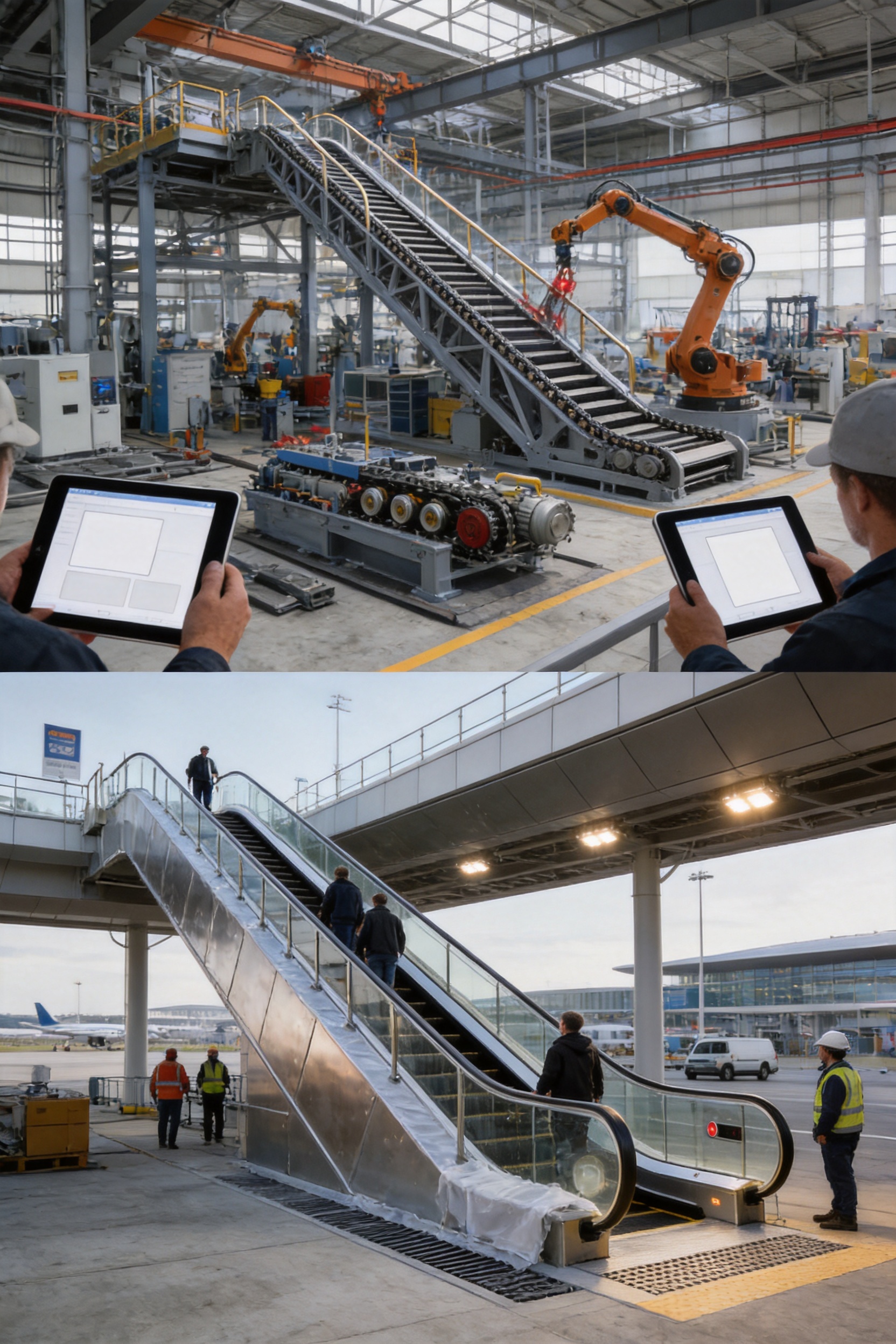
Environmental performance includes more than reducing electricity consumption. It also involves efficient material use, controlled production, responsible waste management, durable components, maintainable assemblies, and long service life. Equipment that remains reliable for many years can reduce the environmental impact associated with premature replacement.
The manufacturer’s ISO14001-oriented environmental management framework provides a basis for managing production impacts systematically. Intelligent manufacturing can improve material planning, reduce process errors, support equipment utilization, and create better traceability for quality and resource use.
Digital technologies, big-data methods, and Internet of Things capabilities can support equipment monitoring and service management. Depending on the project configuration, data may assist with fault analysis, maintenance scheduling, operating-hour tracking, and performance evaluation. Such tools should be implemented with appropriate cybersecurity, data protection, and operational governance.
Energy-saving motors and inverter control can reduce operating consumption when matched to actual traffic conditions. Standby modes may reduce energy use during low-demand periods, while preventive maintenance can preserve mechanical efficiency. These measures are most effective when they are incorporated into a complete facility-management strategy.
Global Project Support
International elevator and escalator projects require more than equipment shipment. They require technical drawings, installation guidance, commissioning support, spare-parts planning, operator training, inspection documentation, and after-sales communication.
The manufacturer exports products to multiple countries and regions and has experience in integrated elevator solutions. This international orientation can help project teams coordinate technical information across different languages, construction practices, and approval processes.
For an overseas project, the purchaser should request confirmation of applicable standards, electrical requirements, environmental ratings, documentation packages, testing procedures, warranty conditions, recommended spare parts, and local service arrangements. Early clarification reduces the risk of redesign or delay after manufacturing has begun.
Installation quality is as important as factory quality. The escalator must be transported, stored, assembled, aligned, wired, tested, and commissioned correctly. A professional supplier should cooperate with the local contractor and provide practical instructions for lifting, positioning, joining, adjustment, and inspection.
After handover, operators should receive training on normal operation, emergency stopping, visual inspection, cleaning, reporting faults, and restricting access to technical areas. Clear responsibilities between the building owner, operator, maintenance contractor, and equipment manufacturer help support long-term safety.
Selection Guide for Project Owners
When evaluating a heavy-duty public transportation escalator, buyers should consider the following questions.
First, what passenger volume is expected during normal, peak, and emergency conditions? The answer affects step width, operating schedule, speed, arrangement, and the number of escalators required.
Second, what is the required traveling height and horizontal span? These dimensions determine the structural arrangement, support points, machine-room requirements, transportation logistics, and installation sequence.
Third, is the escalator indoor, outdoor, or semi-outdoor? Environmental conditions influence materials, protective covers, drainage, electrical enclosures, coatings, and service intervals.
Fourth, which inclination is appropriate? A 35-degree space-saving concept may reduce the required footprint in suitable applications, while the 30-degree public transportation test-tower configuration offers a different balance of comfort and layout efficiency. The final selection must comply with local rules and the project’s operational goals.
Fifth, how will maintenance be performed? Buyers should examine access to rollers, step chains, drive assemblies, brakes, control cabinets, and emergency devices. The ability to renew selected components independently can be an important lifecycle advantage.
Sixth, what level of customization is needed? Architectural projects may require specific handrail colors, side-panel materials, step finishes, protective features, or integration with surrounding structures.
Finally, what service and spare-parts support will be available after installation? A product’s value depends on its long-term support as much as its initial specifications.
Frequently Asked Questions
What type of facility is this escalator designed for?
It is designed primarily for heavy public traffic applications, including subway stations, airports, railway stations, transport interchanges, exhibition centers, shopping complexes, and other buildings with frequent passenger movement. It may also be adapted for selected office and commercial applications.
What is the difference between the 35-degree description and the 30-degree technical specification?
The 35-degree description refers to a space-saving escalator concept intended for compact installations. The technical test-tower data for the heavy-duty public transportation unit lists a 30-degree inclination. The final angle should be selected according to the exact model, project layout, applicable regulations, and passenger-flow requirements.
What is the rated speed of the test-tower installation?
The listed rated speed is 0.65 meters per second. Actual operating settings and permitted speed may depend on local regulations, project requirements, controls, and commissioning conditions.
What is the step width?
The published test-tower specification lists a step width of 1,000 millimeters. This width is appropriate for substantial passenger flow and can provide useful space for travelers carrying personal belongings or luggage.
Why are four horizontal steps used?
Four horizontal steps increase the transition and buffer distance at the upper and lower landings. This gives passengers more time to adjust their posture when entering or exiting the inclined step band.
How does the roller arrangement support maintenance?
The roller is positioned outside the step chain, and both the main and secondary rollers are specified at 100 millimeters in diameter. The design is intended to reduce compressed loading on the main wheel and allows the roller to be renewed independently, which may shorten repair periods when replacement is required.
What braking protection is provided?
The escalator includes an auxiliary brake located in the upper machine-room area. It uses a friction principle involving a wedge and brake disc installed on the drive spindle. The complete braking system must be inspected and tested according to the manufacturer’s instructions and applicable safety requirements.
Where are the emergency stop switches located?
Emergency stop switches are provided at the upper and lower entrances and exits. Additional switches are positioned at intervals of approximately five meters on the outer cover plate to support rapid stopping along the escalator length.
Can the escalator be customized for a specific building?
Yes. Available customization may include step finishes, handrail colors, side-panel materials, and other visible design elements. Customization must be coordinated with safety, inspection, cleaning, drainage, access, and maintenance requirements.
Can it be installed outdoors?
The product category includes outdoor escalator applications, and the technical type is identified as an outside-type unit. Outdoor projects require dedicated evaluation of weather exposure, corrosion protection, drainage, covers, electrical enclosures, lighting, temperature, and maintenance access.
How does the manufacturer support quality?
The manufacturer integrates design, research and development, manufacturing, installation, and after-sales service. Its stated capabilities include Industry 4.0 intelligent manufacturing, automated production lines, data and Internet of Things technologies, and a closed-loop quality-control system. It also reports management-system compliance with ISO9001, ISO14001, and OHSMS18001.
Is the escalator energy efficient?
The product incorporates high-efficiency motor concepts, inverter control, and standby-mode operation. Energy performance depends on the selected configuration, passenger demand, control strategy, operating schedule, maintenance condition, and local energy-management requirements.
What should be confirmed before ordering?
Purchasers should confirm the required height, span, inclination, step width, speed, environmental conditions, structural supports, electrical supply, safety standards, finishes, control functions, installation responsibilities, commissioning procedures, warranty terms, spare parts, and local maintenance arrangements.
Conclusion
A heavy-duty public traffic escalator must combine capacity, safety, durability, maintainability, and architectural adaptability. The product presented here is engineered around those requirements, with a 25-meter test-tower traveling height, a 1,000-millimeter step width, a 0.65-meter-per-second rated speed, four horizontal steps, dual 37-kilowatt traction machines, a 75-kilowatt inverter, reinforced step-chain construction, 100-millimeter rollers, sprocket-driven handrails, auxiliary braking, and multiple emergency stop switches.
Its competitive value comes from the way these features work together. The design addresses passenger flow, mechanical loading, emergency response, component replacement, energy management, outdoor installation, and visual customization. The roller arrangement and enlarged transmission space focus on durability and serviceability, while the handrail, braking, and emergency systems provide additional layers of protection.
The manufacturer strengthens the product proposition through integrated design and production capabilities, intelligent manufacturing, automated lines, digital technologies, closed-loop quality control, international management systems, and global service experience. These capabilities can help project owners obtain a more coordinated solution from initial engineering through installation and long-term maintenance.
For subway, airport, railway, and other major public facilities, the final equipment selection should be based on a complete project evaluation. Passenger demand, building geometry, local codes, environmental exposure, energy objectives, maintenance access, and lifecycle cost must all be considered. When properly specified, installed, commissioned, and maintained, this type of escalator can provide dependable vertical circulation for demanding public transportation environments.
References
1. Manufacturer-provided product information for the heavy-duty public transportation escalator and escalator test-tower installation.
2. Manufacturer-provided technical specifications covering traveling height, horizontal span, inclination, step width, speed, traction power, inverter capacity, rollers, and handrail drive configuration.
3. Manufacturer-provided engineering descriptions of the V-shaped handrail, external roller arrangement, reinforced step chain, enlarged transmission space, auxiliary brake, emergency stop switches, and four horizontal steps.
4. ISO 9001, Quality Management Systems: Requirements.
5. ISO 14001, Environmental Management Systems: Requirements with Guidance for Use.
6. OHSMS18001, Occupational Health and Safety Management System framework referenced in the supplied company information.
7. General principles of escalator planning, passenger-flow management, preventive maintenance, commissioning, and public transportation equipment safety.
Product: Heavy Duty Public Traffic Escalator for Subway & Airport Standards

Related Products
Related News
Built on safety, forging trust in vertical mobility.
lf you have any questions or need help, feel free to contact with our team.
 export@tenau.com.cn
 +86-18601458867
 +86-512-65059883
Elevator & Escalator
Factory Add
East of Xicheng Road, North of Lianyi Road, Nanxun Economic Development Zone, Nanxun District, Huzhou City, Zhejiang Province, P.R.China
Copyright © Tenau Elevator (China) Co., Ltd. All Rightd Reserved.
Custom High Quality Elevator Suppliers and World Brand Elevator Company