

 en
en Español
 русский
 中文简体
中文简体
Car Elevator Solutions for Safe Vertical Vehicle Transport
Content
- 1 Modern Parking Challenges and the Need for Vertical Vehicle Transport
- 2 Product Overview: A Machine Room Car Elevator Designed for Heavy-Duty Use
- 3 Key Advantages Over Ordinary Vehicle Lifting Solutions
- 4 Technical Strength: Smooth Movement, Accurate Leveling, and Strong Braking
- 5 Safety Engineering for Drivers, Vehicles, and Buildings
- 6 Structural Durability and Long Service Life
- 7 Comfort and Convenience for Real Users
- 8 Function Overview
- 9 Applications in Different Building Types
- 10 Advanced Manufacturing Strength Behind the Product
- 11 How Manufacturing Precision Improves Elevator Performance
- 12 Service Strength and Life-Cycle Support
- 13 Customization and Project Adaptability
- 14 Energy Efficiency and Environmental Considerations
- 15 Comparison With Common Alternatives
- 16 Why This Product Stands Out in Competitive Markets
- 17 Installation and Maintenance Considerations
- 18 Q and A Section
- 18.1 What is a car elevator?
- 18.2 How is this product different from a simple vehicle lift?
- 18.3 What load capacity does the elevator support?
- 18.4 Why is VVVF drive important for a car elevator?
- 18.5 Can cars enter from one side and exit from the other?
- 18.6 How does the elevator improve parking space efficiency?
- 18.7 What safety functions are available?
- 18.8 Is the car elevator suitable for commercial buildings?
- 18.9 Is the elevator suitable for private homes or villas?
- 18.10 What makes the manufacturer strong?
- 18.11 Does the elevator require regular maintenance?
- 19 Conclusion
- 20 References
- 21 Product: Car Elevator
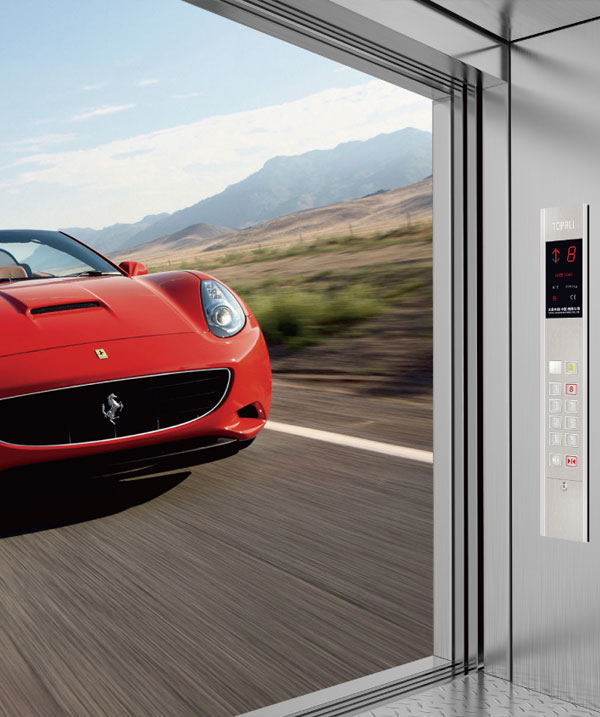
Urban development has changed the way buildings use space. As cities become denser, land becomes more valuable, and parking becomes more difficult, property owners need smarter ways to move vehicles vertically. A car elevator is one of the most effective solutions for modern parking structures, private residences, showrooms, service centers, hotels, commercial buildings, and mixed-use developments. It allows vehicles to travel between floors safely and efficiently, reducing ramp space, improving traffic flow, and helping architects create more flexible building layouts.
The car elevator described here belongs to the machine room elevator category and is designed specifically for vehicle transportation. Unlike ordinary passenger elevators, it is built for heavy loads, larger cabin dimensions, durable structures, and frequent vehicle access. Its purpose is clear: to give cars a safe, stable, and convenient vertical passage in buildings where traditional ramps are impractical, expensive, or space-consuming.
Tenau Elevator (China) Co., Ltd. applies mature elevator engineering, advanced manufacturing systems, and strict quality control to this car elevator solution. The product is designed around the actual dimensions, weight, entry requirements, and safety demands of various vehicles. With a rated load capacity commonly reaching 3 tons or more, a wide car area, convenient front and rear door configurations, stable drive technology, and multiple safety protections, the elevator provides reliable performance for demanding parking and vehicle-handling environments.
In a competitive elevator market, the difference between an ordinary vehicle lift and a professionally engineered car elevator is significant. A high-quality car elevator must not only lift a heavy load; it must do so smoothly, repeatedly, safely, and with accurate leveling. It must protect the vehicle, the driver, the building structure, and maintenance personnel. It must reduce noise and vibration, resist corrosion, support long service life, and adapt to different project conditions. These are the areas where the product demonstrates its value.
Modern Parking Challenges and the Need for Vertical Vehicle Transport
The rapid growth of vehicle ownership has created serious parking pressure in urban areas. In city centers, residential communities, office towers, hotels, hospitals, and commercial complexes, the space needed for conventional parking ramps can be difficult to justify. Ramps require long circulation paths, large turning radii, and substantial floor area. In many projects, a ramp may occupy space that could otherwise be used for parking bays, retail areas, storage, residential amenities, or building services.
A car elevator changes this equation by replacing sloped vehicular circulation with a vertical lifting path. Vehicles enter the elevator cabin at one level and exit at another, allowing parking levels to be stacked more efficiently. In many projects, this can save a significant amount of construction area. The product information highlights a construction area saving of up to 80 percent in suitable applications, which is a compelling advantage for developers and architects seeking efficient building layouts.
Vertical vehicle transport is especially useful in narrow sites, underground parking garages, car showrooms, luxury villas, repair workshops, museums, vehicle storage facilities, and urban redevelopment projects. In these scenarios, a ramp may be impossible or may reduce the economic value of the building. A car elevator provides a compact, controlled, and safe solution.
The growth of electric vehicles also strengthens the demand for intelligent parking movement. As charging stations are installed on different levels, and as premium buildings seek clean and organized parking flow, elevators designed for vehicles become an important part of the overall building system. The car elevator supports this trend by offering stable transportation, accurate leveling, and a structure designed for the size and weight of modern cars.
Product Overview: A Machine Room Car Elevator Designed for Heavy-Duty Use
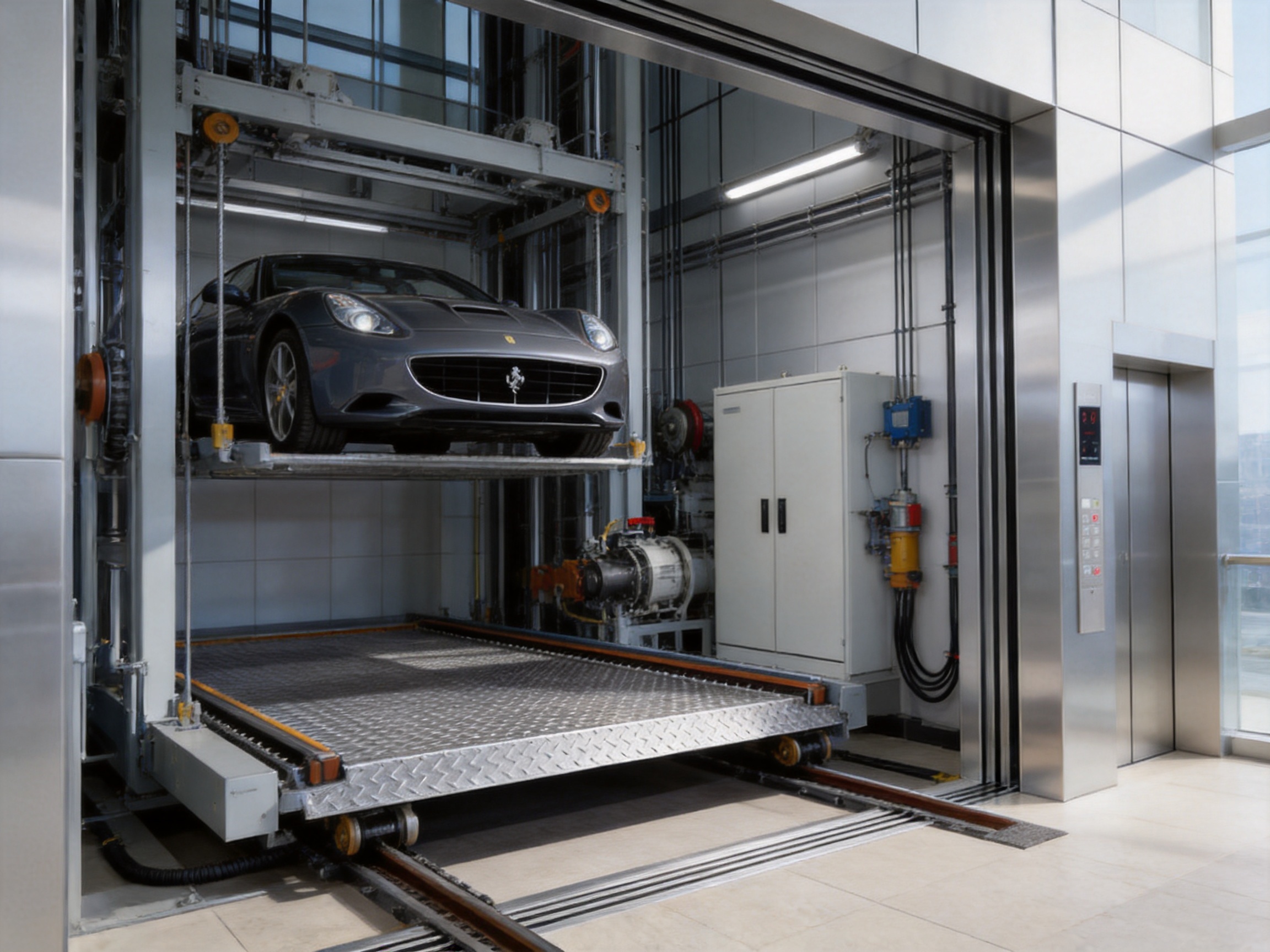
This car elevator is a machine room elevator, meaning that its drive and related equipment are installed in a dedicated machine room. This configuration offers reliable maintenance access, stable operation, and proven mechanical arrangement. For vehicle transportation, machine room design can be particularly attractive because it allows powerful equipment, robust braking performance, and easier inspection of key components.
The elevator is designed for the vertical transportation of cars, not for general passenger-only service. It considers the performance and dimensions of different vehicles, from compact cars to larger passenger vehicles, depending on the selected specifications. Its cabin area is larger than that of a typical passenger elevator, and its structure is strengthened to handle concentrated wheel loads and repeated entry and exit movements.
A major feature is its large load capacity. The product information indicates a normal load capacity of over 3 tons, enabling the elevator to handle many types of vehicles. This capacity is supported by a high-intensity car bottom, a strengthened car frame, thickened steel plates, and mechanical processing designed to ensure dependable cargo-carrying capability.
The elevator can be configured with through doors at the front and rear, allowing a vehicle to enter from one side and exit from the other. This design reduces the need for reversing inside a confined cabin, improves convenience, and enhances safety for drivers. In parking facilities, showrooms, and service buildings, through-door access can significantly improve operating efficiency.
Another important characteristic is the use of advanced control systems and variable-frequency speed regulation. From CPU or PC-based control modules to VVVF drive technology, the elevator is engineered to move smoothly and intelligently. This improves ride comfort, reduces starting and stopping shock, and supports precise floor leveling even under heavy load conditions.
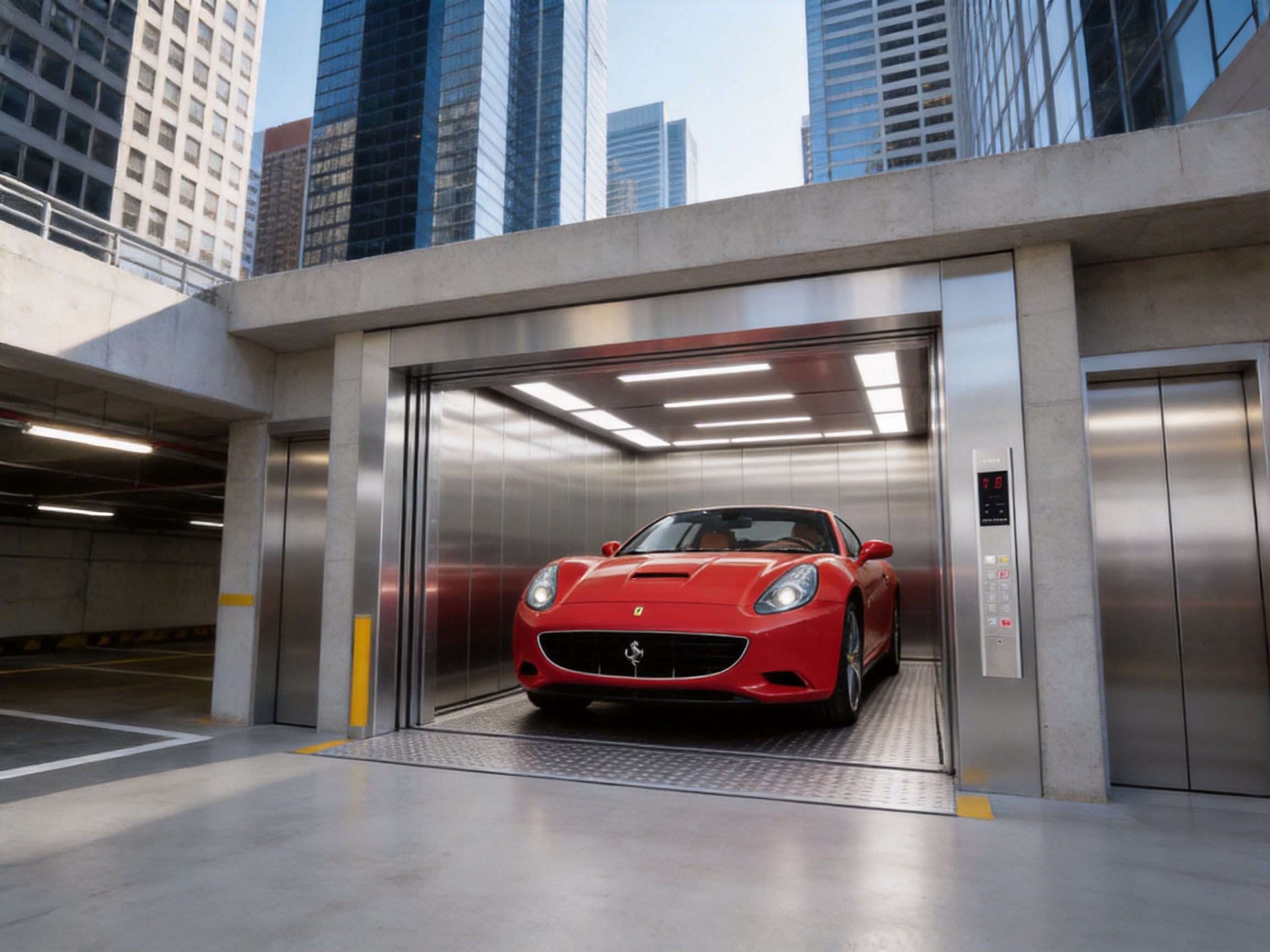
Key Advantages Over Ordinary Vehicle Lifting Solutions
Not all vehicle lifts are equal. Some systems are basic platforms intended for limited use, while a professionally manufactured car elevator is a complete vertical transportation system. The difference becomes clear in safety, comfort, durability, control precision, and adaptability. This car elevator offers several advantages over many ordinary vehicle lifting devices and low-grade competitors.
First, the elevator is based on mature elevator technology rather than a simple lifting platform concept. Elevator engineering includes coordinated systems for drive, control, guide rails, braking, door operation, leveling, safety circuits, emergency functions, and monitoring. This integrated approach gives the product stronger reliability than equipment that only focuses on lifting movement.
Second, the product emphasizes high load capacity and structural strength. Vehicle movement creates dynamic forces, wheel loads, and possible uneven loading conditions. A strong car bottom and reinforced frame are necessary to maintain long-term safety. The use of high-intensity materials and thickened steel plates gives the elevator the mechanical stability needed for repeated heavy-duty operation.
Third, the elevator offers smoother operation through VVVF drive technology. Compared with traditional direct-start systems, variable-frequency control can reduce acceleration shock, lower vibration, improve energy efficiency, and make the vehicle transport experience more stable. Drivers feel more secure when the cabin starts and stops gently, and the building benefits from reduced mechanical stress.
Fourth, the braking system is designed with large rated braking torque. For vehicle transport, braking performance is critical because the elevator must hold heavy loads securely. A strong brake contributes to safe stopping, reliable holding, and confident operation under demanding conditions.
Fifth, the product can include front and rear doors, wide door openings, and door operator technology suitable for vehicle access. Door width and access design are often overlooked by lower-end suppliers, but they determine whether drivers can use the elevator comfortably. A car elevator must allow safe entry and exit without excessive maneuvering. This product addresses that requirement directly.
Sixth, the elevator incorporates multiple safety protections, including safety gear, speed limiter, overload protection, terminal forced slow-down protection, door interlock protection, brake detection, safety circuit protection, emergency lighting, inspection operation, inching operation, and fire emergency return functions depending on configuration. These features create a more complete safety environment than simple lifting devices.
Seventh, the company behind the product combines manufacturing experience, intelligent production equipment, and international service awareness. In elevator projects, supplier strength matters as much as product design. A reliable manufacturer can deliver consistent quality, customization, technical support, maintenance guidance, and long-term spare parts availability.
Technical Strength: Smooth Movement, Accurate Leveling, and Strong Braking
A car elevator must do more than carry a static load. It must manage the movement of a heavy object safely through vertical space. This requires a coordinated balance of mechanical strength, drive precision, braking reliability, and control logic.
The VVVF drive system is one of the most important technical features. VVVF stands for variable voltage and variable frequency, a drive method widely used in modern elevators to control motor speed precisely. By adjusting frequency and voltage during starting, running, and stopping, the system reduces sudden movement and provides smoother acceleration and deceleration. For vehicle transportation, this reduces discomfort for the driver and minimizes rolling or shifting forces on the vehicle.
Precise floor leveling is another essential feature. When the elevator arrives at a floor, the cabin sill must align with the landing floor as accurately as possible. If the level difference is too large, it may create inconvenience or risk during vehicle entry and exit. The product uses specific leveling technology to maintain accurate leveling under large loads, making vehicle movement feel more like driving across a flat surface.
The braking system is engineered for high rated braking torque. This matters because a car elevator carries heavy loads and must hold the cabin securely at each floor. Reliable braking performance contributes to safety during loading, unloading, emergency conditions, and normal operation. A strong brake also improves user confidence, especially in facilities where the elevator is used frequently.
The door operator can also use VVVF control, which supports stable door opening and closing. Vehicle elevators often require wider doors, and wider doors must move smoothly and reliably. Intelligent door control helps reduce impact, improve service life, and support safe access.
Because the car elevator may be installed in buildings with different floor heights and usage patterns, the control system includes self-tuning and adjustment functions. Well and floor distance self-tuning, automatic adjustment of door open holding time, car call cancellation, and running control functions help the elevator adapt to actual operating conditions.
Safety Engineering for Drivers, Vehicles, and Buildings
Safety is the foundation of any elevator product, and it becomes even more important when the passenger is inside a vehicle or when valuable vehicles are being transported. This car elevator includes a multi-layer safety concept that protects the car, the driver, the elevator system, and the surrounding building environment.
The safety components, including safety gear and speed limiters, are manufactured according to international elevator codes and established industry practices. The speed limiter monitors elevator speed and activates safety mechanisms if abnormal overspeed conditions occur. Safety gear can stop or hold the cabin in emergency circumstances, helping prevent uncontrolled movement.
Door interlock protection ensures that the elevator cannot run unless doors are properly closed and locked. For car elevators, this is particularly important because a wide door opening creates a large access point. The interlock system prevents unsafe movement while doors are open.
Overload protection is another critical function. Vehicles vary in weight, and some buildings may attempt to transport heavier-than-specified vehicles. Overload warning and stop functions help prevent operation beyond rated capacity. This protects the elevator structure, drive system, braking system, and users.
Terminal forced slow-down protection helps control the elevator as it approaches the top or bottom terminal floors. Up and down over-run protection, final limit protection, down overspeed protection, and up overspeed protection create additional layers of movement safety. These functions reduce the risk of uncontrolled travel outside the intended operating range.
The elevator may also include emergency car lighting, five-way communication, car bell, fault self-diagnosis, fire emergency return, automatic landing with fault, and power failure emergency leveling depending on selected configuration. These features are valuable in real-world operation, where power fluctuations, user mistakes, building emergencies, and maintenance events may occur.
A safety device mounted on the bottom of the elevator car can alert drivers in real time and help ensure safe operation. Driver awareness is important because car elevators involve a vehicle entering an enclosed moving cabin. Clear signals, stable leveling, and reliable door control all contribute to a safer user experience.
Structural Durability and Long Service Life
Durability is a major concern for any building owner investing in a car elevator. The elevator may be used daily, sometimes by multiple vehicles, and it must withstand repeated wheel loads, environmental exposure, and mechanical stress. The product addresses durability through material selection, car bottom design, corrosion resistance, and precise manufacturing.
The bottom of the elevator car is strengthened with high-intensity material. This supports large load capacity and allows the car to transport different vehicle types within the rated range. A weak or poorly designed floor structure could deform over time, create leveling issues, or reduce user confidence. A strong bottom structure is therefore a key advantage.
Rust resistance at the bottom of the car is improved to prolong service life. This is important because vehicles may carry water, mud, snow, salt, or dust into the elevator. In underground garages and coastal areas, corrosion risk can be higher. Enhanced corrosion resistance helps maintain structural integrity and reduces maintenance pressure.
The car frame and cabin are designed according to mechanical principles. Thickened steel boards increase load sustainability and improve the strength of the overall structure. When combined with accurate processing, the result is a cabin that can handle vehicle use with greater stability.
Precise mechanical processing improves component fit and movement accuracy. Elevator operation depends on the alignment of guide rails, frames, drive components, doors, and cabin parts. Manufacturing precision reduces vibration, supports smooth movement, and contributes to long-term reliability.
The result is an elevator designed not only for initial performance but also for years of dependable operation. This is a major difference between a purpose-built car elevator and a low-cost lifting platform that may require frequent repairs or may not meet the same safety expectations.
Comfort and Convenience for Real Users
Although a car elevator is a heavy-duty machine, user comfort still matters. Drivers need to feel that entry, movement, and exit are easy and safe. Building operators need predictable performance. Maintenance teams need accessible systems. Designers need flexible options. This product addresses these practical needs.
The large cabin area allows normal vehicle entry and supports load capacity over 3 tons. Drivers can position the vehicle more comfortably, and the elevator can accommodate a wider range of cars depending on selected dimensions. In premium buildings, vehicle protection and user confidence are especially important.
The through-door configuration, with front and rear door opening, makes it easier for vehicles to move in and out. Instead of reversing out of the elevator, the driver can enter from one side and leave from the other, if the building layout supports this design. This reduces maneuvering difficulty and improves traffic flow.
Wide door openings are specifically designed for vehicle transportation. A narrow or poorly aligned access opening can create driver anxiety and increase the risk of scratches or collision. A suitable door system improves daily usability.
The elevator movement is steady, with low vibration and low noise. This is supported by the drive system, braking system, mechanical design, and quality manufacturing. Quiet and stable operation is important in residential buildings, hotels, hospitals, and commercial environments where noise control affects overall building quality.
Comfort functions can include repeated door closing, reopening with hall call, express door closing, car stop and door open, door close delay, and door opening time extension. These details help the elevator adapt to different user behaviors and building traffic conditions.
Function Overview
The car elevator can be configured with a broad range of control, information, safety, and comfort functions. The exact configuration may vary by project requirements, local standards, and selected options, but the function system demonstrates the product's professional elevator foundation.
| Function Category | Typical Functions | Value for Car Elevator Users |
|---|---|---|
| Control Functions | VVVF drive, VVVF door operator, floor distance self-tuning, power-on re-leveling, start protection, attendant running, duplex control, double door control, IC card control options | Improves movement precision, access control, operating flexibility, and adaptation to different building layouts |
| Information Functions | Full collective control, full-load bypass, fault self-diagnosis, five-way communication, car bell, floor and direction indicators, voice announcement options, traffic dispatch options | Supports communication, monitoring, user guidance, and efficient dispatching |
| Safety Functions | Light curtain protection, overload stop, terminal forced slow-down, over-run protection, overspeed protection, safety stop, inspection operation, emergency leveling, fire emergency return, door interlock, brake detection | Protects vehicles, users, equipment, and building operations through multiple safety layers |
| Comfort Functions | Emergency lighting, ventilation and lighting control, repeated door closing, reopening with hall call, express door closing, door close delay, door opening time extension options | Enhances convenience, confidence, and daily usability |
| Structural Features | High-intensity car bottom, strengthened car frame, thickened steel board, improved rust resistance, wide door opening | Provides high load capacity, durability, and easier vehicle access |
Applications in Different Building Types
The car elevator can be used in many building environments. Its greatest value appears where vehicle circulation is difficult, where land is expensive, or where parking efficiency directly affects project profitability.
In residential buildings and private villas, the elevator allows owners to store vehicles underground or on upper levels without a long ramp. This is especially attractive for luxury residences where space, aesthetics, and security matter. Vehicles can be moved discreetly and protected from weather.
In commercial parking facilities, a car elevator can increase the number of available parking spaces by reducing ramp area. For narrow urban sites, it may be the only practical way to create multi-level parking. The elevator can also support automated or semi-automated parking processes depending on the overall system design.
In car showrooms, the elevator can move vehicles between display levels, delivery areas, service floors, and storage areas. Smooth movement and accurate leveling protect the appearance of new vehicles and support professional presentation. A quiet and stable elevator also improves the customer experience in premium retail environments.
In repair shops and service centers, the elevator helps move vehicles between inspection, maintenance, storage, and delivery areas. Strong load capacity and durable structure are essential because service vehicles may include tools, parts, or different weight conditions.
In hotels and mixed-use buildings, vehicle elevators can provide access to underground garages or restricted parking areas. Combined with card control and traffic dispatch options, the elevator can support controlled entry and improve property management.
In hospitals and public buildings, efficient vehicle movement may be needed for service vehicles, logistics, or special parking arrangements. Stable operation, low noise, safety communication, and emergency functions become especially valuable in these environments.
Advanced Manufacturing Strength Behind the Product
A high-quality car elevator depends not only on design but also on manufacturing strength. Tenau Elevator (China) Co., Ltd. is located in Huzhou City, Zhejiang Province, near Shanghai, and benefits from industrial resources, logistics convenience, and a mature elevator manufacturing environment. The company focuses on overseas markets and provides elevator and escalator products for customers in many countries.
The company has professional elevator and escalator production lines, automatic panel production equipment, and an experienced workforce. Its manufacturing platform has been developed through years of elevator industry experience, including the integration of production bases that support different product categories. This background gives the company practical knowledge in passenger elevators, cargo elevators, home lifts, escalators, and vehicle transportation solutions.
For car elevators, manufacturing quality is especially important because the product must carry heavy loads and operate safely under demanding conditions. The company applies modern industrial production concepts, intelligent equipment, and strict process control. The intelligent production base is designed to integrate efficient operation, green environment, and advanced manufacturing aesthetics.
The production system follows Industry 4.0 ideas, using automatic production equipment, data-driven manufacturing, intelligent processing, intelligent detection, and intelligent monitoring of production procedures. This is a significant advantage over manufacturers that rely heavily on manual production without advanced process tracking. Intelligent manufacturing helps improve consistency, reduce defects, and maintain stable product quality across different orders.
Quality control is treated as a core principle. The company emphasizes high standards, high precision, and zero defect as strategic objectives. From material processing to component inspection, from structural assembly to final testing, a rigorous detection system supports product reliability. This is essential for elevator safety, where hidden defects can create serious operational risks.
The company also offers multilingual service capabilities, including English, Spanish, Russian, and Arabic communication. For international customers, this improves project coordination, technical clarification, installation guidance, and after-sales support. Elevator projects often require detailed communication among architects, contractors, consultants, and owners. A supplier that understands technical language and customer needs can reduce project risk.
How Manufacturing Precision Improves Elevator Performance
Manufacturing precision directly affects elevator operation. Even a strong design can perform poorly if components are not accurately processed or assembled. In a car elevator, precision matters in guide rail alignment, cabin structure, door movement, drive installation, brake adjustment, controller integration, and safety device calibration.
Automatic panel production equipment can improve the consistency of cabin and door components. Consistent panel dimensions support better assembly, smoother door operation, and improved appearance. For vehicle elevators installed in commercial or luxury environments, appearance is also part of perceived quality.
Intelligent processing improves repeatability. When components are produced according to controlled parameters, each unit can meet design tolerances more reliably. This reduces the chance of vibration, noise, uneven wear, or alignment problems after installation.
Intelligent detection helps identify production issues before products leave the factory. Elevators contain mechanical, electrical, and control components that must work together. Detection systems can verify key dimensions, structural quality, electrical performance, and component compatibility.
Intelligent monitoring of industrial procedures supports traceability. If a project requires technical review, production data and inspection records can help confirm manufacturing quality. This is important for international projects, large developments, and customers who require documentation.
Strict quality control also helps the product maintain long-term reliability. A car elevator is not a disposable device; it is a long-life building system. Better manufacturing reduces maintenance surprises and protects the investment of the building owner.
Service Strength and Life-Cycle Support
Elevator value continues long after delivery. Installation, commissioning, maintenance, inspection, modernization, and spare parts all affect the user experience. The product is supported by a service concept that emphasizes unified standards, exclusive maintenance planning, intelligent monitoring, and full-time response.
Unified service standards and maintenance processes help ensure that elevators are inspected and maintained consistently. Like any other means of transportation, an elevator requires regular maintenance to preserve safety and performance. Preventive maintenance can identify wear, adjust components, test safety systems, and reduce downtime.
Exclusive service means that customer data files can be managed individually and maintenance plans can be formulated according to actual project conditions. A car elevator in a private villa may have different usage patterns from one in a public parking garage. Maintenance planning should reflect load frequency, environment, door cycles, and local regulations.
Intelligent monitoring, such as a remote elevator operation monitoring system, can help keep safety information under control. Remote monitoring supports faster diagnosis, better maintenance planning, and improved response to abnormal conditions. In modern building management, this kind of visibility is increasingly valuable.
Full-time service response is important because elevator downtime can disrupt building operations. A 24-hour service team concept ensures that customer needs can be addressed quickly. For commercial parking facilities and high-end properties, fast service response protects reputation and user satisfaction.
The company states a commitment to replying patiently and professionally to customer questions, providing reasonable pricing, communicating on new product needs, and completing orders with speed and quality. This customer-oriented approach is important for customized elevator projects, where each building may have unique dimensions, regulations, and operating goals.
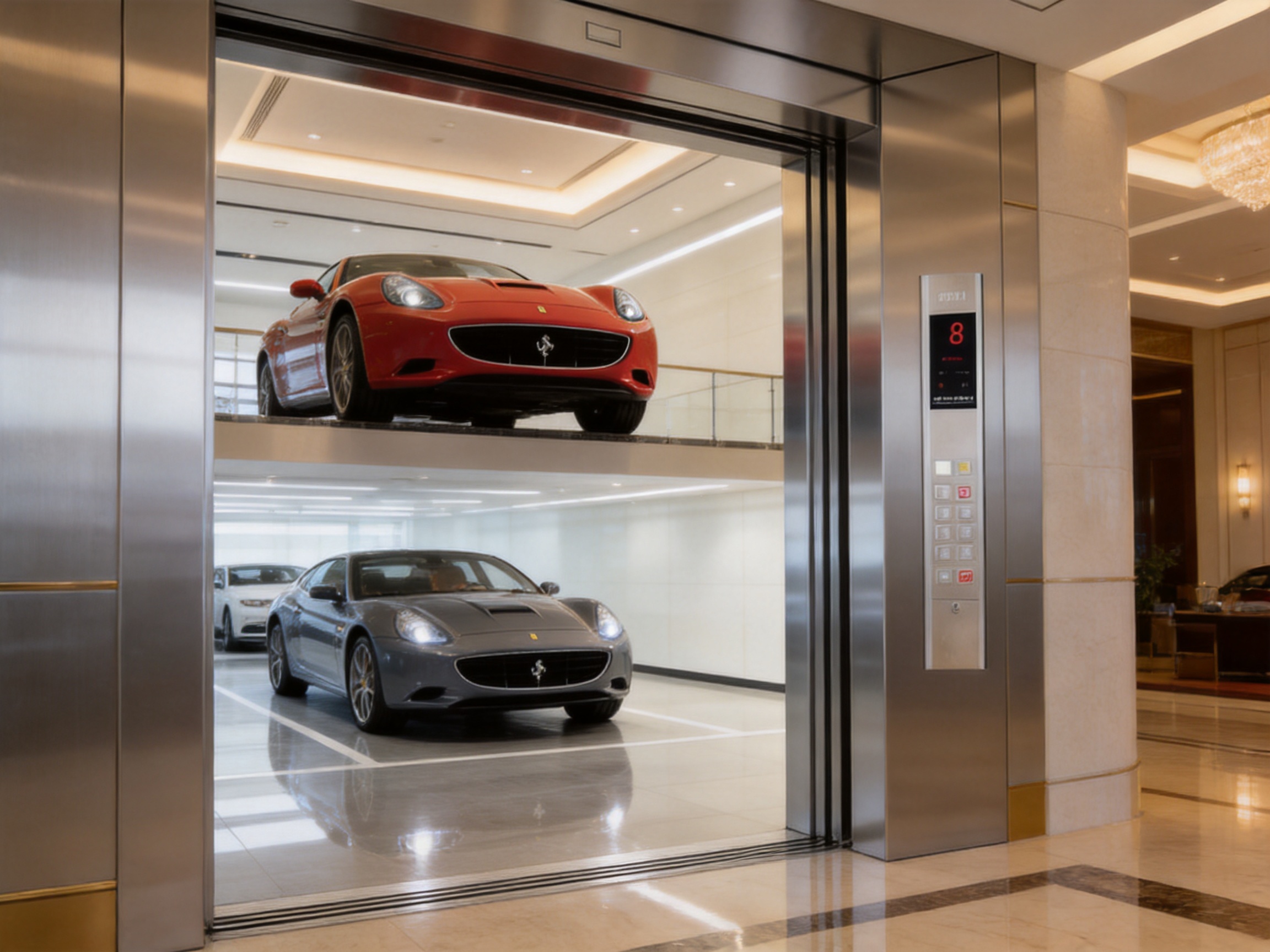
Customization and Project Adaptability
Car elevator projects are rarely identical. Buildings differ in shaft dimensions, pit depth, overhead height, floor distance, door arrangement, traffic direction, load requirements, and architectural style. A strong manufacturer must be able to provide customized solutions rather than forcing every customer into a standard model.
The company positions itself as a professional elevator and escalator manufacturing enterprise capable of providing customized solutions, whether for a single product or complete equipment sets. This approach is well suited to car elevators because project conditions often require careful engineering review.
Customization may involve rated load, car size, door width, door opening direction, control panel arrangement, access control, signal fixtures, interior finishing, speed selection, machine room layout, and safety options. For example, a showroom may prioritize appearance and smoothness, while a garage may prioritize durability and traffic efficiency. A villa may require quiet operation and architectural integration, while a service center may require rugged construction and simple operation.
The elevator can also be adapted to different door configurations. Through-door access is useful when cars need to drive forward through the elevator. Single-side access may be suitable for compact sites. Double door control functions can support more complex building circulation patterns.
Control options such as IC card control can support restricted access. This is useful for private garages, hotels, office buildings, and residential developments. Traffic dispatch options can improve operation in busier facilities.
Because car elevator installation involves civil construction coordination, early technical consultation is valuable. Shaft dimensions, structural load-bearing capacity, electrical supply, drainage, ventilation, fire safety, and local code requirements should be reviewed before final design. A manufacturer with engineering experience can provide guidance to reduce project risk.
Energy Efficiency and Environmental Considerations
Modern building equipment must balance performance and energy use. The car elevator supports energy-conscious operation through VVVF drive technology, intelligent control, and efficient movement management. Compared with older drive methods, VVVF systems can reduce unnecessary energy consumption during acceleration and deceleration while also improving ride quality.
Energy saving is not only about electricity. Efficient space use also has environmental value. By reducing or eliminating ramps, a car elevator can help lower the amount of construction material required for large circulation areas. It can also allow more compact building footprints, which is valuable in dense urban environments.
Stable movement and reduced vibration may also extend component life. Longer service life means fewer replacements, less waste, and better long-term sustainability. Improved rust resistance further supports durability, especially in challenging environments.
The company's intelligent production base also reflects green and efficient manufacturing concepts. The integration of advanced equipment, intelligent monitoring, and efficient operation can reduce waste and improve manufacturing consistency. A product built through controlled processes is more likely to perform reliably, which reduces resource loss from rework or premature replacement.
Comparison With Common Alternatives
When planning vehicle movement inside a building, owners usually compare several options: traditional ramps, simple hydraulic platforms, mechanical parking systems, and dedicated car elevators. Each has advantages, but a purpose-built car elevator offers a strong balance of safety, space saving, usability, and building integration.
Traditional ramps are familiar and simple for drivers, but they require large floor areas and may reduce parking capacity. They can be difficult to install in narrow sites and may create long driving paths. For high-value urban land, the cost of ramp space can be significant.
Simple lifting platforms may be cheaper initially, but they often lack the complete safety, comfort, door control, cabin structure, and elevator-grade functions expected in professional buildings. They may be suitable for limited private use but may not meet the requirements of frequent operation or high-end projects.
Mechanical parking systems can store many cars efficiently, but they may require users to leave vehicles in a transfer area and rely on automated equipment. A car elevator allows direct vehicle movement between levels and may be easier to integrate into buildings where drivers need access to different floors.
A dedicated car elevator provides a complete vertical transportation experience. It supports heavy loads, safe cabin movement, accurate leveling, door protection, control functions, and building access management. For projects that need driver-operated vehicle movement, it is often the most practical and professional solution.
Why This Product Stands Out in Competitive Markets
The global elevator market includes many suppliers, but product quality and manufacturing capability vary widely. This car elevator stands out because it combines heavy-duty vehicle-specific design, mature elevator control technology, advanced safety functions, durable structure, and intelligent manufacturing support.
Its load capacity over 3 tons gives it practical value for a wide range of vehicles. Its large cabin area and wide doors improve usability. Its through-door configuration supports convenient traffic flow. Its reinforced car bottom and thickened steel structure improve durability. Its VVVF drive and precise leveling improve comfort and safety. Its multiple safety protections provide confidence for building owners and users.
The product also benefits from the manufacturer's industrial background. Tenau Elevator (China) Co., Ltd. has experience serving overseas markets and customers from many countries. Its production system reflects automation, intelligent processing, and strict quality control. Its service concept includes unified standards, remote monitoring, individual maintenance planning, and full-time support.
For customers, this means the purchase is not only a machine but a complete solution supported by engineering, production, quality inspection, customization, and life-cycle service. That comprehensive strength is a major advantage over competitors who may only provide basic equipment without strong technical and service support.
Installation and Maintenance Considerations
Successful car elevator performance depends on correct installation and ongoing maintenance. Before installation, the project team should confirm shaft dimensions, pit depth, overhead clearance, machine room space, electrical supply, structural load capacity, and access routes for equipment delivery. Civil construction accuracy is important because elevator components must align properly.
The machine room should provide safe access for maintenance personnel and enough space for equipment inspection. Good ventilation, lighting, and working clearance support safe maintenance. Electrical systems should comply with local regulations and elevator requirements.
During installation, guide rail alignment, door installation, machine positioning, brake adjustment, controller wiring, safety circuit testing, and leveling calibration must be performed carefully. Commissioning should verify normal operation, emergency functions, overload protection, door interlocks, communication systems, and safety devices.
After the elevator enters service, regular maintenance is necessary. Maintenance tasks may include checking brakes, ropes or traction components as applicable, guide shoes, doors, door locks, control panels, safety circuits, lighting, ventilation, leveling accuracy, and emergency communication. The car bottom should be inspected for corrosion, wear, or damage caused by vehicle use.
Users should also follow operating guidelines. Vehicles should not exceed rated load. Drivers should enter slowly, stop at the correct position, engage the vehicle brake when required, and follow signal instructions. Building managers should prevent unauthorized use if the elevator is intended for restricted areas.
Q and A Section
What is a car elevator?
A car elevator is a vertical transportation system designed to move vehicles between floors. It has a larger cabin, stronger structure, higher load capacity, and vehicle-specific access design compared with ordinary passenger elevators.
How is this product different from a simple vehicle lift?
This product is based on professional elevator technology. It includes advanced control, VVVF drive, safety components, door interlocks, overload protection, accurate leveling, emergency functions, and a reinforced cabin structure. A simple vehicle lift may not offer the same level of safety, comfort, durability, or building integration.
What load capacity does the elevator support?
The product information highlights a normal load capacity of over 3 tons, making it suitable for many types of passenger vehicles. Exact load capacity should be confirmed according to project requirements and selected specifications.
Why is VVVF drive important for a car elevator?
VVF drive technology controls motor speed smoothly by adjusting voltage and frequency. It reduces starting and stopping shock, lowers vibration, improves comfort, supports energy efficiency, and helps protect the vehicle and elevator components.
Can cars enter from one side and exit from the other?
Yes, the elevator can be designed with front and rear doors, allowing through movement where the building layout supports it. This makes vehicle entry and exit easier and reduces the need for reversing inside the cabin.
How does the elevator improve parking space efficiency?
By replacing or reducing ramps, the elevator can save valuable construction area. In suitable projects, this can increase usable parking or functional space and allow more flexible architectural layouts.
What safety functions are available?
Available safety functions may include light curtain protection, overload stop, terminal forced slow-down, over-run protection, overspeed protection, safety stop, inspection operation, emergency leveling, fire emergency return, door interlock protection, main contactor protection, brake detection, and safety circuit protection.
Is the car elevator suitable for commercial buildings?
Yes. It can be used in commercial parking garages, hotels, showrooms, office buildings, service centers, and mixed-use developments. Its heavy-duty structure and control functions support professional use.
Is the elevator suitable for private homes or villas?
Yes. In private residences and villas, a car elevator can provide secure and space-saving access to underground or upper-level parking areas. Quiet operation, smooth movement, and customized design can support premium residential applications.
What makes the manufacturer strong?
Tenau Elevator (China) Co., Ltd. combines professional elevator production lines, automatic panel production equipment, intelligent manufacturing concepts, strict quality control, international market experience, multilingual service, and life-cycle support. These strengths help deliver reliable products for global customers.
Does the elevator require regular maintenance?
Yes. Like all elevator systems, it requires regular inspection and maintenance to ensure safety, performance, and long service life. Maintenance should be performed according to manufacturer guidance and local regulations.
Conclusion
A car elevator is no longer a luxury accessory for unusual buildings; it is a practical solution for modern urban space management. As parking demand increases and construction land becomes more valuable, vertical vehicle transportation offers clear advantages. It can reduce ramp area, improve building flexibility, support premium parking experiences, and make difficult sites usable.
This machine room car elevator is designed specifically for safe and efficient vehicle transport. Its over-3-ton load capacity, large cabin area, front and rear door options, reinforced structure, accurate leveling, VVVF drive, strong braking, and comprehensive safety functions make it a strong choice for residential, commercial, showroom, service, and parking applications.
Its competitive advantage is not limited to product specifications. The manufacturing strength behind it is equally important. Tenau Elevator (China) Co., Ltd. brings advanced production lines, intelligent manufacturing, strict inspection, international service experience, and customer-oriented engineering support. This combination of product performance and manufacturing capability helps customers obtain a complete, reliable, and adaptable solution.
For architects, developers, building owners, and parking operators, the car elevator provides a way to solve parking difficulty while improving space efficiency and user convenience. For drivers, it offers a safe and steady way to move a beloved vehicle between levels. For long-term building value, it represents a modern investment in efficient, reliable, and intelligent vertical transportation.
References
Barney, G. C. Elevator Traffic Handbook: Theory and Practice.
Strakosch, G. R., and Caporale, R. S. The Vertical Transportation Handbook.
International Organization for Standardization. Safety Rules for the Construction and Installation of Lifts.
European Committee for Standardization. Safety Rules for the Construction and Installation of Lifts.
China Elevator Association. Elevator Manufacturing and Installation Technical Guidance.
Building Owners and Managers Association. Best Practices for Vertical Transportation Maintenance.
National Elevator Industry, Inc. Elevator and Escalator Maintenance Principles.
Product: Car Elevator

Related Products


Related News
Built on safety, forging trust in vertical mobility.
lf you have any questions or need help, feel free to contact with our team.
 export@tenau.com.cn
 +86-18601458867
 +86-512-65059883
Elevator & Escalator
Factory Add
East of Xicheng Road, North of Lianyi Road, Nanxun Economic Development Zone, Nanxun District, Huzhou City, Zhejiang Province, P.R.China
Copyright © Tenau Elevator (China) Co., Ltd. All Rightd Reserved.
Custom High Quality Elevator Suppliers and World Brand Elevator Company